The Device Memory Paradox
You ran the same study across desktop and mobile users. The results told a clear story: mobile users reported higher satisfaction, faster task completion, and fewer pain points. Desktop users catalogued frustrations, described workarounds, and expressed resignation about persistent problems.
The product team concluded the desktop experience needed urgent attention while the mobile experience was healthy. They were wrong on both counts.
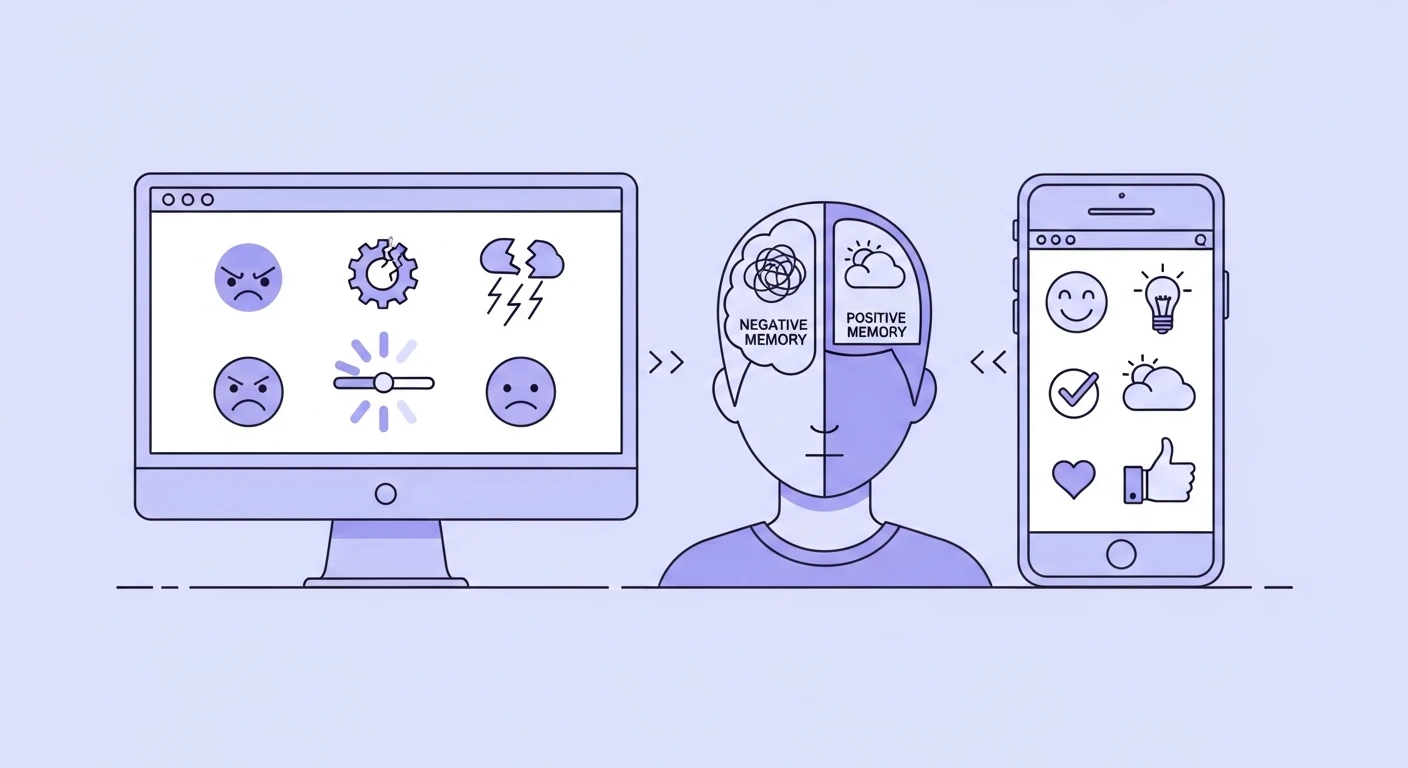
What they measured was not differential experience quality. They measured differential memory encoding shaped by the physical and cognitive context of each device. Users on mobile encode experiences differently than users on desktop -- not because the experiences differ, but because the encoding context differs.
This is the asymmetric recall problem in cross-platform research. And if you are not accounting for it, your comparative findings are measuring your methodology, not your product.
Why Device Context Shapes Memory Encoding
Cognitive science has established that memory encoding is context-dependent. The environment, physical posture, attentional state, and cognitive load present during an experience all determine which aspects get encoded into long-term memory and which fade.
Desktop usage typically occurs in sustained-attention contexts: seated at a desk, in a work environment, during focused task sessions. These conditions create high encoding fidelity for frustration and friction because the user has the cognitive bandwidth to notice and register problems. Each micro-frustration gets encoded because nothing else is competing for attention.
Mobile usage occurs in fragmented-attention contexts: commuting, waiting in lines, between other activities. These conditions create selective encoding that privileges task completion over process. Users register whether they accomplished their goal but encode fewer details about the journey. Friction that would be memorable on desktop passes unnoticed on mobile because attentional resources are divided.
The research on recall bias and memory distortion in user interviews demonstrates that what participants report reflects their memory, not their experience. In cross-platform research, memory formation itself varies by device.
The Satisfaction Inflation Effect on Mobile
Mobile users systematically over-report satisfaction in retrospective research for three interconnected reasons:
Completion salience. Mobile sessions are typically goal-directed and brief. Users remember achieving the goal. The path to achievement fades because mobile attention is structured around outcomes, not processes.
Effort discounting. Because mobile interactions occur alongside other activities, users do not attribute full cognitive effort to the mobile task. Lower perceived effort maps to higher perceived satisfaction regardless of actual friction encountered.
Environmental attribution. When frustration does occur during mobile use, users are more likely to attribute it to their environment (bad connection, being distracted, small screen) than to the product. Desktop users have no such external attribution available -- if something is frustrating at their desk with a large screen and fast connection, the product is the only available target.
These biases combine to create a systematic satisfaction inflation for mobile experiences that has nothing to do with the quality of the mobile product and everything to do with how mobile contexts shape memory.
The Pain Magnification Effect on Desktop
Desktop users systematically over-report friction because their usage context creates optimal conditions for pain encoding:
Extended exposure windows. Desktop sessions are longer, creating more opportunities to encounter and register friction. A user who spends 45 minutes in a desktop application will encounter and remember more problems than a user who spends 3 minutes in the mobile version -- even if the per-minute friction rate is identical.
Comparative anchoring. Desktop users operate in environments with multiple high-quality tools visible. Their browser has other tabs open. Their operating system provides polished interactions. Every friction point in your product gets unconsciously compared against the ambient quality level of the desktop environment. Mobile users compare against other mobile experiences, where tolerance for compromise is higher.
Documentation behavior. Desktop users can more easily take notes, screenshots, or bookmark issues for later. This documentation behavior reinforces memory encoding. Problems that get documented become more salient in recall. As research on contextual activation and environmental triggers shows, the environment scaffolds what gets encoded and what fades.
Methodological Corrections
Recognizing asymmetric recall requires methodological adjustment, not just analytical awareness:
Temporal proximity. Interview participants as close to their actual usage as possible. The encoding asymmetry grows over time. Same-day interviews capture more equivalent data across platforms than next-week interviews.
Context matching. When possible, interview mobile users while they are in mobile contexts and desktop users at their desks. Environmental reinstatement improves recall fidelity and reduces the asymmetry introduced by context switching.
Behavioral triangulation. Supplement recall data with observational data. Screen recordings, interaction logs, and diary studies capture what happened rather than what participants remember happening. Cross-reference self-report against behavioral evidence before drawing comparative conclusions.
Within-person comparison. Where possible, study the same participants across both platforms rather than separate samples. Within-person designs control for individual differences in memory and reporting style, isolating the device-context effect from the person effect.
To effectively implement these corrections at scale, research teams increasingly turn to monitoring and observability approaches borrowed from engineering -- instrumenting the actual experience rather than relying solely on retrospective accounts.
The Data Integration Challenge
Even with methodological corrections, integrating cross-platform data requires acknowledging that you are combining fundamentally different data types. Desktop recall data and mobile recall data are not directly comparable any more than interview data and survey data are directly comparable.
Treat cross-platform findings as requiring structured data contracts -- explicit documentation of what each data stream represents, what biases it carries, and how it should be weighted in synthesis. A finding supported by both desktop recall and mobile behavioral data is stronger than one supported by desktop recall alone.
The research community has spent decades developing methods for triangulating across data sources. The cross-platform context adds a new dimension: you must triangulate not just across methods but across encoding contexts.
When the Asymmetry Is Real
Not every cross-platform difference is an artifact of recall asymmetry. Sometimes the desktop experience genuinely is worse than the mobile experience. The question is how to distinguish real differences from methodological artifacts.
Look for convergent evidence: if behavioral metrics (task completion rates, error rates, time-on-task) align with self-report differences, the asymmetry likely reflects real experience differences. If behavioral metrics are equivalent but self-report diverges, recall asymmetry is the more parsimonious explanation.
Look for specificity: if desktop users describe specific, detailed friction points that can be independently verified in the interface, their pain reports likely reflect real problems. If they report diffuse dissatisfaction without specific anchors, context-driven pain magnification is more likely.
Practical Implications
Stop presenting cross-platform satisfaction scores as directly comparable metrics. They measure different things through different cognitive lenses.
Design separate analytical frameworks for each platform context. Ask what desktop data tells you about sustained-use friction and what mobile data tells you about goal-completion efficiency. These are different questions answered by different memory systems.
When stakeholders ask "is our mobile experience better than desktop?" the honest answer is: the data cannot tell you that directly. It can tell you what desktop users remember about sustained sessions and what mobile users remember about brief goal-directed interactions. Translating that into a single comparative judgment requires assumptions that should be made explicit, not hidden inside a satisfaction score.