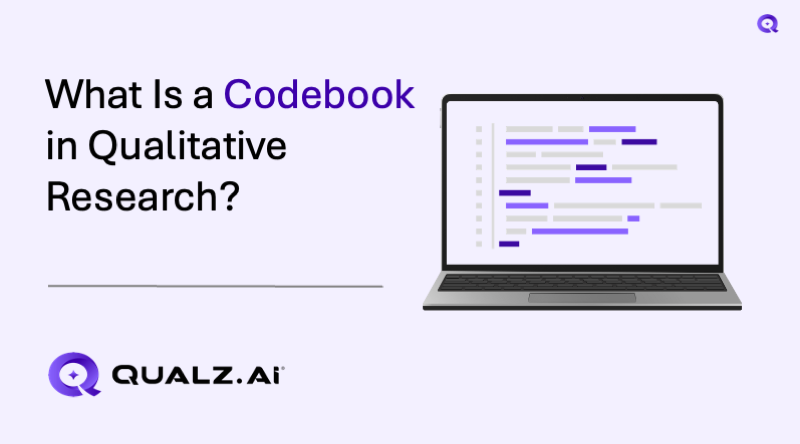
A codebook is the backbone of systematic qualitative analysis. AI can help build them faster without sacrificing credibility.
What Makes a Good Codebook
Clear Code Definitions
Each code needs:
- Name (concise label)
- Definition (what it captures)
- Inclusion criteria (when to apply)
- Exclusion criteria (when not to apply)
- Examples (from actual data)
Hierarchical Structure
Codes organized into:
- Categories (mid-level groupings)
- Themes (high-level concepts)
- Relationships between codes
Iteration History
Document how codes evolved:
- Initial codes
- Merged codes
- Split codes
- Retired codes
Traditional Codebook Development
- Multiple analysts read transcripts
- Each generates initial codes independently
- Team meets to compare and reconcile
- Codes are tested on new data
- Iterate until stable
Problem: This takes weeks and significant analyst hours.
AI-Assisted Codebook Development
Stage 1: Initial Code Generation
AI reads transcripts and proposes codes based on:
- Recurring language patterns
- Semantic similarity clusters
- Frequency of concepts
Human role: Review AI codes for relevance and coherence.
Stage 2: Code Refinement
AI helps identify:
- Overlapping codes to merge
- Broad codes to split
- Gaps in code coverage
Human role: Make final decisions on code structure.
Stage 3: Definition Writing
AI drafts definitions based on:
- Coded segments
- Language patterns
- Contextual usage
Human role: Edit definitions for precision and clarity.
Stage 4: Example Selection
AI identifies:
- Clear examples for each code
- Edge cases for inclusion/exclusion criteria
- Counter-examples
Human role: Approve representative examples.
Maintaining Credibility
Transparency
Document AI involvement:
- Which steps used AI
- What human review occurred
- How decisions were made
Validation
Test AI-generated codes:
- Inter-rater reliability checks
- Member checking where appropriate
- Audit trail maintenance
Iteration
Don't accept first AI output:
- Review with domain experts
- Test on held-out data
- Refine based on analysis needs
Sample Workflow
| Step | AI Role | Human Role | Time |
|---|---|---|---|
| Initial coding | Generate candidate codes | Review, filter | 2 hours |
| Structure | Propose hierarchy | Validate logic | 1 hour |
| Definitions | Draft text | Edit, approve | 2 hours |
| Examples | Select candidates | Verify appropriateness | 1 hour |
| Testing | Apply to new data | Check accuracy | 2 hours |
Total: About 8 hours vs. 40+ hours traditional
Common Concerns
"AI codes lack nuance"
True for initial output. Human review adds nuance.
"We can't trust AI judgment"
Don't. Use AI for speed, humans for judgment.
"Reviewers won't accept AI involvement"
Document methodology clearly. Many journals now accept AI-assisted analysis with proper disclosure.
Qualz.ai's analysis platform includes automated codebook generation with full human oversight—accelerating the process while maintaining the rigor qualitative research demands.