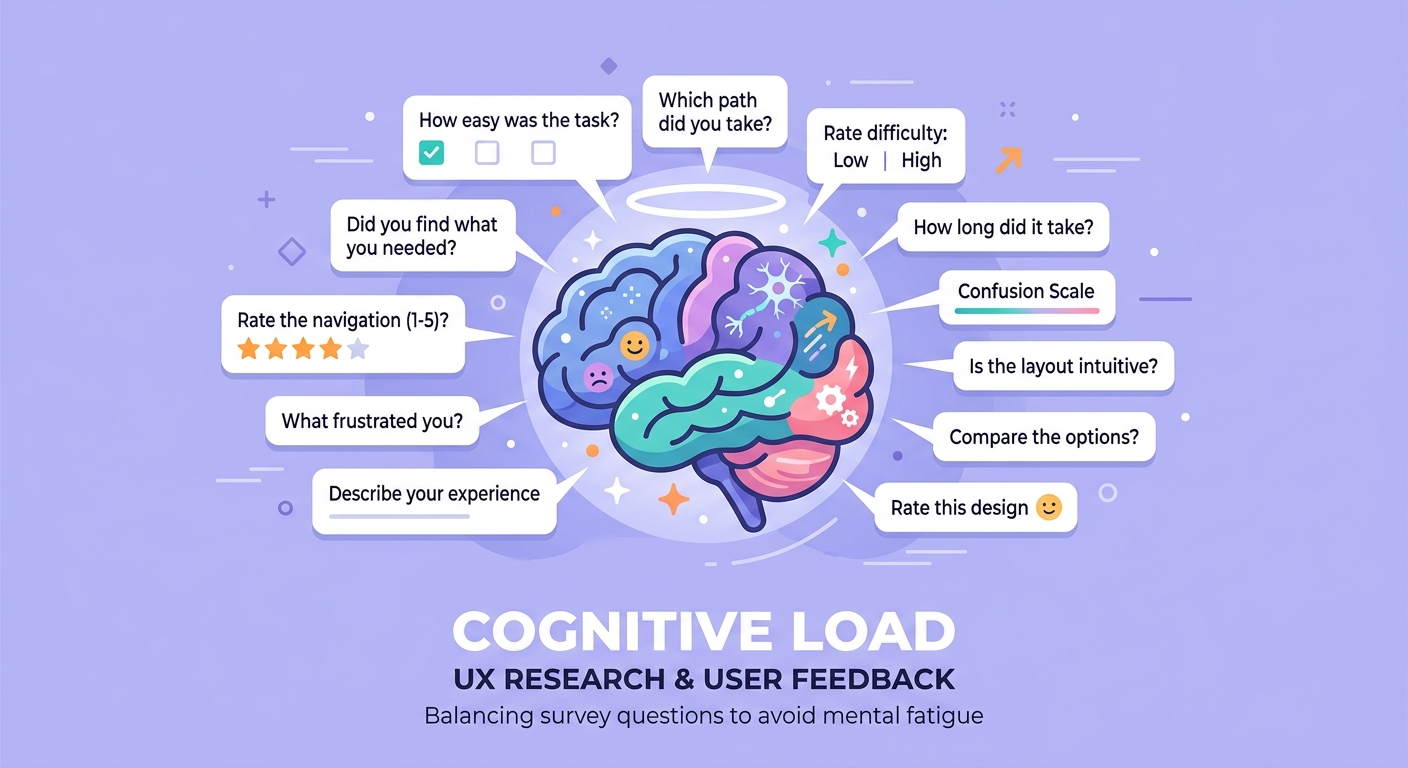
The research community has developed an almost religious commitment to survey brevity. "Keep it under five minutes." "Fewer than 10 questions." "If it's longer than one page, you'll lose them." These rules of thumb have calcified into dogma, and the result is a generation of surveys that are short, shallow, and largely useless for product decisions.
The problem is not that brevity is unimportant. Participant time is valuable, and respect for that time is non-negotiable. The problem is that the industry has confused brevity with low cognitive load, and they are not the same thing.
A five-question survey where each question requires the respondent to mentally juggle three abstract concepts and map them onto a seven-point Likert scale is far more cognitively demanding than a fifteen-question survey with clear, concrete, sequentially logical questions. Length is a proxy for effort, and like most proxies, it breaks down under scrutiny.
What Cognitive Load Actually Means for Survey Respondents
Cognitive load theory, originally developed by John Sweller for instructional design, distinguishes between three types of mental burden: intrinsic load (the inherent complexity of the material), extraneous load (unnecessary complexity introduced by poor design), and germane load (productive mental effort that aids understanding).
Applied to survey design, this framework reveals why the "shorter is better" mantra fails. A survey with high extraneous load -- confusing question wording, unexpected scales, ambiguous response options -- will fatigue respondents in three questions. A survey with low extraneous load but meaningful intrinsic load can sustain engagement for twenty.
The distinction matters enormously for product teams. When you strip a survey down to five questions to hit an arbitrary brevity target, you often introduce more cognitive load per question, not less. Each remaining question has to carry more conceptual weight. You combine constructs that should be measured separately. You use compound questions that force respondents to evaluate two things simultaneously. The survey is shorter, but the mental effort per question is higher.
The Completion Rate Trap
Product managers love completion rates as a metric for survey quality. "We got 78% completion -- the survey is working." But completion rate measures persistence, not data quality. A respondent who straight-lines through a confusing survey in 90 seconds has completed it. The data is garbage.
Research on satisficing behavior -- the tendency to provide "good enough" rather than optimal responses -- shows that cognitive load is the primary driver of low-quality survey responses. When questions are hard to understand, respondents don't quit. They simplify. They pick the middle option. They agree with everything. They select the first plausible answer. The survey looks fine from a completion metrics standpoint while the underlying data is noise.
This is why teams that rely heavily on survey data often find their results contradicted by in-depth qualitative analysis. The surveys captured the surface-level response that required the least cognitive effort, not the actual opinion.
Designing for Cognitive Ease, Not Minimum Length
The goal should be minimizing extraneous cognitive load while preserving the intrinsic complexity necessary to capture meaningful data. Here is what that looks like in practice.
Sequential logic over random ordering. Questions should follow the natural flow of how people think about a topic. If you are asking about a product experience, start with the trigger (why they used the product), move through the experience (what happened), and end with the outcome (how they feel about it). This narrative structure leverages the respondent's existing mental model rather than forcing them to context-switch between unrelated constructs.
Concrete over abstract. "How satisfied are you with the onboarding experience?" requires the respondent to mentally reconstruct the entire onboarding flow, evaluate each component, somehow aggregate those evaluations, and map the aggregate onto a scale. "Did you find it easy to set up your first project?" asks about a specific, concrete action with a clear yes/no evaluation. The concrete question is more informative and less demanding.
Progressive disclosure in digital surveys. Show one question or one logical group at a time. This reduces the visual and cognitive overwhelm of seeing twenty questions simultaneously. The total survey length is the same, but the moment-to-moment cognitive demand is dramatically lower. Teams using modern survey platforms with AI-powered adaptive logic can take this further by dynamically routing respondents through only the questions relevant to their specific experience.
Scale consistency within sections. Switching between a 5-point agreement scale, a 7-point satisfaction scale, and a 10-point likelihood scale within the same survey section forces respondents to recalibrate their mental mapping with every question. Pick one scale type per section and stick with it.
When Length Actually Matters
Survey length does matter -- but the relationship is not linear. Research consistently shows a step function rather than a gradual decline. Engagement remains relatively stable until a threshold, then drops sharply. That threshold varies dramatically based on topic relevance, cognitive load per question, and respondent motivation.
For unsolicited surveys (pop-ups, email blasts to inactive users), the threshold is genuinely low -- two to three minutes of actual effort. For solicited surveys (users who opted in, customers with a stake in the outcome), the threshold extends to ten or even fifteen minutes if the questions are engaging and well-designed.
The implication is that survey design effort should focus on reducing extraneous load and increasing question quality rather than cutting questions to hit an arbitrary length target. A well-designed twelve-question survey will outperform a poorly designed six-question survey on every metric that matters: response quality, respondent experience, and actionability of insights.
The Open-Ended Question Paradox
Open-ended questions are the most valuable and most cognitively demanding question type. They require the respondent to generate a response rather than select one -- a fundamentally different cognitive operation.
Many survey designers avoid open-ended questions entirely because they "increase length" and "reduce completion rates." This is backwards. A single well-placed open-ended question at a low-cognitive-load moment in the survey often produces more actionable insight than ten closed-ended questions combined. The key is placement. After a series of concrete, easy-to-answer questions about a specific experience, respondents have mentally reconstructed that experience and are primed to elaborate. "Is there anything else you want us to know about this experience?" placed at that moment captures what no scale question ever could.
The challenge, of course, is analyzing open-ended responses at scale. Teams with hundreds or thousands of responses need systematic approaches to extract themes from unstructured text without losing nuance. This is where AI-powered analysis has genuinely transformed the economics of open-ended survey design -- the analysis bottleneck that previously made open-ended questions impractical at scale has been eliminated.
Adaptive Survey Design: The Cognitive Load Solution
The most sophisticated approach to managing cognitive load is adaptive survey design -- surveys that modify their content and structure based on respondent behavior in real time.
At its simplest, this means skip logic: if a respondent has not used a feature, skip the questions about that feature. But modern adaptive surveys go much further. They monitor response time per question as a proxy for cognitive load, adjust question complexity when response times spike, and dynamically reorder sections based on the respondent's engagement trajectory.
This approach borrows from how compound AI systems orchestrate multiple components to optimize for a global objective. The survey is not a fixed instrument but a dynamic system that adapts to each respondent's cognitive state. The result is a survey that feels shorter than it is because the cognitive load is consistently manageable.
The challenge with adaptive design is that it introduces complexity in analysis. If different respondents answered different questions, how do you compare? The answer is the same as in adaptive testing in psychometrics: you design the adaptation logic to preserve measurement comparability while varying the presentation. This requires upfront investment in survey architecture that most teams skip -- and then wonder why their fixed-format surveys produce mediocre data.
The Real Metric: Insight Per Minute of Respondent Time
If you accept that neither length nor completion rate is the right optimization target, what is? The answer is insight density: actionable insight generated per minute of respondent time invested.
This metric forces you to evaluate every question against two criteria. First, does this question generate data that will change a decision? If no question in your survey addresses a decision the team is actually facing, the survey should not exist regardless of its length. Second, is this the lowest-cognitive-load way to capture this data? If you can get the same information from a simpler question format, behavioral data, or an existing research repository, the question is wasting respondent time.
Teams that adopt this framing consistently end up with surveys that are moderately longer than the "keep it short" dogma prescribes but dramatically more useful. They ask more questions, but each question is simpler, more concrete, and more directly tied to a pending decision.
This is ultimately about understanding why organizations struggle to translate collected data into action. The bottleneck is never the volume of data collected. It is whether the data is structured to answer the specific questions that drive product decisions.
Practical Recommendations
Stop optimizing for survey length. Start optimizing for cognitive load per question. Here is the checklist:
- Audit every question for extraneous cognitive load. Can the wording be more concrete? Can compound questions be split? Can abstract scales be replaced with behavioral anchors?
- Test cognitive load directly. Pilot your survey with five users while thinking aloud. Where do they pause? Where do they reread? Where do they guess? Those are your high-load questions.
- Use progressive disclosure. One question or one group per screen. Let respondents focus.
- Place open-ended questions strategically. After a concrete experience reconstruction, not at the beginning or end.
- Implement adaptive logic. Even basic skip logic reduces irrelevant cognitive load. Advanced adaptive design is worth the investment for recurring surveys.
- Measure insight density, not completion rate. Track which questions actually influenced decisions in the last quarter. Cut the ones that did not.
The goal is not a shorter survey. The goal is a survey that respects respondent cognition, captures genuine opinions rather than satisficing artifacts, and generates data that actually changes how you build your product.