The Study You Think You Designed
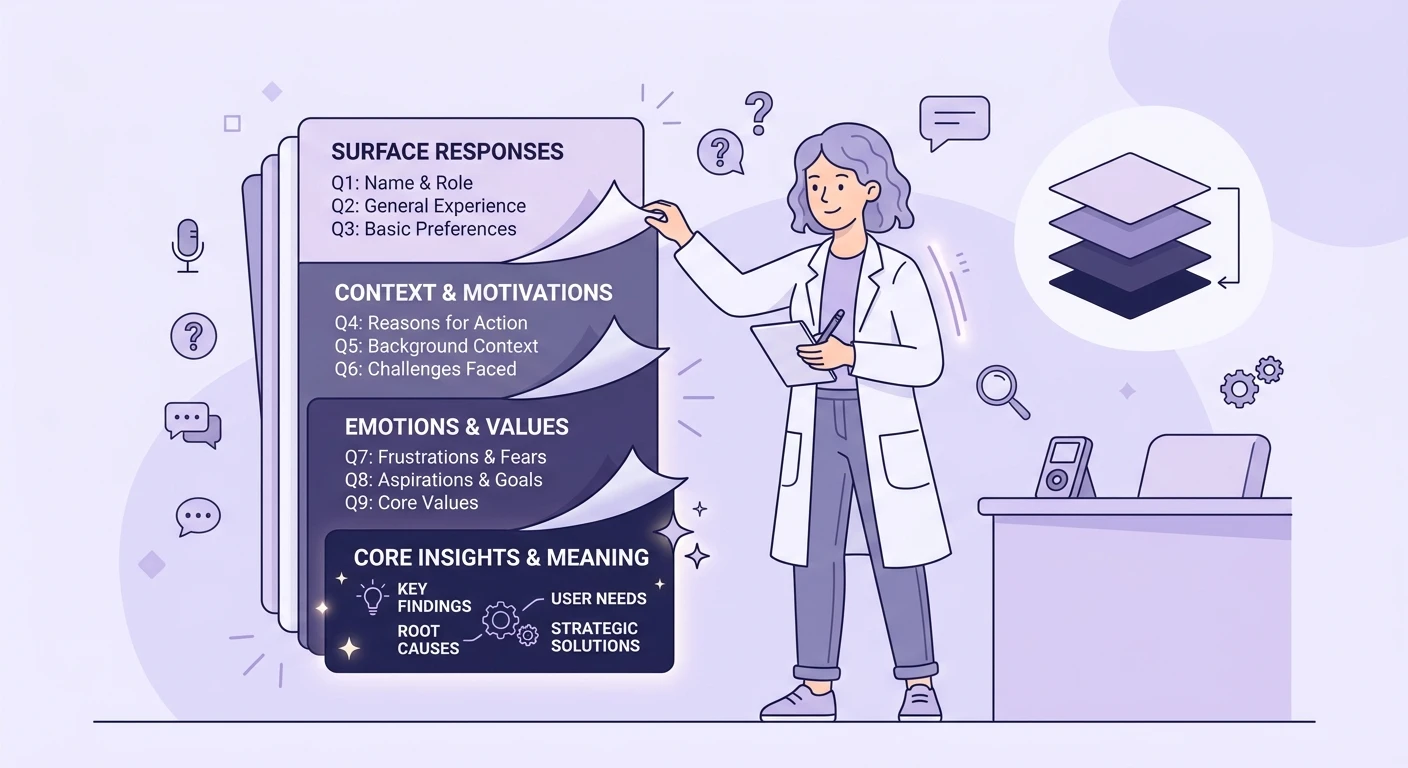
In a lightly regulated consumer app, the researcher owns the study. You write the guide, recruit the users, ask what you want, and follow the conversation wherever it goes. In healthcare, financial services, insurance, and pharma, that autonomy is an illusion. Before a single participant is scheduled, your study passes through legal review, compliance sign-off, privacy assessment, and often a medical or regulatory affairs desk. Each of those gates edits your design. By the time you sit down with a participant, the conversation that is permitted to happen has already been narrowed by people who were never in the room.
We call this the compliance cascade: the sequence of upstream edits -- to consent language, topic scope, permissible follow-ups, and data handling -- that reshapes qualitative data before collection begins. It is not a villain. It exists for good reasons. But most research teams treat compliance as a hurdle to clear rather than a variable that systematically biases their findings. That is a mistake, because the cascade does not just slow you down. It changes what you learn.
How the Cascade Rewrites Your Data
Consider a patient-experience study. You want to understand why people abandon a treatment adherence program. Your original guide asks openly about side effects, cost, and trust in the provider. Legal reviews the guide and returns it with edits: the side-effect questions are reframed to avoid anything that could be construed as pharmacovigilance data collection, the cost questions are bounded to avoid implying financial advice, and any spontaneous mention of an adverse event now triggers a mandatory reporting script that interrupts the flow of the interview.
Each edit is defensible. Together they produce a systematic distortion. Participants are steered away from exactly the raw, unmediated frustration you were trying to capture. This is a close cousin of what we described in research consent theater, where participants sign forms without understanding how their data will be processed -- except here the theater runs in reverse, shaping the researcher's questions rather than the participant's understanding.
The Permission Problem, Institutionalized
We have written before about the permission problem, where participants self-censor because they are unsure what they are allowed to say. In regulated research, that self-censorship is not just a participant psychology effect -- it is baked into the protocol. The consent form, laden with regulatory language, functions as a priming document. A participant who has just initialed six paragraphs about data rights, mandatory reporting, and limits of confidentiality enters the conversation in a defensive posture. They have been told, in effect, which topics are dangerous. They behave accordingly.
The result is a register shift not unlike the one we documented in the authority gradient, where participants match their response sophistication to perceived researcher status. The heavy institutional framing signals high stakes, and participants respond with guarded, sanitized answers -- precisely when you need candor most.
Why Governance Belongs in the Analysis, Not Just the Approval
The deeper problem is that the compliance cascade is invisible in the final deliverable. A stakeholder reading your findings sees clean themes. They do not see that three of your sharpest questions were struck in legal review, or that a mandatory-reporting interruption killed the rapport in half your sessions. The upstream filtering is not documented anywhere the analysis can account for it.
This is where enterprise practice offers a lesson. Regulated AI systems have learned to treat governance constraints as first-class, logged artifacts -- not as invisible gates. The discipline of maintaining AI audit trails and explainability in the enterprise exists precisely so that downstream consumers of a system's output can see which constraints shaped it. Research needs the same instinct. And just as enterprise teams codify what data may flow where through data contracts for AI pipelines, research teams should treat the compliance-edited protocol as an explicit contract that travels with the findings.
Working With the Cascade Instead of Against It
You cannot -- and should not -- eliminate compliance review. But you can stop letting it silently corrupt your data. Three practices help.
Log every edit. Keep a redline of what legal and compliance changed, and why. When you present findings, annotate which questions were altered or removed. A theme that never appeared may be absent because participants did not experience it -- or because you were never allowed to ask.
Separate the mandatory script from the conversation. If a regulatory interruption (adverse-event reporting, disclosure scripts) must occur, sequence it to the end of the session or a clearly bracketed segment so it does not contaminate the exploratory portion. This mirrors the discipline we described in adaptive interview termination, where knowing when to stop protects data quality.
Pilot the consent framing itself. Treat the consent document as a study variable. Run a small comparison of heavily-worded versus plain-language consent and observe how participant candor differs. You may find the regulatory framing costs you more signal than you assumed.
The compliance cascade is real, it is systematic, and in regulated industries it is unavoidable. The teams that produce trustworthy patient and customer intelligence are not the ones who pretend the filter does not exist. They are the ones who document it, sequence around it, and read their findings with the filter firmly in view.
Turning Constraint Into Rigor
Regulated research is harder, but it is not lesser. The constraints that shape your study can be a source of rigor if you make them visible. Qualz.ai helps regulated teams keep a transparent record of how each study was scoped and analyzed, so the story of how findings were produced travels with the findings themselves. If your interviews live in industries where legal review is part of every study, the answer is not to fight the cascade -- it is to instrument it.