When Your AI Tool Has a Cultural Accent
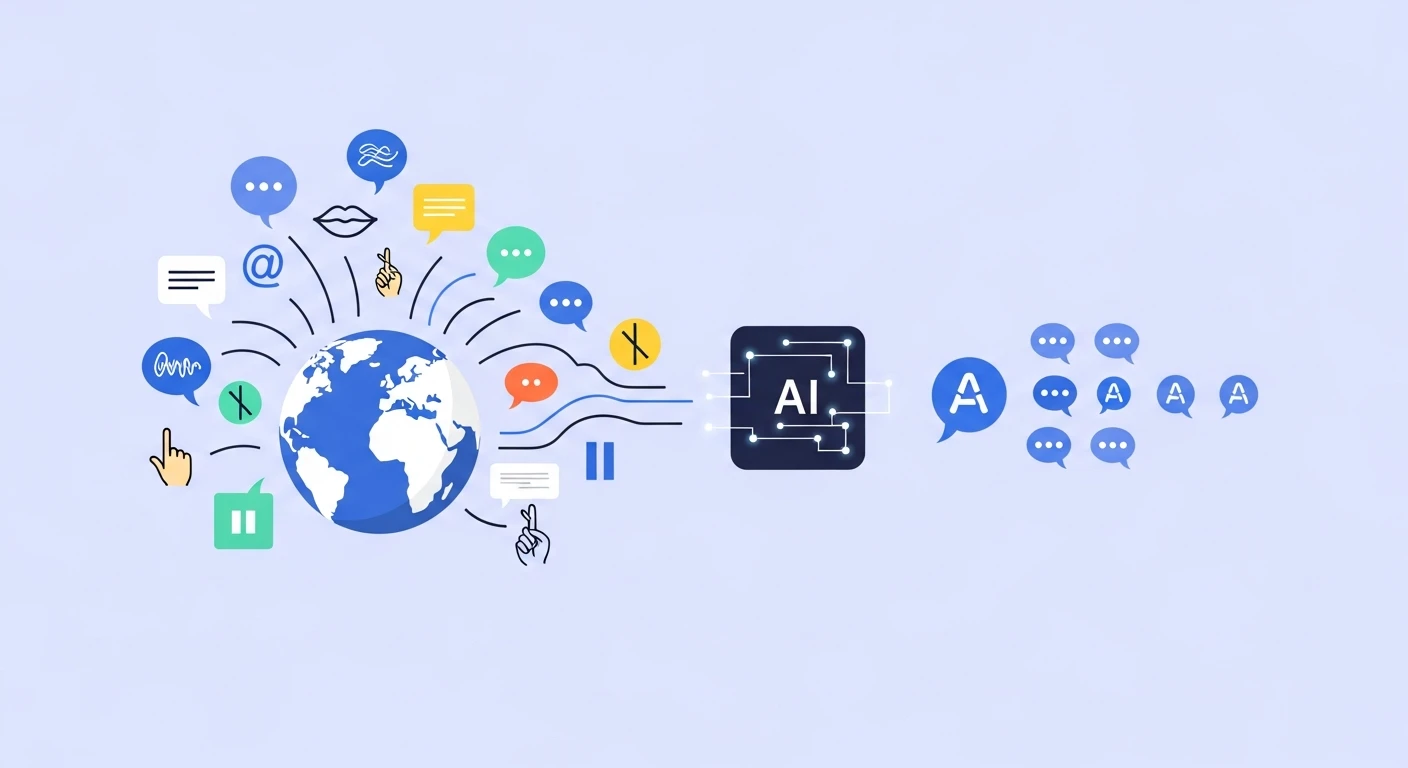
Every AI interview analysis tool carries the invisible fingerprint of its training data. And that training data — overwhelmingly sourced from English-language, Western-context research sessions — encodes a specific set of assumptions about what "good" interview participation looks like: direct answers, linear narratives, explicit emotional expression, and silence as hesitation.
These assumptions break catastrophically when applied to participants from cultures where communication operates by different rules. High-context cultures where meaning lives between words rather than in them. Cultures where silence signals respect rather than discomfort. Cultures where circular narratives carry more truth than linear ones.
The AI does not know it has a cultural accent. It processes every transcript through the same analytical lens, systematically misclassifying culturally normative communication patterns as analytical red flags. The result is not just inaccurate analysis — it is a form of epistemic colonialism automated at scale.
The Training Data Problem Nobody Discusses
The foundational training sets for most NLP models used in interview analysis come from a narrow cultural band: primarily North American and Western European English-language content. The labeled datasets that teach AI to identify "engagement," "hesitation," "emotional valence," and "response quality" were annotated by researchers working within Western academic traditions.
This means the AI has learned that:
- Direct answers indicate engagement (but in many East Asian cultures, indirect answers signal thoughtfulness and respect)
- Silence indicates discomfort or confusion (but in Finnish, Japanese, and many Indigenous cultures, silence indicates active listening or deep consideration)
- Linear narrative structure indicates coherent thinking (but in many African, Middle Eastern, and Indigenous cultures, circular or spiral narratives are the natural form of sense-making)
- Explicit emotional labeling indicates self-awareness (but many cultures consider direct emotional declaration inappropriate or overly simplistic)
When researchers deploy these tools in global UX research programs, they inherit these biases invisibly. The tool does not flag its own cultural limitations — it simply produces confident analytical outputs that systematically disadvantage non-Western participants.
Specific Misclassification Patterns
Japanese communication patterns: The AI consistently misreads tatemae (social front) and honne (true feelings) dynamics. Japanese participants may express agreement verbally while their actual position is quite different — a cultural norm the AI reads as "inconsistency" or "contradiction" rather than recognizing it as culturally appropriate communication that requires interpretive skill to decode.
East African narrative styles: In many East African cultures, questions are answered through extended narratives that circle toward the point rather than stating it directly. AI tools trained on Western response patterns flag these as "tangential" or "off-topic" when they are, in fact, the richest data in the transcript — the participant is contextualizing their answer within a broader meaning-making framework.
Middle Eastern hospitality norms: Participants from many Middle Eastern cultures will spend significant time on relational discourse before addressing research questions. AI tools classify this as "low relevance" warm-up chatter, missing that this relational foundation is what enables honest disclosure later in the session.
Nordic silence patterns: Finnish and Scandinavian communication styles include extended comfortable silences that carry no negative valence. AI tools consistently flag these as "hesitation" or "processing difficulty" when they are simply the natural rhythm of Nordic discourse.
These misclassifications create systematic bias in cross-cultural research — the very type of research where detecting contradictions requires cultural sensitivity rather than algorithmic pattern-matching.
The Compound Bias in Multi-Market Studies
The problem intensifies in multi-market research programs where AI analysis is applied uniformly across cultural contexts. Consider a global product study with participants from the US, Japan, Brazil, Germany, and Nigeria:
The AI produces engagement scores, sentiment analysis, and theme extraction for all markets simultaneously. But its analytical calibration is set for US-style communication. The result:
- US participants appear "highly engaged" and "emotionally expressive" — they match the training data
- Japanese participants appear "reserved" and "uncertain" — their cultural communication norms are misread as analytical signals
- Nigerian participants appear "tangential" and "unfocused" — their rich narrative style is classified as noise
- Brazilian participants appear "emotional" and "potentially unreliable" — their expressive style triggers sentiment analysis overweighting
- German participants appear "direct" and "confident" — coincidentally closest to US patterns
The cross-market comparison that emerges from this analysis is not a comparison of user experiences — it is a comparison of how closely each culture's communication style matches the AI's training data. Genuine cross-cultural insights are buried under measurement artifacts.
As the field recognizes, methodological transparency in AI-assisted research must include disclosure of training data cultural composition — something no current tool provides.
Why Localized Prompts Are Not Enough
Some teams attempt to address this by localizing AI prompts or adding cultural context instructions. This approach fails for three reasons:
First, culture is not a parameter you can inject. The biases are embedded in the model's foundational understanding of language and communication, not in the surface-level instructions. Telling the AI to "account for Japanese communication norms" does not rewire its underlying pattern recognition.
Second, cultural communication patterns are not uniform within any culture. Individual variation within a culture often exceeds variation between cultures. A Japanese participant educated in the US may communicate very differently from one who has never left Tokyo. Applying cultural "corrections" as blanket rules creates a different kind of stereotyping.
Third, the interaction between researcher culture, participant culture, and AI culture creates a three-way interference pattern that simple localization cannot address. The AI is analyzing an already cross-cultural interaction (Western researcher interviewing non-Western participant) through a culturally biased lens.
What Cross-Cultural AI Research Actually Requires
Culture-specific baseline calibration: Before applying AI analysis to a non-Western market, establish baseline communication patterns by analyzing sessions with culturally matched researchers who understand the normative patterns. Use these baselines to calibrate — not just prompt — the AI's analytical thresholds.
Dual-analysis protocols: Run every cross-cultural transcript through both AI analysis and culturally competent human review. Use disagreements between the two as signals of cultural misclassification rather than analytical errors.
Participant communication style profiling: Instead of applying uniform analysis, first classify each participant's communication style (direct/indirect, linear/circular, explicit/implicit) and apply style-appropriate analytical frameworks.
Training data transparency: Demand that AI tool vendors disclose the cultural composition of their training datasets. If 90% of training data comes from US English interviews, the tool is a US English analysis tool being misapplied to global contexts.
Cultural validity testing: Before deploying AI analysis in a new market, test it against expert-coded transcripts from that culture. Measure classification accuracy specifically for culturally normative patterns that differ from Western norms.
The structured output engineering principles that govern production AI systems must extend to cultural validity — ensuring that outputs are not just structurally correct but semantically appropriate across cultural contexts.
The Ethical Dimension
This is not merely a methodological concern — it is an ethical one. When AI tools systematically misinterpret non-Western communication patterns, they:
- Devalue non-Western participant contributions by flagging them as lower quality
- Reinforce Western communication norms as the implicit standard for research participation
- Produce cross-cultural research findings that are actually measurements of cultural proximity to Western norms
- Create product decisions informed by culturally biased analysis that disadvantages non-Western users
Research teams using AI analysis tools in cross-cultural contexts have an obligation to understand and disclose these limitations. The data contracts that govern AI pipelines must include cultural validity specifications alongside technical accuracy metrics.
Until AI tools can genuinely account for the full spectrum of human communication patterns, cross-cultural research requires human cultural expertise as a non-negotiable analytical layer — not as a luxury, but as a validity requirement.