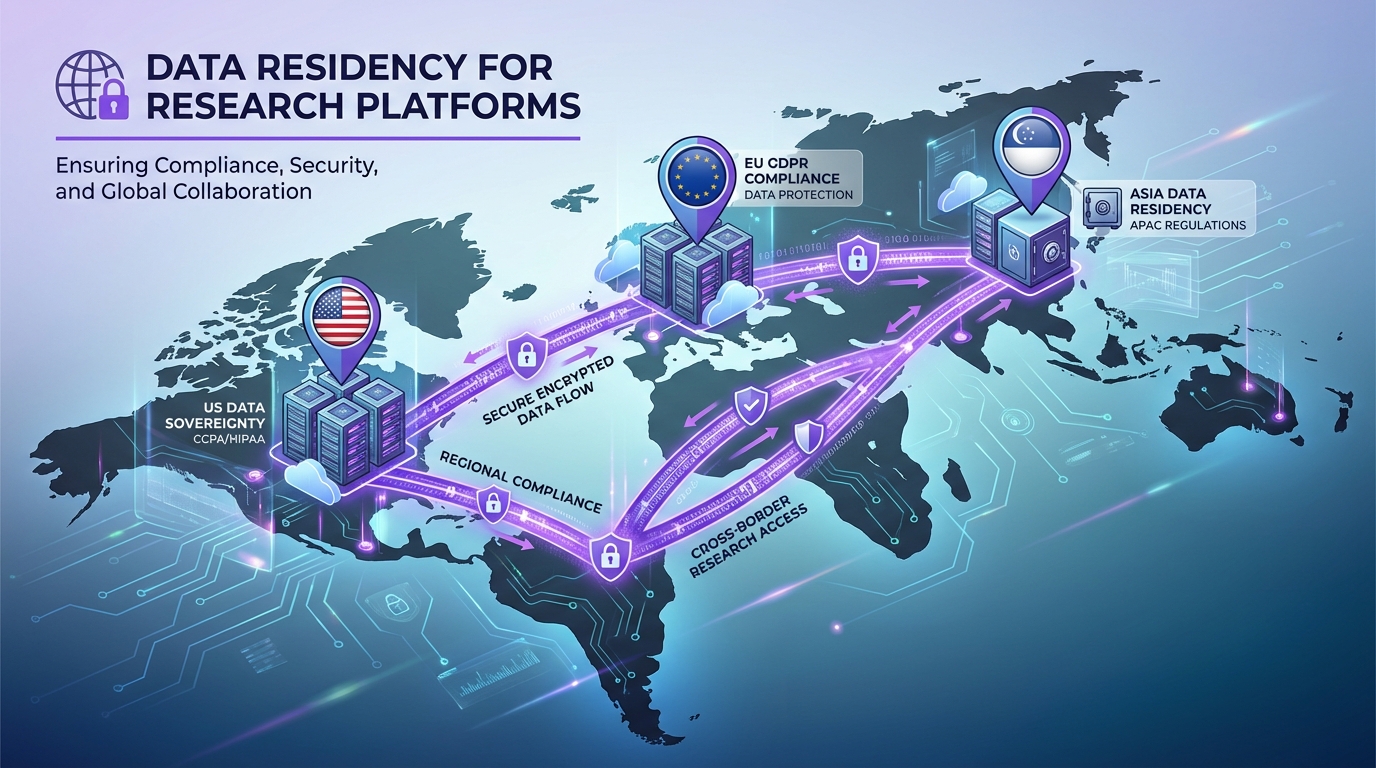
When you upload interview transcripts to a research platform, where does that data actually go? Which country's servers? Which company's infrastructure? Under whose legal jurisdiction?
These questions matter more than ever. Data residency requirements are proliferating, and many researchers are unknowingly violating regulations by using platforms that store data in the wrong places.
Here's what you need to know about data residency for qualitative research.
What Is Data Residency?
Data residency refers to the physical or geographic location where data is stored. It's distinct from:
Data sovereignty: The legal jurisdiction governing data (which laws apply)
Data localization: Requirements that data must stay within certain borders
These concepts overlap but aren't identical. Data can be stored in Germany (residency) under EU law (sovereignty) with no requirement that it stay there (no localization requirement).
Why Data Residency Matters for Research
Regulatory Requirements
Multiple regulations impose data residency constraints:
GDPR (EU): Doesn't require EU storage but restricts transfers outside EU without adequate protection measures.
China PIPL: Requires personal information of Chinese citizens to be stored in China for many data categories.
Russia Data Localization: Requires Russian citizens' personal data to be stored on Russian servers.
Brazil LGPD: Similar structure to GDPR with transfer restrictions.
Various US State Laws: California, Virginia, Colorado, and others have emerging requirements.
Sector-specific rules: Healthcare, financial services, and government contracts often have specific residency requirements.
Contractual Obligations
Even without regulatory requirements, contracts may impose residency constraints:
- Enterprise clients requiring data stay in specific regions
- Government contracts requiring domestic storage
- Industry certifications with residency components
Risk Management
Data residency affects risk profile:
- Data in politically unstable regions may be vulnerable
- Cross-border transfers create legal complexity
- Jurisdictional conflicts can create compliance uncertainty
The Problem with Most Research Platforms
Many research tools don't clearly disclose data residency:
Cloud Platform Defaults
Tools built on AWS, Google Cloud, or Azure default to specific regions. Often US-East or US-West. A European research platform might actually store data on American servers.
Subprocessor Complexity
Even if the primary platform stores data in your preferred region, subprocessors might not. Your transcription service, AI analysis provider, or backup system might route data through different jurisdictions.
Terms of Service Ambiguity
Standard terms often reserve the right to move data without notice. "Data may be processed in any country where our service providers operate" is common language that provides no residency assurance.
Transfer Without Awareness
Some platforms transfer data across borders for processing (AI analysis, search indexing, backup) even if primary storage is local. This transfer may violate regulations even if storage doesn't.
How to Evaluate Platform Data Residency
When choosing a research platform, ask specifically:
Primary Storage Questions
- In which country/region is primary data stored?
- Can I choose my data residency region?
- What's the technical architecture (which cloud provider, which regions)?
- Are there redundancy/backup locations?
Subprocessor Questions
- Which subprocessors handle my data?
- Where are subprocessors located?
- What data goes to each subprocessor?
- Do subprocessors have their own subprocessors?
Transfer Questions
- Under what circumstances does data leave the primary storage region?
- What transfer mechanisms are used (Standard Contractual Clauses, adequacy decisions, etc.)?
- Can I opt out of cross-border transfers?
Documentation Questions
- Can you provide written confirmation of data residency?
- Do you maintain current subprocessor lists?
- How do you notify customers of changes?
Data Residency for Specific Jurisdictions
European Union
Requirements: GDPR doesn't mandate EU storage but restricts transfers to countries without adequacy decisions unless additional safeguards (like Standard Contractual Clauses) are in place.
Practical implication: EU-based storage is safest. US-based storage requires additional legal mechanisms since Schrems II invalidated Privacy Shield.
Look for: EU data center options, Standard Contractual Clauses in DPA, adequacy decision compliance for any non-EU transfers.
United Kingdom
Requirements: Post-Brexit, UK has its own data protection regime (UK GDPR) but currently maintains mutual adequacy with EU.
Practical implication: UK or EU storage both work, but verify continued adequacy status.
Look for: UK data center option or clear adequacy-decision-based transfer mechanisms.
United States
Requirements: No federal data residency requirement for general business data, but sector-specific rules (HIPAA, financial regulations) and state laws may apply.
Practical implication: US storage is generally fine for US-origin data. Be cautious with EU/international data.
Look for: US data center options; if handling EU data, verify GDPR compliance mechanisms.
Asia-Pacific
Requirements: Highly variable. China has strict localization. Japan, South Korea, Australia have varying frameworks.
Practical implication: Research each country's requirements specifically. Don't assume uniformity.
Look for: Regional data center options; local legal advice for country-specific compliance.
AI and Data Residency
AI introduces additional residency considerations:
AI Processing Location
When you send transcripts for AI analysis, where does that processing happen? AI providers often have limited geographic options.
Training Data Concerns
Does AI analysis contribute to model training? If so, data effectively transfers to wherever training occurs.
Real-Time Processing vs. Storage
Even if final results are stored locally, real-time processing might route through other jurisdictions.
Questions to Ask
- Where does AI processing physically occur?
- Does any data persist in AI systems beyond immediate processing?
- Is data used for model training (opt-in or opt-out)?
- Are there AI residency options (EU-hosted AI, etc.)?
Qualz.ai's Approach to Data Residency
Qualz.ai provides data residency options:
Storage region selection: Choose where your data is stored based on your compliance requirements.
Subprocessor transparency: Clear documentation of all subprocessors and their locations.
Transfer mechanisms: Standard Contractual Clauses and other mechanisms for compliant cross-border transfers when needed.
AI processing clarity: Transparent documentation of where AI processing occurs.
Practical Steps for Researchers
For New Platform Selection
- Document your data residency requirements before evaluating platforms
- Request written confirmation of data residency from vendors
- Review subprocessor lists and locations
- Verify transfer mechanisms for any cross-border data flows
- Include data residency requirements in contracts
For Current Platform Use
- Audit where your existing platforms store data
- Check subprocessor lists (usually in privacy policies or DPAs)
- Assess gap between requirements and reality
- Plan migration if current platforms don't meet requirements
For Ongoing Compliance
- Monitor platform changes (storage location, subprocessor changes)
- Track regulatory evolution (new laws, enforcement trends)
- Document your data flow decisions for audit purposes
- Review annually at minimum
The Bigger Picture
Data residency may feel like bureaucratic overhead, but it reflects genuine concerns:
- Government access: Data in a jurisdiction is subject to that government's legal access powers
- Legal protection: Data protection laws only apply where they have jurisdiction
- Client trust: Clients increasingly ask where their data goes
Taking data residency seriously isn't just compliance checkbox-ticking. It's responsible data stewardship for the research participants whose information you handle.
Need a research platform with clear data residency options? Explore Qualz.ai's security and compliance features or contact us to discuss your specific requirements.