The Appeal and the Trap
The five-second test has earned its popularity for good reason. It is fast, cheap, requires no complex recruitment, and produces clear quantitative results. Show users a design for five seconds, take it away, ask what they remember. Clean data. Clear signal. Ship the variant with better recall.
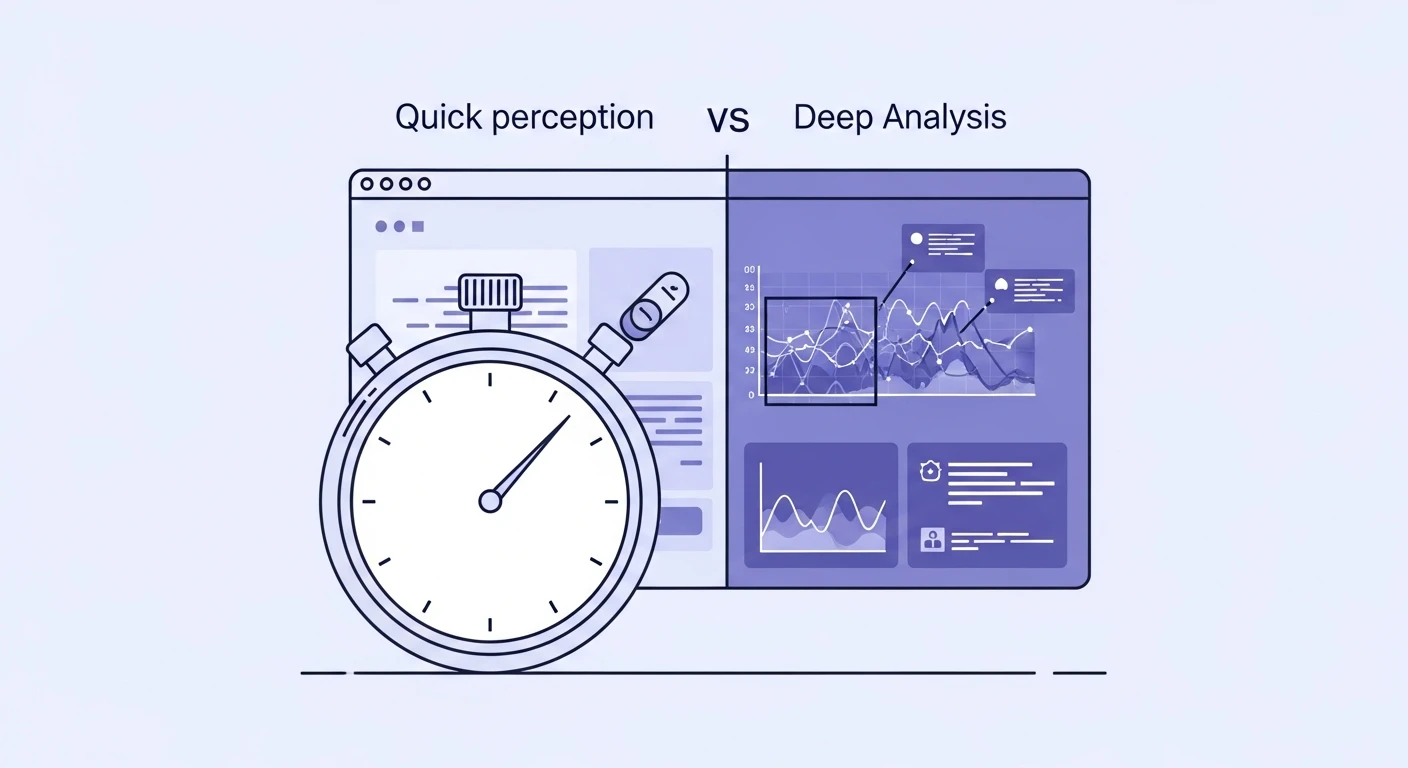
Except the signal is not what most teams think it is. A five-second test measures visual salience and immediate pattern recognition. It does not measure comprehension, trust formation, decision confidence, or the dozens of micro-evaluations users perform when actually deciding whether to engage with a product. Teams that optimize for five-second test performance often optimize for attention capture at the expense of everything that happens after second six.
The fallacy is not that five-second tests are useless. They genuinely reveal whether key elements achieve visual prominence. The fallacy is treating them as proxies for design quality or user experience when they measure only the opening milliseconds of a complex cognitive journey.
What Users Actually Do in Five Seconds
Cognitive science tells us what happens in those five seconds: pre-attentive processing identifies shapes, colors, and spatial groupings. Working memory encodes the most visually prominent elements. Pattern recognition matches what is seen against existing mental models. That is it.
What does not happen in five seconds: evaluation of information architecture, assessment of whether content addresses user needs, trust calibration based on specificity and tone, navigation planning, or comparison against alternatives. These processes require fifteen to sixty seconds of engaged attention — and they determine actual user behavior far more than initial recognition.
The disconnect becomes dangerous when teams use five-second test results to validate information-dense screens — dashboards, pricing pages, settings panels — where success depends not on immediate recognition but on progressive comprehension. A pricing page that scores well on a five-second test (users recall the headline) may perform terribly in practice because the comparison logic requires careful reading that five seconds never allows.
When Five-Second Tests Actively Mislead
Three scenarios produce systematically misleading five-second test results:
High-density interfaces. Complex screens with multiple information hierarchies get flattened to their most visually dominant element. A dashboard where the key insight is a trend in a secondary chart will always lose a five-second test to a dashboard with a giant hero number — even if the trend view produces better decisions over time.
Trust-dependent flows. Landing pages for financial services, healthcare, or enterprise software require trust formation that operates on a slower timescale than visual recognition. Users need to read specific claims, evaluate credibility signals, and assess relevance to their situation. Five-second tests for these pages optimize for visual boldness when the actual conversion driver is content specificity.
Progressive disclosure designs. Interfaces designed with progressive disclosure principles intentionally reveal complexity gradually. Testing them at five seconds evaluates only the entry state, missing the entire interaction model that makes the design effective.
Better Alternatives for Different Questions
The fix is not eliminating five-second tests but matching test methodology to the question being asked:
For visual hierarchy validation — five-second tests work well. Use them to confirm that key elements achieve appropriate prominence. But limit your conclusions to prominence, not effectiveness.
For comprehension testing — use twenty-second tests or self-paced exposure with comprehension questions. These capture whether users actually understand what the interface communicates, not just what they notice.
For decision-quality testing — task-based usability tests remain the standard. Observe users making actual decisions with the interface. Time-on-task, error rates, and decision confidence reveal far more than recall metrics.
For trust assessment — think-aloud protocols during extended exposure reveal the trust calibration process. As research on the observer effect has shown, even observed behavior reveals trust signals that snapshot testing misses entirely.
The principle of research triangulation applies directly here — no single method answers complex design questions. Five-second tests provide one data point in a triangulation that should include longer-exposure comprehension testing and behavioral observation.
The Organizational Pressure Toward Speed
Why do teams over-rely on five-second tests? Because they are fast. In continuous discovery environments operating under sprint pressure, the test that produces results in an afternoon wins over the test that requires a week of recruitment and sessions. This creates a methodological monoculture where speed of insight production outweighs depth of insight quality.
The organizational fix requires making the trade-off explicit. A five-second test answers: "Do users notice the primary element?" It does not answer: "Does this design help users accomplish their goal?" When stakeholders conflate these questions, the research program produces false confidence — teams ship designs validated for attention capture that fail in actual usage.
This is the same dynamic that creates recency bias in continuous discovery — the most recent, most easily obtained data point disproportionately influences decisions, not because it is most valid but because it is most available.
Building a Layered Testing Practice
The most effective teams use five-second tests as one layer in a multi-resolution testing practice:
Layer 1: Visual salience (5 seconds) — Does the visual hierarchy communicate priority correctly? Quick, cheap, run frequently.
Layer 2: Comprehension (20–60 seconds) — Do users understand what the interface communicates? Moderate effort, run for key flows.
Layer 3: Task completion (3–5 minutes) — Can users accomplish goals using this interface? Higher effort, run for critical journeys.
Layer 4: Extended engagement (session-length) — Does the interface support sustained work? Highest effort, run for core product experiences.
Each layer answers different questions. Problems caught at Layer 1 are cheap to fix. Problems that only surface at Layer 4 are expensive to discover but critical to address. Teams that only test at Layer 1 accumulate usability debt that surfaces as adoption failures and support tickets.
The AI-powered adaptive testing approaches emerging in production systems follow a similar principle — layered evaluation at different depths catches different classes of failures. The same logic applies to user experience evaluation: different time horizons reveal different truths about design quality.
What to Do Tomorrow
If your team currently relies on five-second tests for design validation:
- Audit which design decisions were made solely on five-second test data in the past quarter
- For each, identify whether the question being answered was actually about visual salience or about deeper comprehension and usability
- For decisions beyond salience, add a twenty-second comprehension test or a brief task-based evaluation to your toolkit
- Make the test-to-question mapping explicit in your research briefs: state which layer each test is evaluating
The goal is not more testing. It is matched testing — ensuring the methodology you apply actually answers the question your team needs answered. Five-second tests answer their question well. They just do not answer every question, and mistaking their narrow validity for broad design validation is a trap that costs teams months of misdirected iteration.