The Incidental PHI Problem
A mid-size healthcare agency runs a patient experience study on post-surgical recovery. The screener collects no names. Participants get a study ID. The discussion guide never asks for dates, facilities or providers. Compliance signs off.
Then, eleven minutes into the third interview, a participant says: "After Dr. Okafor did my knee at St. Luke's on March 4th, the follow-up nurse called my cell, 555-0142, and told me my A1c was too high to start PT."
One sentence, and the recording now holds a provider name, a facility, a treatment date, a phone number and a lab value, all tied to a voice. Nobody asked for any of it. The participant was being helpful by giving context, which is exactly what a good interview invites people to do.
We call this the Incidental PHI Problem: in voice interviews, protected health information comes in through the participant's narrative, not through your data collection fields. Most study designs, and most compliance reviews, only look at the fields.
Why voice interviews pull in identifiers
The mechanism is simple, and once you see it you can't stop seeing it.
Narrative recall is anchored to specifics. People remember healthcare experiences as episodes: who, where, when. Ask "tell me about the first week after your procedure" and recall arrives tied to the doctor's name, the hospital and the calendar date. Stripping those out while talking takes effort, and participants don't spend effort on things they don't know matter.
Rapport lowers the guard. The better the interview goes, the more people share. A participant who trusts the moderator gives the full story, including the parts that identify them. Good technique and PHI exposure grow together.
AI moderators probe for concreteness. A well-built AI moderator is trained to follow up on vague answers: "Can you walk me through that specific appointment?" That is what produces rich data, and it is also the question most likely to bring out a date and a location. If you've read our workflow comparison of AI-moderated and human-moderated interviews, you know the AI's consistency is a strength. Here it means the AI will also be consistent about inviting specifics unless you design against it.
Voice is itself a biometric. Even a perfectly scrubbed transcript sits next to an audio file. A voiceprint counts as one of the 18 HIPAA Safe Harbor identifiers, and in a small patient population a distinctive voice plus a rare condition can be enough to re-identify someone.
Where PHI enters: the five entry points
Map these before you write a single question.
- The screener and recruitment trail. Contact details, eligibility answers about diagnoses, referral source. This is the one entry point most teams already handle.
- The audio recording. Voice, background sounds (a pharmacy name over a PA system, a family member saying the participant's name), and anything said before or after the formal questions.
- The live transcript. Every spoken identifier turns into searchable text, which is easier to leak than audio because anyone can copy and paste it.
- AI processing and summaries. If transcripts go to a model for probing, summarising or coding, the PHI goes with them. The question is whether every system in that chain is covered by a business associate agreement and whether any of them keeps or trains on the data.
- Downstream artefacts. Highlight reels, quote banks, slide decks and exported CSVs. The PHI that survived redaction in the transcript gets pasted into a deck that goes to forty stakeholders.
Most compliance reviews look closely at entry point one, skim entry point four, and never look at five.
Why it matters: the decisions that go wrong
The Incidental PHI Problem leads to three bad decisions, and they pull in opposite directions.
The first is false confidence. The team calls the study "de-identified" because the screener collected no names, and treats the outputs with matching informality. Transcripts land in a shared drive. A clip ends up in an all-hands. Nobody did anything malicious, but the organisation now has unmanaged PHI in places it can't audit. We wrote about this gap between labels and practice in the HIPAA Label Gap: a workflow isn't HIPAA-aware because a vendor badge says so.
The second is overcorrection. A compliance officer who has seen this happen bans recording outright, or demands a script so locked down that participants can't tell a story at all. You get compliant data that is too thin to act on, and the study doesn't answer the question it was paid to answer.
The third is delayed analysis. Teams that find PHI after the fact stop everything for manual redaction. Two weeks later the findings arrive after the decision they were meant to inform.
None of these is solved by caring more about privacy. They're solved by design.
The counter-practice: design for insight, not identifiers
The goal is not zero PHI risk, which nobody can promise in a live conversation. The goal is a study where identifiers are never needed for the analysis, are discouraged in the moment, are caught automatically when they show up anyway, and are never passed downstream.
1. Decide what the insight actually needs
Before writing the guide, list every analytical question and ask what data each one truly requires. "How do patients experience the gap between discharge and first PT session?" needs the duration of the gap and how it felt. It doesn't need the date. It needs "my orthopaedic surgeon," not the surgeon's name. It needs "a large hospital system," not the facility.
Write this down as a data minimisation table: analytical need in one column, the minimum resolution of data that serves it in the next. That table becomes your redaction spec and your consent language.
2. Write questions that pull for relative, not absolute, specifics
You can keep concreteness without inviting identifiers. Swap absolute anchors for relative ones:
- "When was your surgery?" becomes "How long ago was your surgery, roughly?"
- "Which hospital?" becomes "What kind of place was it -- a large hospital, a smaller clinic, an outpatient centre?"
- "Who was your doctor?" becomes "What was your relationship with the doctor who did the procedure like?"
- "What were your test results?" becomes "What did you understand your results to mean for you?"
The last one usually gets better data anyway. You're researching experience, not chart review.
3. Pre-frame, briefly, at the start
Tell participants once, in plain language, before the first substantive question: "You don't need to share names of doctors, hospitals, or exact dates -- general descriptions are perfect." Keep it to one sentence. As we found studying the Recording Notification Effect, heavy-handed privacy warnings at the start make participants guarded for the first ten minutes. One calm sentence sets the norm without chilling the conversation.
4. Configure the AI moderator to redirect, not scold
When a participant volunteers an identifier mid-answer, the moderator shouldn't stop them. That breaks rapport and teaches them to stop telling stories. Have the moderator keep going with the substance and, where it fits, add a light reminder in the next turn: "Thanks -- and no need for names, the general picture is great. What happened after that call?" The probe instructions in your guide should say clearly which specifics to chase (sequence, feelings, workarounds) and which to steer away from (names, dates, numbers).
5. Redact at ingestion, not at reporting
Automated PII and PHI redaction should run on the transcript before it becomes the working copy anyone analyses. Names, facilities, dates, phone numbers, record numbers and lab values get replaced with typed placeholders such as [PROVIDER], [FACILITY], [DATE]. That keeps the narrative structure for analysis while removing the identifier. Keep raw audio in a restricted tier with a defined retention period, and give analysts the redacted transcript by default.
6. Close the AI processing chain
For every model call in your pipeline, confirm three things: a signed BAA or equivalent DPA covers it, the provider doesn't keep inputs past processing, and nothing is used for training. This is the part teams most often take on faith. The engineering side of this, building systems so compliance doesn't have to be bolted on later, is covered well in the AI Compliance Cliff on bigyan.dev.
What your consent language has to say
Generic research consent wasn't written with AI processing of voice in mind. Patient-facing consent for an AI-moderated interview should cover, in plain language:
- That an AI will conduct or assist the interview, and that a human research team reviews the outputs.
- What is recorded: audio, a transcript, or both.
- That they don't need to share identifying details, and what happens if they do: "If you mention names, places, or dates, these are automatically removed from the transcript our team analyses."
- Who processes the data, including the fact that third-party AI services under data protection agreements are involved, and that their data isn't used to train AI models.
- Retention: how long audio is kept, how long transcripts are kept, and when each is deleted.
- Withdrawal: how to withdraw, and what happens to data already collected.
- That participation won't affect their care, which matters most when recruitment runs through a provider.
Keep it short enough that people actually read it. Our post on the Consent Fatigue Effect shows how longer, repeated permission prompts train participants to click through without reading. A clear one-page consent beats a legally exhaustive one nobody reads.
How this looks in practice
A 30-person research consultancy running a payer-sponsored study on medication adherence rebuilt its approach around this framework. The data minimisation table cut the guide's identifier-pulling questions from nine to zero without losing a single analytical objective. The one-sentence pre-frame cut volunteered provider names by roughly two-thirds in the pilot. Ingestion-time redaction caught the rest, and the analysis team never handled a raw transcript. The client's compliance review, which had stalled the previous study for three weeks, finished in four days, because the team could show the data flow instead of describing it.
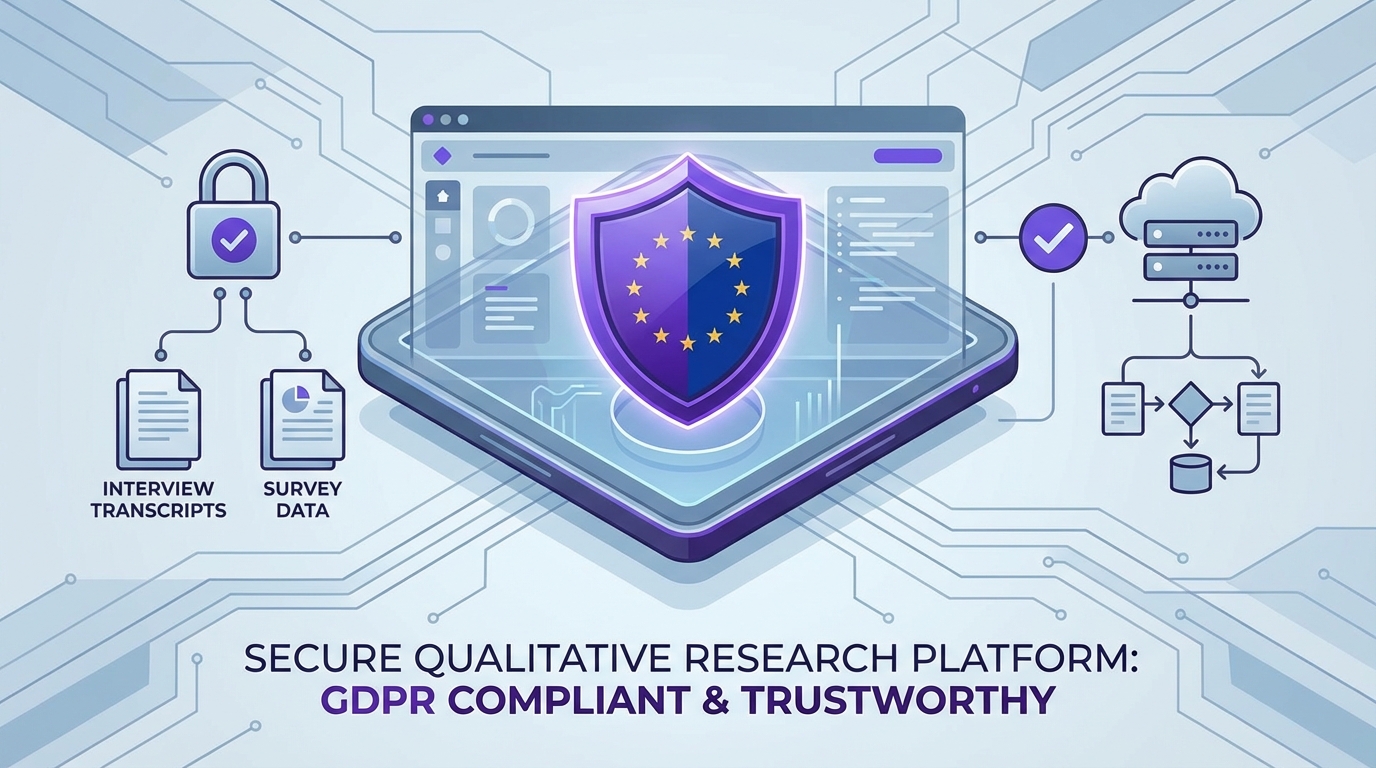
That is what Qualz.ai is built for: AI-moderated voice interviews with configurable probing rules, automatic PII and PHI redaction at transcript ingestion, a privacy-first architecture where model providers don't keep or train on research data, and a Trust Center and DPA your compliance officer can review before the first patient is recruited.
Practical takeaways
- Map all five PHI entry points -- screener, audio, transcript, AI processing, downstream artefacts -- before compliance review, not after fieldwork.
- Build a data minimisation table that ties each analytical question to the lowest-resolution data that answers it.
- Rewrite absolute questions as relative ones: durations instead of dates, types of facility instead of names.
- Use a single calm pre-frame sentence telling participants that general descriptions are perfect.
- Configure the AI moderator to redirect gently in the next turn rather than interrupting a participant mid-story.
- Redact at ingestion with typed placeholders, and keep raw audio in a restricted, time-limited tier.
- Verify BAA or DPA coverage, zero retention and no training for every model in your processing chain, and say so in plain language in your consent form.
If you're planning patient interviews and want to see how redaction, probing rules and the processing chain work end to end, book a demo with our team. Bring your compliance officer. They'll have better questions than the brochure answers.