The gap between what users do and what they say they did is enormous. Behavioral analytics shows you the clicks. Post-session interviews capture a reconstructed narrative filtered through hindsight bias, social desirability, and plain forgetfulness. Neither gives you the real story of why a user made a decision at the exact moment they made it.
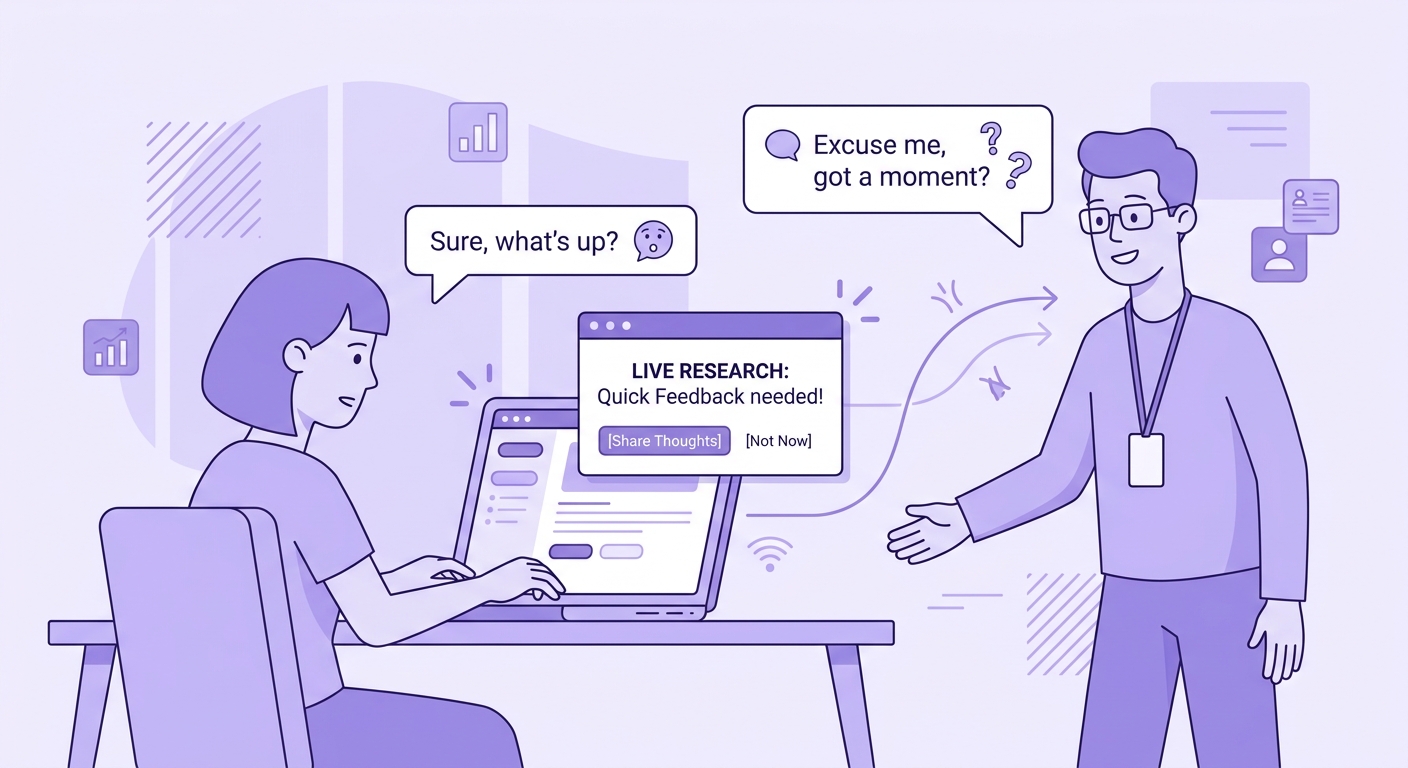
Intercept studies close that gap. By triggering a short research interaction at the precise moment of interest -- right after a user completes a task, abandons a flow, or encounters a friction point -- you capture intent and context while the experience is still raw and unfiltered.
For SaaS product teams drowning in behavioral data but starving for context, intercept studies are the most underused method in the research toolkit.
Why Post-Hoc Research Misses the Signal
Traditional user research operates on a delay. You observe a pattern in analytics -- say, a 40% drop-off at step three of your onboarding flow -- and then you schedule interviews two weeks later to understand why. By the time you are sitting across from the participant, they have forgotten the specific moment of confusion. They reconstruct a plausible narrative that may or may not reflect what actually happened.
This is not a criticism of users. It is how human memory works. Daniel Kahneman's work on the experiencing self versus the remembering self demonstrates that people do not accurately recall moment-to-moment experiences. They remember peaks, endings, and narratives -- not the granular sequence of micro-decisions that constitute a product interaction.
Intercept studies sidestep this problem entirely. When you ask a user "What were you trying to accomplish just now?" within seconds of the behavior, you get the experiencing self's answer, not the remembering self's rationalization.
Designing Effective Intercept Triggers
The power of intercept studies lives or dies on trigger design. A poorly timed intercept is worse than no intercept at all -- it disrupts the user experience and generates low-quality data simultaneously.
The most effective triggers are behavioral, not temporal. Instead of intercepting every fifth user or popping up after 30 seconds on a page, trigger based on specific actions that signal research-relevant moments:
Abandonment triggers fire when a user starts a flow and exits before completion. A user who opens your report builder, adds two data sources, and then navigates away without generating a report has a story worth hearing. The question "What made you decide not to generate the report?" asked within 10 seconds of the abandonment captures genuine friction that a weekly survey never will.
Completion triggers fire after a user successfully finishes a key task. This is not about measuring satisfaction -- it is about understanding the path. "Was there anything confusing or unexpected about that process?" captures usability issues that users would never think to mention in a scheduled interview because they ultimately succeeded.
Exploration triggers fire when a user visits a feature or page for the first time. First-contact moments are goldmines for understanding mental models. "What did you expect to find here?" reveals the gap between your information architecture and the user's expectations.
Rage triggers fire after signals of frustration -- rapid repeated clicks, back-and-forth navigation, or aggressive scrolling. These moments capture genuine emotional responses that users will downplay or rationalize in retrospective research.
The key principle: intercept at moments of high cognitive engagement, not random intervals. The data quality difference is orders of magnitude.
The Micro-Interview Format
Intercept studies are not surveys with a different trigger mechanism. The format matters as much as the timing.
Effective intercept micro-interviews follow a strict structure: one to three questions, open-ended, completable in under 60 seconds. Anything longer and completion rates collapse. Anything closed-ended and you have just built a contextual survey, which is a different tool entirely.
The opening question should always be about intent or expectation: "What were you trying to do?" or "What did you expect to happen?" This grounds the response in the user's actual goal rather than your product's feature set.
The follow-up should probe the gap between expectation and reality: "Was anything surprising or confusing?" or "What would have made this easier?"
If you have earned the right to a third question, use it for forward-looking insight: "What will you try next?" or "Would you use this feature again?"
The conversational format matters. As research on AI-moderated interview techniques has shown, even brief interactions produce richer data when they feel like conversations rather than forms. AI-powered intercept systems can adapt follow-up questions based on the initial response, turning a static three-question template into a dynamic micro-conversation.
Sampling Without Bias
The biggest methodological risk with intercept studies is selection bias. If you intercept every user who triggers the condition, you will overwhelm high-frequency users and miss low-frequency ones. If you use random sampling, you will miss rare but critical behaviors.
The solution is stratified behavioral sampling. Define your user segments -- by tenure, plan type, usage frequency, or any dimension relevant to your research question -- and set sampling quotas per segment. This ensures you hear from the power user who has completed this flow 200 times and the new user attempting it for the first time.
Sample size depends on the diversity of your user base, not just statistical significance. For qualitative intercept studies, 15-20 responses per behavioral trigger per segment is typically sufficient to reach thematic saturation. The principles of research triangulation apply here -- intercept data is most powerful when combined with behavioral analytics and periodic depth interviews.
From Intercept Data to Product Decisions
Raw intercept responses are valuable but chaotic. You are collecting hundreds of micro-narratives from different contexts, triggered by different behaviors, from users at different stages of their journey. Without a systematic synthesis process, the data becomes another pile of unanalyzed qualitative evidence.
The analysis workflow should mirror the trigger taxonomy. Group responses by trigger type first, then by behavioral segment, then by emergent theme. This structure lets you answer specific questions: "Why do enterprise users abandon the report builder?" rather than the vague "What do users think about our product?"
Analyzing open-ended responses at scale is where AI-powered analysis tools transform intercept studies from a niche method to a scalable research program. When you are collecting 500 intercept responses per week, manual coding is not viable. AI-assisted thematic analysis can surface patterns across thousands of micro-interviews while preserving the nuance that makes qualitative data valuable.
The output should be a continuous insight feed, not periodic research reports. Intercept data is most valuable when it flows into product decisions in near real-time. A spike in confusion-themed responses from your onboarding intercepts should reach the product team within days, not after the quarterly research readout.
Integration With Continuous Discovery
Intercept studies fit naturally into a continuous discovery operating model. Where traditional project-based research creates periodic snapshots of user understanding, intercepts create an always-on stream of contextual intelligence.
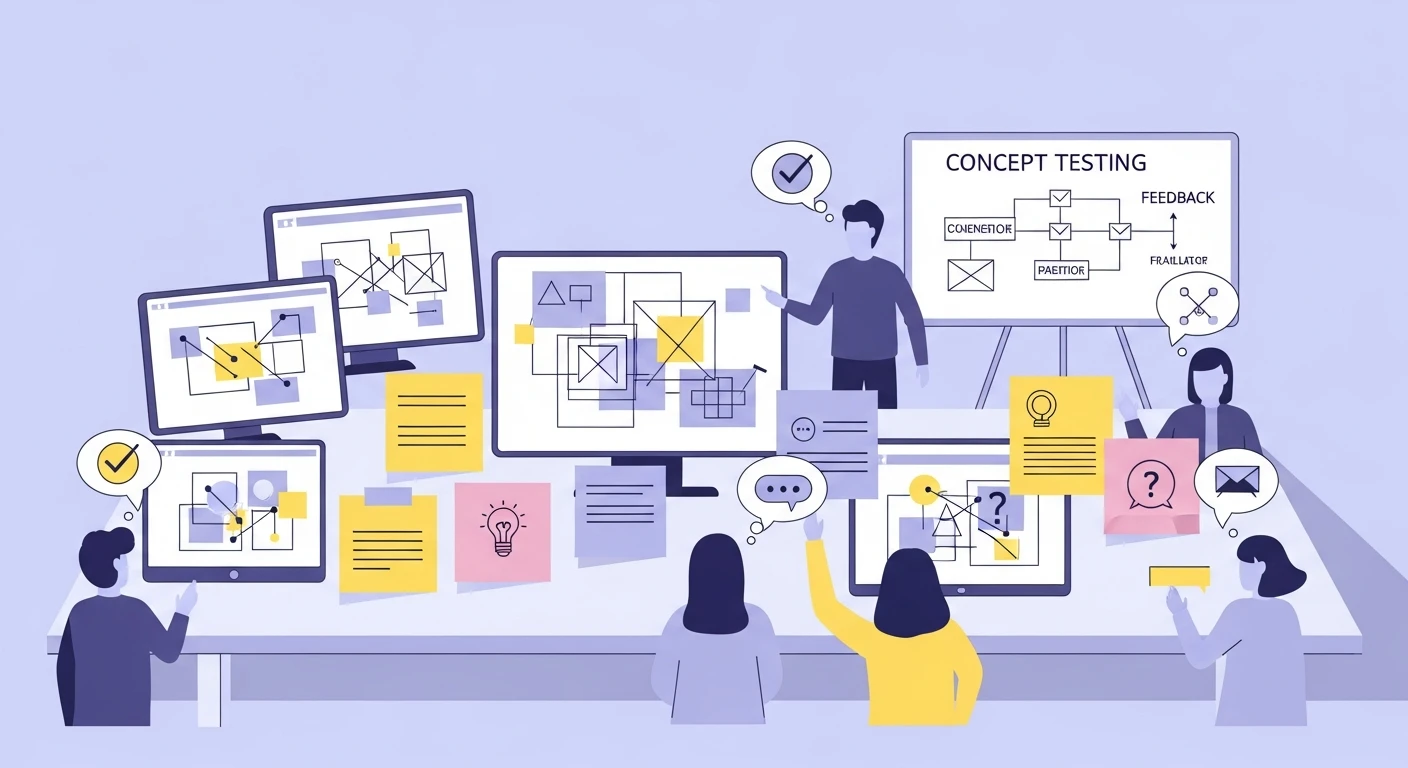
The combination is powerful: continuous intercept data identifies emerging patterns and friction points, which inform the questions you explore in depth interviews and usability sessions. Instead of guessing which topics to explore in your next research sprint, the intercept data tells you exactly where users are struggling.
For teams building AI-native operating models, intercept studies represent the kind of real-time human intelligence that complements behavioral analytics. The analytics tell you what happened. The intercepts tell you why. Together, they create a feedback loop that keeps product development grounded in actual user experience rather than internal assumptions.
Making It Work in Practice
The technical implementation of intercept studies is straightforward -- most product analytics platforms support event-triggered in-app prompts. The harder challenge is organizational.
Product teams need to agree on intercept budgets: how many users can be intercepted per day without degrading the overall experience. Research teams need to maintain the trigger library and ensure questions stay relevant as the product evolves. Engineering needs to instrument the behavioral events that power the triggers.
Start with a single high-impact trigger. Pick the behavior that generates the most internal debate -- the drop-off that nobody can explain, the feature that gets used differently than expected, the flow that support tickets cluster around. Run intercepts for two weeks, analyze the data, and present the findings. The specificity and immediacy of intercept insights tends to convert skeptics faster than any methodology pitch.
The goal is not to replace your existing research practice. It is to fill the gap between what behavioral analytics shows you and what depth interviews tell you. That gap is where most product decisions go wrong, and intercept studies are the most direct way to close it.