Most product teams have heard of Jobs-to-Be-Done. Fewer have conducted rigorous JTBD interviews. And almost none are analyzing them correctly.
The framework is powerful: instead of asking what features customers want, you uncover the progress they are trying to make in their lives and the circumstances that trigger a switch from one solution to another. The "job" is the unit of analysis, not the customer demographic, not the feature request, not the NPS score.
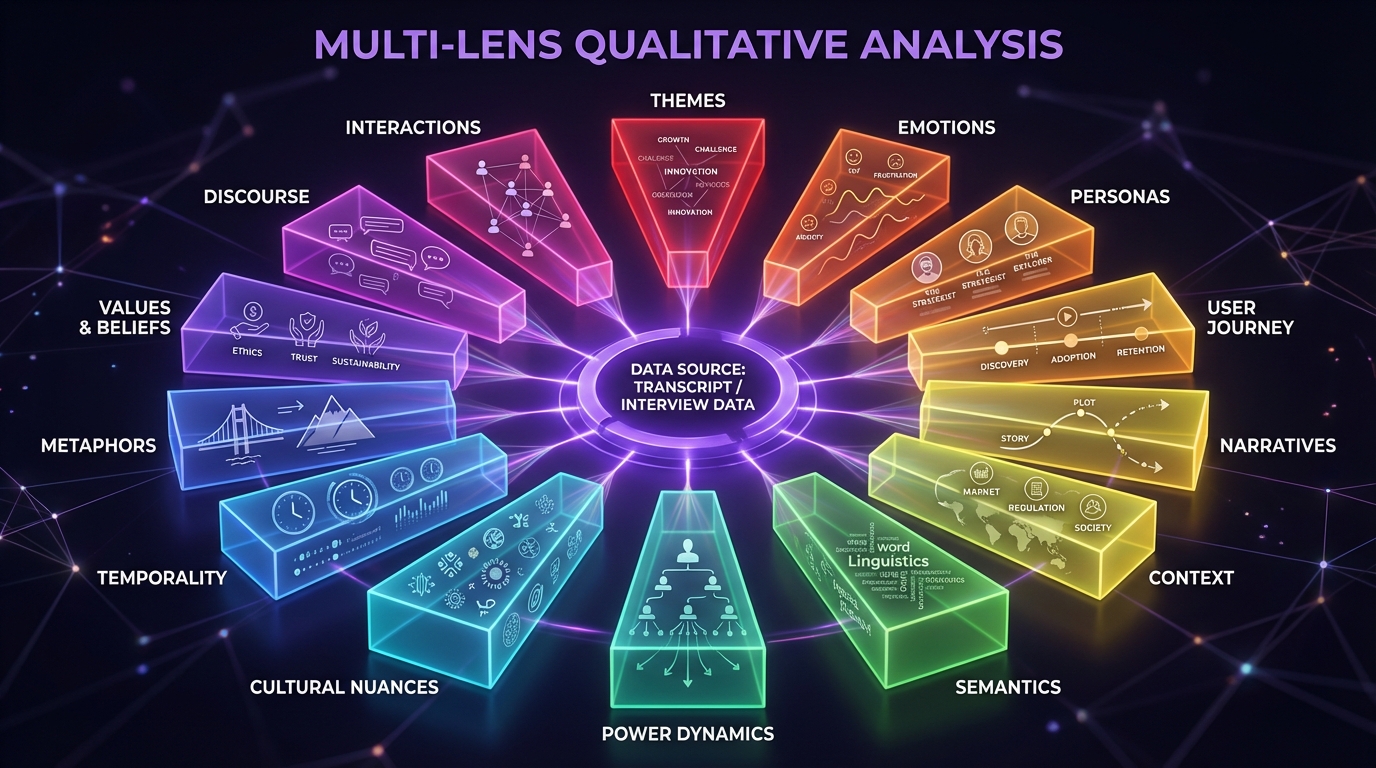
But here is the problem that nobody talks about. JTBD interviews generate some of the richest, most complex qualitative data in all of product research. A single forty-five-minute switching interview can surface three jobs, seven push-pull forces, two anxieties, and a dozen contextual details that matter. Multiply that by thirty interviews and you are staring at a dataset that overwhelms traditional analysis methods.
This is where most JTBD initiatives die — not in the interview room, but in the synthesis phase.
Why Traditional JTBD Analysis Breaks Down
Clayton Christensen's original JTBD framework was never designed for systematic analysis at scale. It was a thinking tool, a lens for understanding demand. The operational challenge — how do you actually process fifty switching interviews into actionable product strategy — was left as an exercise for the reader.
The Forces Diagram Problem
Every JTBD practitioner knows the four forces: push of the current situation, pull of the new solution, anxiety of the new solution, and habit of the current situation. The forces diagram is elegant. It is also impossible to populate rigorously from manual transcript review.
Here is why. Push and pull forces are relatively easy to identify. Customers describe frustrations (push) and aspirations (pull) in explicit language. But anxiety and habit — the forces that prevent switching — are almost never stated directly. They show up as hesitation, qualification, conditional language, and stories about failed past switches. A customer will not say "I had switching anxiety." They will say "We looked at three other tools but the migration seemed like it would take forever, and we had a big launch coming up, so we just stayed."
That sentence contains switching anxiety, a timeline trigger, and a competing priority — none of which traditional coding frameworks would catch on a first pass. AI-powered thematic analysis, however, can identify these latent patterns across your entire corpus without the analyst needing to hold every transcript in working memory.
The Context Gap
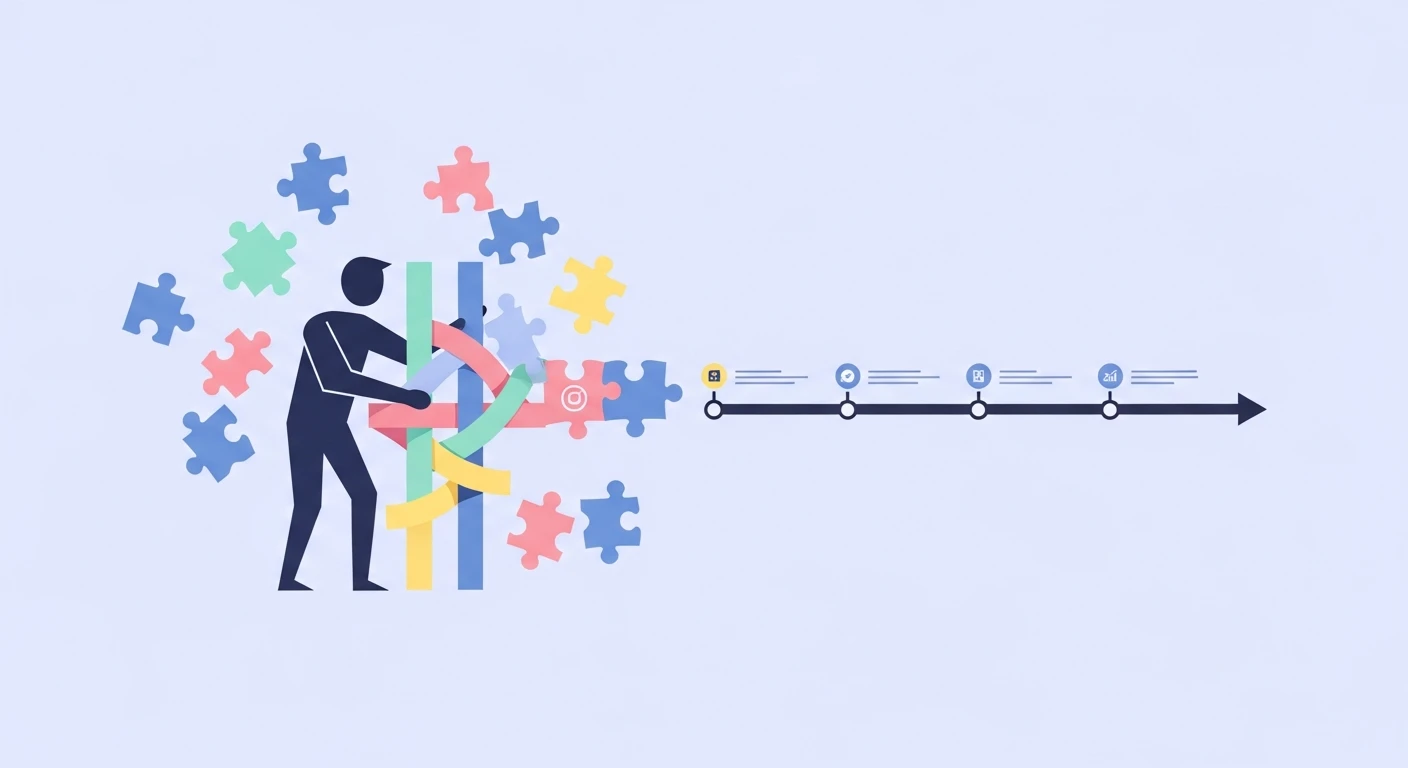
JTBD interviews are supposed to be timeline-based. You walk the customer backward from the moment they switched, through the first thought, the passive looking, the active search, the decision event, and the consumption phase. Each phase contains different data.
Manual analysis tends to flatten this timeline. Quotes get extracted and organized by theme, losing their temporal context. But the sequence matters enormously. A frustration that occurs before passive looking is a fundamentally different signal than one that occurs during active search. The first suggests latent demand. The second suggests evaluation criteria.
Preserving and analyzing temporal sequences across dozens of interviews requires systematic coding that most teams cannot resource manually. This is precisely the kind of structured qualitative data analysis where computational methods deliver their highest value.
The AI Advantage in JTBD Research
Let me be specific about what AI does and does not do well in JTBD analysis.
What AI Excels At
Force identification across the corpus. An AI coding system can tag every mention of push, pull, anxiety, and habit across all interviews simultaneously, applying consistent criteria that a human analyst would struggle to maintain over fifty transcripts. It catches the subtle forces — the ones buried in conditional language — that manual review misses.
Temporal pattern detection. AI can map when specific forces and circumstances appear in the switching timeline, revealing patterns like: "Enterprise buyers consistently experience the push force four to six months before budget cycle, but do not begin active search until a triggering event — usually a failed project — creates organizational permission."
Cross-interview clustering. When you have thirty interviews, identifying that eight of them describe the same job but with different vocabulary requires pattern matching at a scale that exceeds human working memory. AI can cluster semantically similar job statements even when the surface language differs completely.
Hiring criteria extraction. This is the killer application. JTBD theory says customers "hire" products to make progress. The criteria they use to evaluate candidates for the job are scattered throughout the interview — in complaints about the old solution, in praise of the new one, in descriptions of alternatives they rejected. AI can extract and consolidate these hiring criteria systematically, creating a prioritized list that maps directly to product decisions.
What AI Cannot Do
AI cannot determine whether a job is strategic. Two jobs might appear with equal frequency, but one represents a massive growth opportunity and the other is a niche. That judgment requires market context, business strategy, and competitive intelligence that no model possesses.
AI also struggles with the emotional valence of switching stories. A customer might describe a switching experience with humor and lightness, or with genuine distress and frustration. The words might be similar, but the intensity matters for prioritization. Human researchers still need to calibrate emotional weight.
A Practical JTBD-AI Workflow
Here is the workflow we recommend for teams conducting JTBD research with AI-assisted analysis.
Step 1: Structured Interview Design
Design your interview guide with analysis in mind. The classic JTBD switching interview has five phases: first thought, passive looking, active search, decision event, and consumption. Structure your guide so these phases are explicit, not just implicit in the conversation flow.
This matters because it gives the AI coder a structural scaffold. When the transcript is organized around clear phases, the coding quality improves dramatically. For practical guidance on structuring research interviews for analytical rigor, see our guide on designing interviews for your research.
Step 2: Full Transcription With Speaker Identification
Record every interview and transcribe with speaker labels. JTBD interviews involve extensive probing — "tell me more about that moment" — and the interviewer's prompts provide context that shapes how the AI interprets responses.
Use real-time transcription if possible. The live transcript allows the interviewer to spot gaps in the timeline and probe deeper during the conversation, rather than discovering missed opportunities after the fact.
Step 3: AI-Powered Force Mapping
This is where the magic happens. Upload your transcripts and apply a JTBD-specific coding framework:
- Push forces — Frustrations, limitations, trigger events with current solution
- Pull forces — Aspirations, perceived benefits, social proof for new solution
- Anxieties — Risk perception, switching costs, uncertainty about the new solution
- Habits — Comfortable workflows, sunk costs, organizational inertia
- Timeline markers — First thought, passive looking, active search, decision, consumption
- Hiring criteria — Explicit and implicit evaluation criteria for the "job candidate"
- Contextual triggers — Situational factors that accelerated or delayed switching
The AI processes all interviews simultaneously, applying these codes consistently. The output is not a summary — it is a structured dataset that preserves every tagged segment with its source interview, speaker, and timeline position.
Step 4: Synthesis and Strategic Mapping
Now the human expertise becomes critical. With the AI-generated coding in hand:
Map the job landscape. How many distinct jobs appear across your interviews? Which are most common? Which are underserved?
Build force diagrams from data, not intuition. For each major job, populate the four forces with actual coded segments. Count the frequency of each force. Identify which anxieties are blocking adoption most frequently.
Extract the hiring criteria hierarchy. This is your product strategy goldmine. What criteria do customers use to evaluate solutions for this job? Rank them by frequency and by intensity. The criteria that appear across many interviews with high emotional intensity are your must-haves. The criteria that appear occasionally with moderate intensity are your differentiators.
Identify the timeline patterns. How long is the typical switching journey for each job? What triggers the transition from passive looking to active search? Understanding this informs your marketing timing and sales process. As we have explored in the context of closing the insight-to-action gap, the critical step is translating these patterns into concrete product and go-to-market decisions.
Common JTBD Analysis Mistakes That AI Helps Avoid
Mistake 1: Confusing Preferences With Jobs
Customers will tell you they want faster load times, better design, more integrations. These are preferences, not jobs. The job is the underlying progress: "When I am preparing for a board meeting, I need to transform raw research data into a credible narrative in under two hours." AI-powered analysis helps distinguish job statements from feature requests by analyzing the context surrounding each statement.
Mistake 2: Anchoring on the Loudest Voice
In manual analysis, the most articulate interviewee gets quoted most often. Their perspective becomes disproportionately influential. AI coding applies equal analytical weight to every interview, surfacing patterns that exist across the quiet majority, not just the eloquent minority.
Mistake 3: Missing the Non-Consumption Job
Some of the most valuable JTBD insights come from people who are not using any solution — the non-consumers. They have the job, but nothing has been compelling enough to hire. Their switching barriers and hiring criteria often reveal market opportunities that existing-customer interviews miss entirely.
AI analysis helps here by flagging interviews where the forces of habit and anxiety dramatically outweigh pull, indicating non-consumption rather than competitive switching. This is a distinct analytical category that manual analysis often lumps in with regular switching stories.
From JTBD Insights to Product Decisions
The ultimate test of JTBD research is whether it changes what you build. Here is how the AI-analyzed output maps to product decisions:
| JTBD Output | Product Decision |
|---|---|
| Top hiring criteria | Feature prioritization |
| Most common push forces | Marketing messaging |
| Dominant anxieties | Onboarding and trial design |
| Timeline trigger events | Sales process timing |
| Habit forces | Migration and switching tools |
| Underserved jobs | New product opportunities |
The teams that execute JTBD well do not treat it as a one-time exercise. They build it into their continuous discovery practice, conducting switching interviews regularly and tracking how the job landscape evolves over time.
Getting Started
If you are new to JTBD interviews, start with ten switching interviews focused on customers who recently adopted your product or a competitor. Use the five-phase timeline structure. Record and transcribe everything.
Then bring the transcripts into Qualz for AI-powered force mapping and hiring criteria extraction. You will likely discover that the job your product was designed for and the job customers are actually hiring it for are not the same thing.
That gap is where your biggest product opportunity lives.
*Ready to run JTBD interviews with AI-powered analysis? Book a demo to see how Qualz helps teams uncover hidden hiring criteria at scale.*