The Professional Respondent Problem
Somewhere between the rise of remote research and the inflation of participant incentives, a new participant class emerged: the professional respondent. Not a casual participant who happens to join multiple studies, but someone who treats research participation as income -- studying screener patterns, fabricating qualifying criteria, and delivering performance-optimized interview responses designed to maximize session completion rates.
These are not occasional outliers. Estimates suggest 15-30% of participants in unscreened online panels are professional respondents who have participated in 20+ studies in the past year. They know what researchers want to hear. They have practiced the cadence of authentic reflection. They deliver responses that sound genuine but are constructed rather than recalled.
The data they produce is not just noisy -- it is systematically misleading. Professional respondents create false consensus around whatever positions they infer the researcher is hoping to validate. Your "user insights" become a mirror of your interview guide's implicit hypotheses, reflected back by people skilled at reading interviewer cues.
How Professional Respondents Operate
Screener Pattern Recognition
Modern screener questionnaires have predictable structures. Questions about job title, company size, and tool usage typically filter for specific profiles. Professional respondents learn these patterns across studies:
- "Decision-maker" questions: always answer yes to budget authority
- Tool usage: claim familiarity with whatever tools are named
- Frequency questions: always answer at the upper range ("daily" beats "weekly")
- Satisfaction scales: avoid extremes, stay at moderate-positive
They maintain multiple "personas" for different study types -- sometimes they are a marketing manager, sometimes a product lead, sometimes a UX designer. The persona matches whatever the screener rewards.
This is a more sophisticated version of the research panel fatigue problem -- but where fatigued legitimate participants give declining quality data, professional respondents give manufactured data from the start.
Response Performance Patterns
During interviews, professional respondents exhibit specific behavioral signatures:
- Over-fluent responses: They answer complex questions without the natural hesitation, backtracking, or uncertainty that genuine recall produces
- Story consistency without detail evolution: Their narratives maintain suspiciously perfect internal consistency across probes, unlike real experiences which reveal new facets and minor contradictions under questioning
- Interviewer-aligned positioning: Their opinions conveniently align with the direction the interviewer's questions suggest, adapting in real-time to perceived expectations
- Generic specificity: They provide details that sound specific but are actually generic -- mentioning processes, tools, or challenges that apply to any company rather than their actual workplace
Cross-Study Contamination
Professional respondents who participate in multiple studies on similar topics begin blending insights from previous sessions into current ones. They might describe a "workflow pain point" they heard another researcher describe in a different study, or suggest solutions they learned about from a prior concept test.
This creates a contamination vector where your research findings are partially recycled from competitors' research -- a data quality threat that detecting contradictions in qualitative interviews alone cannot catch because the contaminated data is internally consistent.
Why Traditional Screening Fails
The Screener Arms Race
Every screening innovation gets absorbed into the professional respondent playbook within months. Attention checks? They know to pick the specific answer. Trick questions? They have encountered every variation. Open-ended screener responses? They have templates. Verification questions? They maintain consistent persona documentation.
The fundamental problem is that screeners test knowledge and self-report -- both of which are gameable by anyone motivated enough. A professional respondent who claims to be a VP of Product at a 200-person SaaS company can answer product management questions convincingly because they have absorbed the vocabulary from dozens of prior studies.
The Confidence Gap
Recruiters and researchers often feel confident in their screening because they catch obvious bad actors -- the participant who cannot name their own job responsibilities, or who contradicts their screener answers within the first minute. But the professional respondents who survive screening are precisely the ones skilled enough to maintain consistency.
The ones you catch make you feel like your screening works. The ones you miss never give you reason to question their legitimacy. This is survivorship bias applied to data quality.
Behavioral Detection Signals
Temporal Response Patterns
Genuine recall has distinctive temporal signatures. When people access real memories, they exhibit:
- Initial hesitation (accessing the memory)
- Non-linear narrative (remembering details out of order)
- Self-correction ("actually, wait, it was not Tuesday, it was..." )
- Emotional re-experiencing (voice changes when describing frustrating moments)
- Peripheral detail emergence (irrelevant details that come with real memories)
Professional respondents produce suspiciously linear narratives with consistent pacing. Their stories move from beginning to end without the temporal wobble of genuine recall. The articulation gap that makes real users struggle to explain behavior is notably absent in manufactured responses.
Consistency Under Probing
Real experiences contain minor inconsistencies that emerge under probing. Ask someone about the same event from different angles and they will remember different details, sometimes slightly contradictory ones. This is normal memory function -- memories are reconstructed, not replayed.
Professional respondents maintain suspiciously perfect consistency because their responses are constructed rather than remembered. They have a story and they stick to it, even when probed from unexpected angles. This over-consistency is paradoxically a signal of fabrication.
Calibration Response Analysis
Include 2-3 questions in every interview where you already know the general answer range for genuine participants (based on your domain expertise or prior validated research). Professional respondents often over-shoot on these calibration questions because they default to the most "impressive" or "engaged" answer rather than the typical one.
For example, if you know that product managers typically check analytics dashboards 2-3 times per week, a professional respondent claiming daily multi-hour analytics sessions is flagging themselves through implausible engagement levels.
AI-Powered Detection Approaches
Linguistic Pattern Analysis
Trained language models can detect the difference between recalled and constructed narratives by analyzing:
- Disfluency patterns: Real speech contains "um," "uh," self-corrections, and false starts. Professional respondents often produce suspiciously clean verbal output
- Hedging distribution: Genuine uncertainty produces hedging ("I think," "probably," "maybe") at specific semantic positions. Manufactured certainty either over-hedges uniformly or under-hedges completely
- Detail gradient: Real memories have rich sensory detail for salient moments and vague generality for background context. Fabricated narratives maintain uniform detail density
Cross-Session Behavioral Fingerprinting
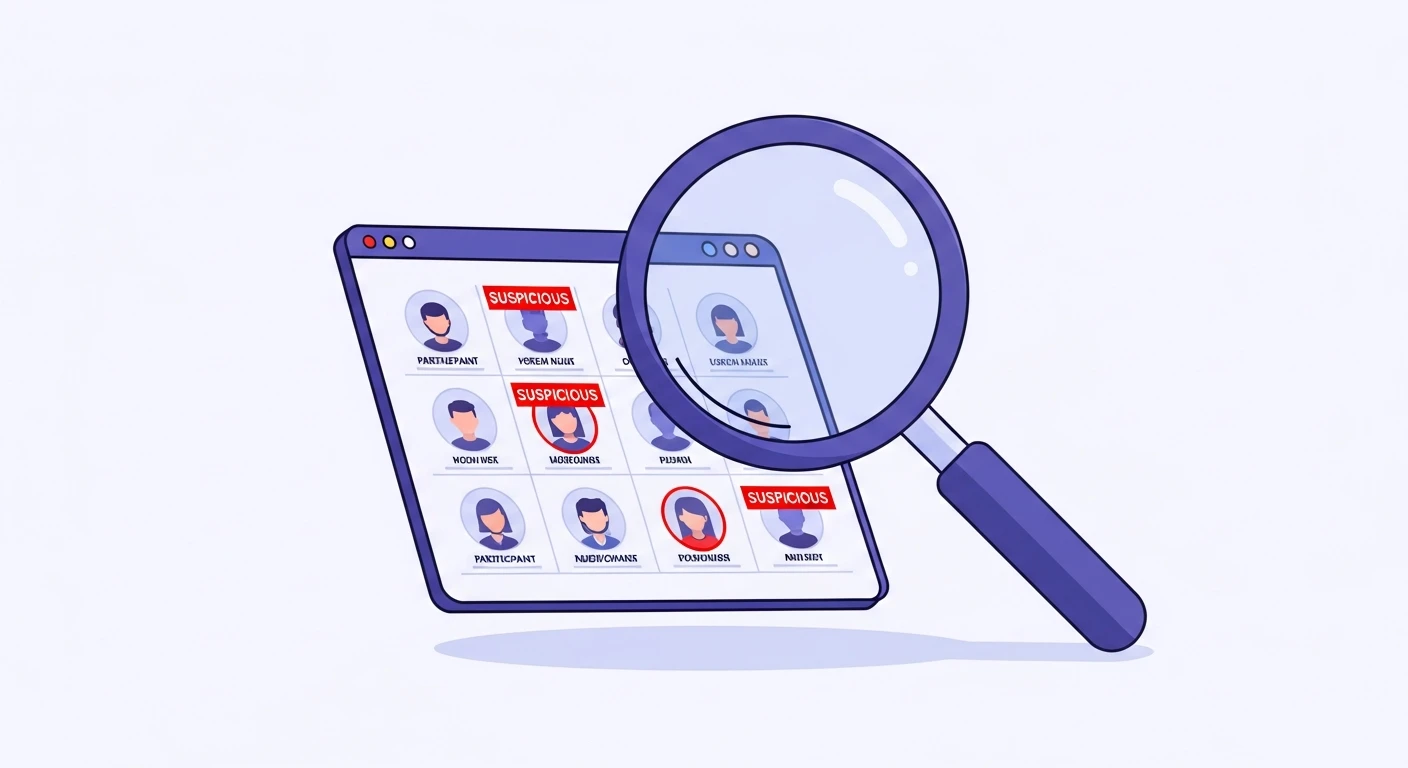
Across a panel, AI can identify participants whose response patterns are statistically anomalous:
- Response latency distributions that do not match genuine recall patterns
- Vocabulary sophistication that shifts to match perceived interviewer expectations
- Topic coverage that mirrors the interview guide structure too closely (genuine participants digress; professional respondents stay on script)
The engineering behind this mirrors the structured output patterns used in production AI systems -- building detection frameworks that operate on behavioral signals rather than content claims.
Panel-Level Anomaly Detection
Rather than evaluating individual participants in isolation, analyze patterns across your full participant pool:
- Clusters of participants who give suspiciously similar responses (indicating shared scripting or community knowledge)
- Response timing patterns that suggest participants are referencing external materials
- Demographic claim patterns that do not match known population distributions
Practical Screening Improvements
Verifiable Credential Checks
Where possible, verify claims rather than trusting self-report:
- LinkedIn profile verification (checking that claimed role, company, and tenure exist)
- Professional email domain confirmation (a @company.com email is harder to fabricate than a Gmail claim)
- Work product samples (asking for screenshots, documents, or artifacts that demonstrate genuine role occupancy)
Dynamic Screener Logic
Instead of static screening questions that can be studied and shared, implement dynamic screening that adapts based on responses:
- If they claim to use a specific tool, ask about features that only active users would know
- If they claim a specific role, present scenarios that require role-specific judgment
- If they claim specific company size, ask about organizational structures typical of that size
Behavioral Pre-Interview Assessment
Before the main interview, include a brief (3-5 minute) behavioral exercise that is harder to game:
- Ask them to walk through their screen and show where the tool/product lives in their actual workflow
- Request a real-time demonstration of a claimed frequent activity
- Have them draw or diagram their actual process (fabrication is harder in visual/spatial modes)
The Organizational Response
Professional respondents are not a recruitment problem alone. They are a symptom of incentive structures that reward participation volume over data quality. The participant economy's incentive inflation creates stronger financial motivation for gaming, while the shift to remote research removes the in-person cues that historically made deception harder.
Organizations should track data quality metrics with the same rigor they apply to research volume metrics. What percentage of your interviews produce novel insight versus confirming existing patterns? How often do follow-up validation attempts confirm participants' claims? How does your findings' reliability compare across recruitment channels?
The AI governance approaches that enterprises apply to their production AI audit trails should equally apply to research participant quality -- systematic monitoring, anomaly detection, and continuous validation rather than one-time screening trust.
Practical Takeaways
- Assume 15-30% contamination in unscreened online panels. Design your analysis to withstand that noise floor.
- Look for over-consistency. Real participants contradict themselves slightly. Perfect narratives are suspect.
- Verify claims where possible. LinkedIn confirmation and domain-verified emails filter the most obvious fabricators.
- Use calibration questions. Include questions where you already know the typical answer range.
- Track response latency patterns. Genuine recall has distinctive temporal signatures that fabrication lacks.
- Analyze at the panel level. Individual evaluation misses patterns visible across your full participant pool.
- Invest in behavioral pre-screening. Live demonstrations and artifact sharing are harder to game than verbal self-report.
The professional respondent problem will not solve itself. As incentives rise and remote research becomes the default, the financial motivation to game participation only increases. Research teams that do not invest in detection capabilities are building product strategies on data that is at least partially manufactured -- and they will never know which findings are real and which are performances.