The Pilot You Skipped Still Happens
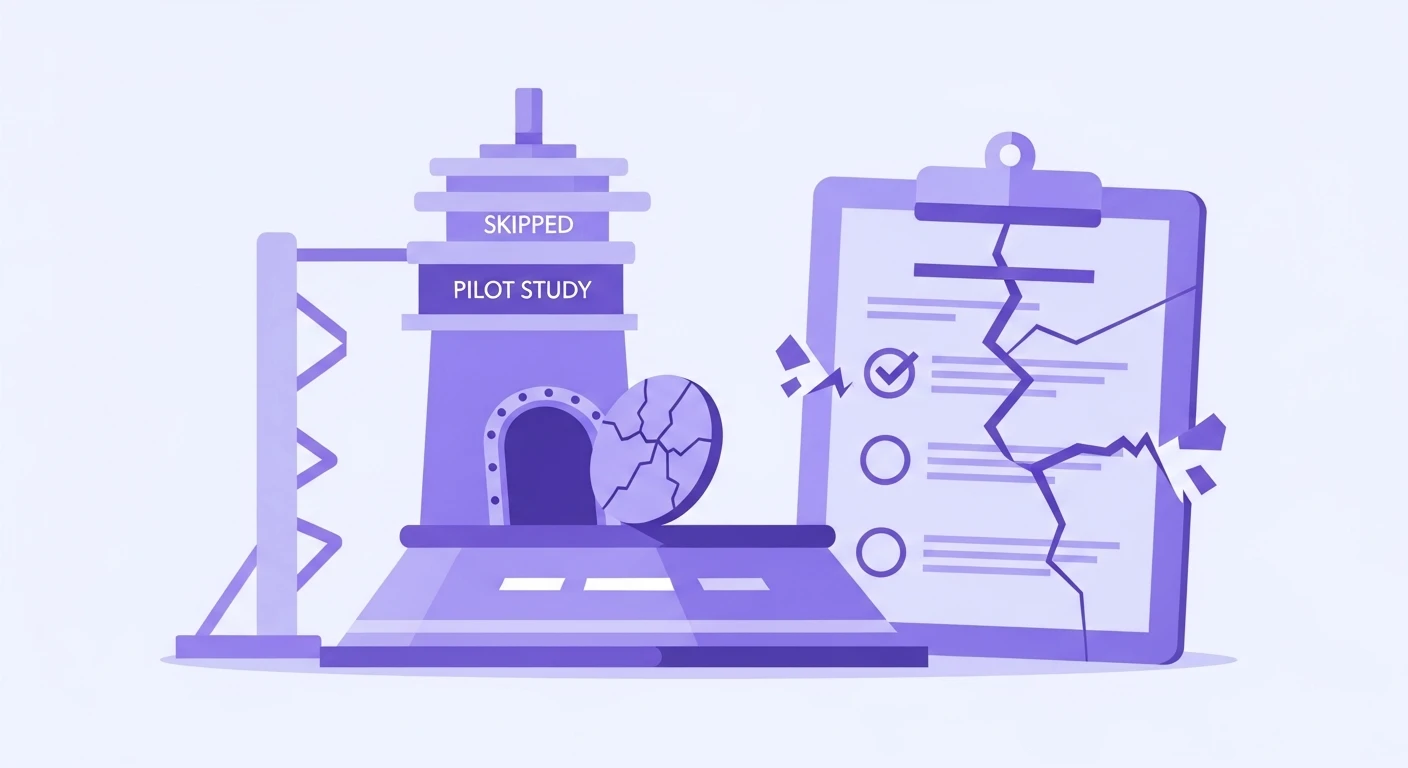
Every experienced researcher has a version of the same story. The study kicked off under deadline pressure. The discussion guide looked clean on paper, the stakeholders had signed off, and running a pilot felt like an indulgence nobody had time for. So the team went straight into real sessions. And somewhere around the third interview, a question that read perfectly in the doc collapsed in the room -- participants misread it, answered a different question than the one intended, or went silent because the phrasing boxed them in. By then, three real participants were already spent.
That is the central, uncomfortable truth about pilots: skipping the pilot does not eliminate it. It relocates it into your live data collection, where it is far more expensive. The first few sessions of any un-piloted study are a pilot whether you planned it or not, except now the cost of a broken question is not a throwaway practice run -- it is a burned participant, a contaminated transcript, and a hole in a dataset you were counting on being clean.
What a Pilot Actually Tests
The reason pilots get cut is that teams misunderstand what they are for. A pilot is not a rehearsal of the researcher's delivery. It is a test of the instrument -- and the instrument fails in ways that are invisible until a real human hits it.
A pilot surfaces the questions that are technically grammatical but functionally broken: double-barreled questions that ask two things at once, questions that assume a behavior the participant does not have, questions whose framing telegraphs the answer you are hoping for. These are exactly the defects that a clean-looking guide hides, and they are the same class of problem that makes poorly scoped research briefs guarantee unusable findings no matter how well the sessions are run. A pilot is where an abstract, performative question reveals itself as abstract -- where you discover that asking "how do you think about your workflow" produces vague theater while a concrete anchor produces real experience, which is the whole argument behind the specificity gradient in interview responses.
The Instrument-Testing Discipline Software Teams Already Have
There is a useful parallel here that research keeps failing to borrow. In production software, nobody ships a system to real users and then discovers in production that a core path is broken -- or at least, mature teams do not, because they build evaluation harnesses that exercise the system against realistic inputs before it goes live. The entire discipline of eval-driven development exists precisely because testing a system against real cases before deployment is cheaper than debugging it in front of customers. A pilot study is eval-driven development for a discussion guide. It runs the instrument against real human inputs in a low-stakes setting so that the failures surface where they cost nothing, not where they cost your best participants.
Skipping it is the research equivalent of shipping untested code straight to production and calling the resulting incidents "learnings."
Why Reused Guides Are Not Pre-Piloted
The most dangerous rationalization is "we do not need a pilot because we have run studies like this before." Teams assume a guide inherited from a previous project is already validated. It is not. A question that worked for one population, one product, or one research goal drifts silently when reused, and the drift is invisible precisely because the words did not change -- this is the core of the question banking antipattern, where reusing interview questions across studies creates methodological drift nobody notices. A reused guide needs a pilot more than a fresh one, because the team's confidence in it is unearned.
How to Pilot Without a Timeline You Do Not Have
The objection is always time. But a pilot does not require a parallel recruitment cycle or a formal round. It requires deliberate treatment of your earliest exposure to the instrument.
- Designate your first session as the pilot, explicitly. Recruit one extra participant and agree in advance that this data may be discarded. This reframes the inevitable rough first session from wasted data into planned instrument-testing.
- Pilot on someone adjacent, not ideal. A colleague, a friendly customer, or a past participant can catch the grossest failures -- double-barreled questions, confusing sequencing, dead-end phrasings -- before you spend a real recruit on them.
- Time-box it to fifteen minutes on the riskiest questions. You do not need to run the whole guide. Run the three questions you are least sure about, because those are where the breakage lives.
- Watch for the participant answering a different question than you asked. That mismatch -- not the participant struggling, but the participant confidently answering something adjacent -- is the single highest-value signal a pilot produces.
The pilot is the cheapest insurance in the research process. The teams that skip it are not saving the pilot's cost; they are paying it later, in the currency of contaminated data and burned participants, at a far worse exchange rate.
Ready to pressure-test your discussion guides before they hit real participants? See how Qualz.ai helps research teams design and validate studies that hold up in the room, not just on paper.