For decades, NVivo has been the gold standard in qualitative data analysis software. Researchers trust it. Universities teach it. It's reliable.
But it's also slow.
As qualitative research demands grow—more interviews, faster timelines, larger datasets—the question isn't whether NVivo works. It's whether manual coding is still the best approach.
The Evolution of Qualitative Analysis
NVivo emerged in an era when the alternative to software-assisted coding was literal cut-and-paste with scissors and paper. It digitized the coding process, making it faster than manual methods and enabling features like complex queries and visualizations.
That was revolutionary—in 1999.
Today, AI can read, understand, and code qualitative data in ways that weren't possible even five years ago. The question researchers now face is: does manual coding still offer enough value to justify the time investment?
What Manual Coding Gets Right
Let's acknowledge NVivo's strengths:
Deep researcher engagement: There's no substitute for reading every word of every transcript. Manual coding forces intimate familiarity with your data.
Interpretive control: You decide what everything means. Every code reflects your judgment, not an algorithm's.
Established credibility: Peer reviewers know manual coding. It's accepted methodology with decades of validation.
Flexibility: You can create whatever coding structure makes sense for your specific project.
These are real advantages. For certain projects—especially theory-building dissertations or highly sensitive topics where nuance is paramount—manual coding remains appropriate.
The Hidden Costs of Manual Coding
But manual coding comes with costs that are easy to underestimate:
Time
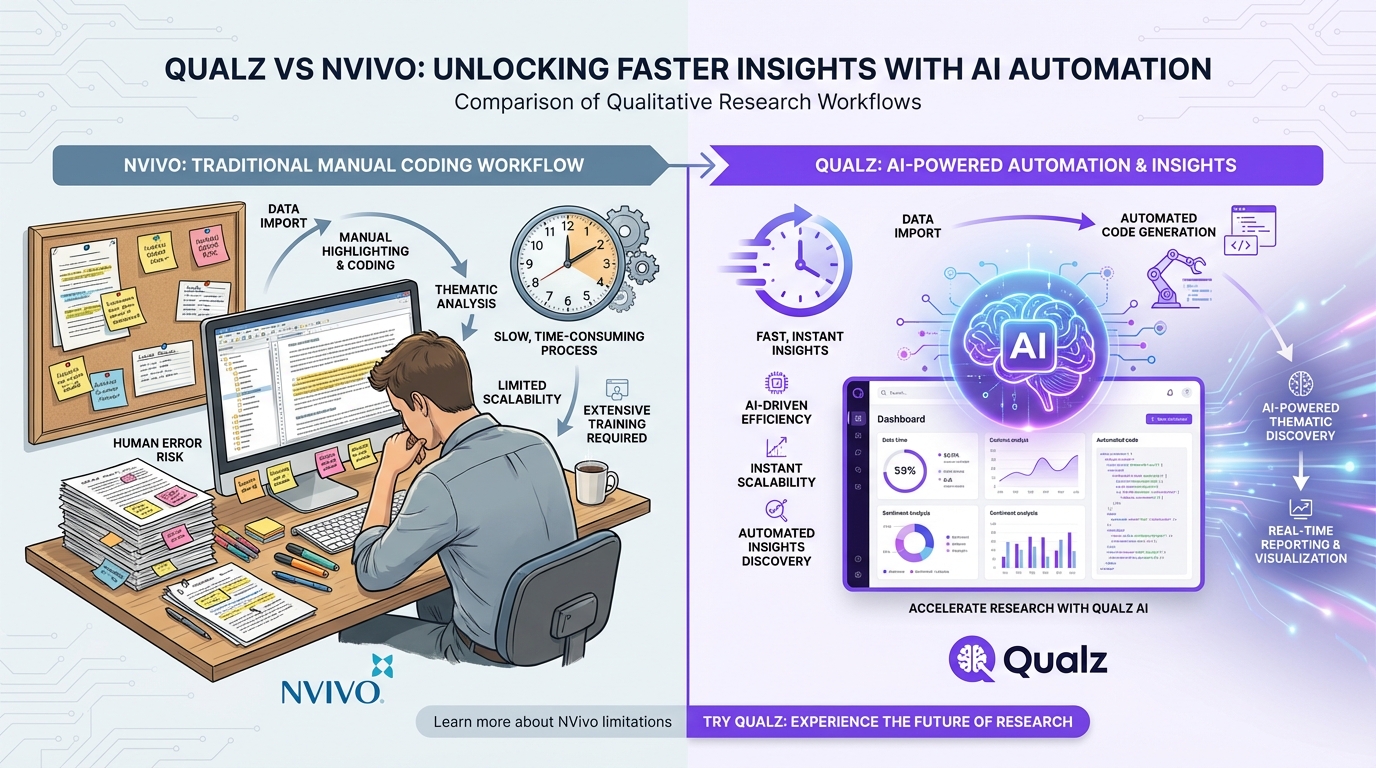
A skilled researcher can code approximately 1-2 hours of interview transcript in 4-6 hours of focused coding work. A typical qualitative study might involve 20-30 interviews. That's 80-180 hours just for initial coding—before you begin categorizing, theming, or writing up findings.
For academic research with long timelines, this is manageable. For commercial research that needs insights in weeks rather than months, it's a constraint.
Consistency
Human coders drift. What you coded as "frustration" in interview 3 might be coded as "disappointment" in interview 23. Solo researchers can mitigate this through constant memoing and codebook refinement, but it's cognitively exhausting.
Teams face even bigger challenges. Inter-rater reliability studies consistently show that coders disagree on 20-40% of coding decisions, even with training and clear codebooks.
Scalability
When your project grows from 20 interviews to 50, manual coding time doubles. When it grows to 200 (common in large-scale UX or market research), manual coding becomes impractical.
NVivo offers query tools and visualizations that help with large datasets, but the fundamental bottleneck—human reading and coding speed—remains.
How AI-Powered Analysis Works
Qualz.ai approaches qualitative analysis differently. Instead of replacing the researcher, it amplifies research capacity through structured AI analysis.
Multi-Lens Analysis
Rather than a single pass through the data, Qualz.ai applies 14 distinct analytical lenses to your transcripts:
- Thematic analysis identifies recurring patterns
- Sentiment analysis maps emotional tone across participants
- Jobs-to-be-done analysis surfaces user goals and obstacles
- Narrative arc analysis reveals story structures
- Journey mapping tracks experiences across touchpoints
Each lens produces structured output with supporting quotes, giving you multiple analytical entry points from a single dataset.
Quote-Level Traceability
Every AI-generated code links back to its source quote. You can click any theme to see exactly which participant statements support it. This isn't a black box—it's transparent analysis you can verify and challenge.
Iterative Refinement
AI analysis isn't a one-time event. You can adjust parameters, run additional lenses, or drill deeper into specific themes. The platform facilitates the kind of iterative engagement that characterizes good qualitative work, just faster.
A Practical Comparison
| Factor | NVivo (Manual) | Qualz.ai (AI-Assisted) |
|---|---|---|
| Initial coding time (20 interviews) | 80-120 hours | 2-4 hours |
| Consistency across dataset | Variable (coder dependent) | Consistent |
| Scalability to 100+ interviews | Impractical | Easy |
| Traceability to quotes | Yes | Yes |
| Multiple analytical frameworks | Manual setup required | Built-in (14 lenses) |
| Learning curve | Steep | Moderate |
| Cost model | Per-license | Usage-based |
When to Use What
Choose manual coding (NVivo) when:
- Building novel theoretical frameworks
- Working on highly sensitive topics requiring maximum interpretive control
- Publishing in journals that specifically require manual coding
- You have ample time and limited data volume
Choose AI-assisted analysis (Qualz.ai) when:
- Timelines are tight and insights are needed fast
- Data volume exceeds what's practical for manual coding
- You need multiple analytical perspectives on the same data
- Consistency across a large dataset is critical
- Commercial research applications where speed matters
The Hybrid Approach
Many researchers are finding value in a hybrid approach:
- Use AI for initial passes: Let Qualz.ai generate codes and themes across all lenses
- Review AI output critically: Examine the codes, challenge interpretations, identify gaps
- Deep dive manually on key areas: For the most important themes, read supporting quotes carefully
- Iterate and refine: Adjust AI parameters based on your emerging understanding
This approach combines AI efficiency with human interpretive depth. You get speed without sacrificing rigor.
The Bigger Picture
The shift from manual to AI-assisted analysis mirrors larger trends in research methodology. Just as statistical software didn't replace statistical thinking (it amplified it), AI qualitative tools don't replace qualitative thinking. They amplify research capacity.
Researchers who embrace these tools will be able to tackle larger studies, deliver insights faster, and compete effectively for both academic and commercial projects. Those who don't may find themselves constrained by methodology that, while rigorous, can't scale.
Making the Transition
If you're considering moving from NVivo to AI-assisted analysis, start small:
- Run a parallel analysis: Code a few interviews manually AND with AI. Compare outputs.
- Test traceability: Click through AI-generated themes to verify they're grounded in data.
- Evaluate fit: Assess whether AI's analytical lenses match your research questions.
The goal isn't to abandon everything you know about qualitative analysis. It's to find tools that let you do more of what you do well, faster.
Curious how AI-assisted analysis handles your data? Upload a transcript and see multi-lens analysis in action.