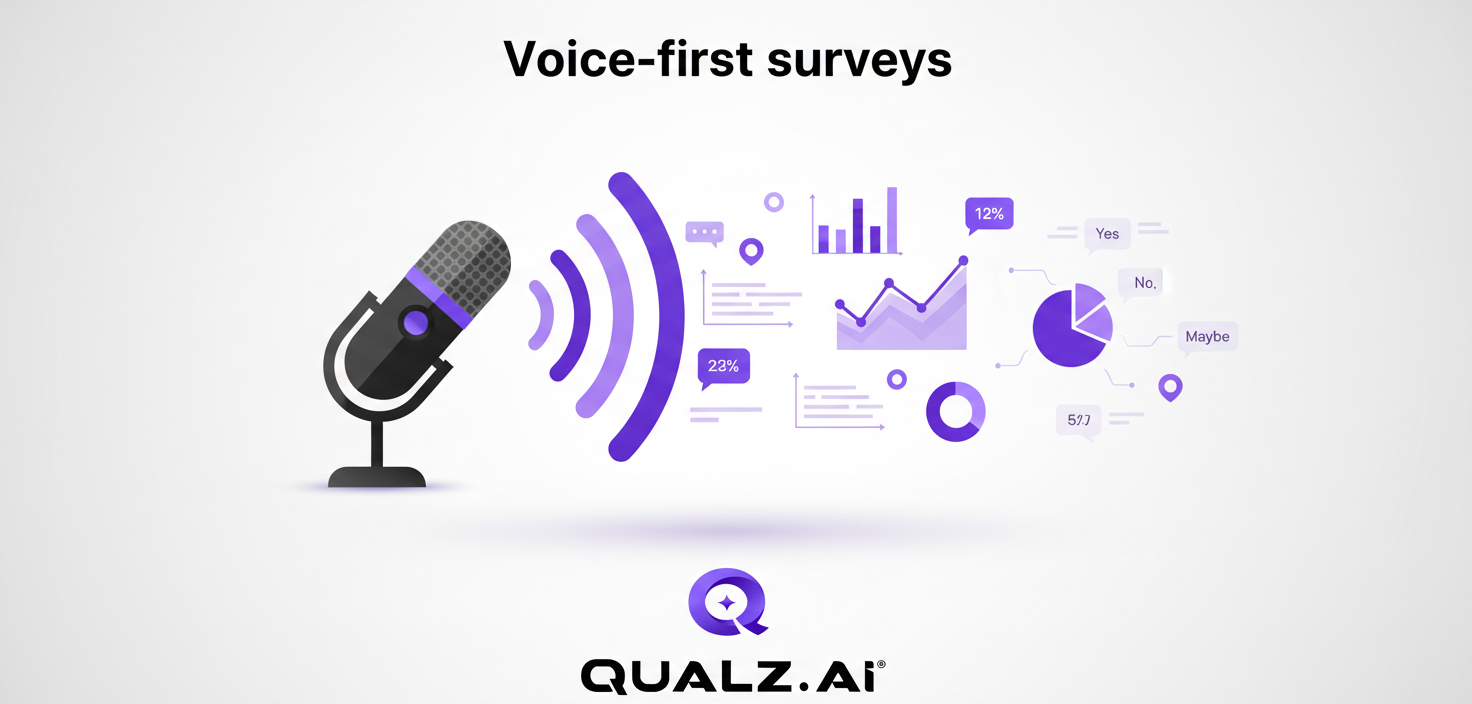
Text-based surveys have dominated market research for decades. Voice-first approaches are revealing what typed responses miss.
The Problem with Typed Responses
Limited Expression
Average typed survey response: 8-15 words.
Average spoken response: 40-60 words.
Participants type the minimum to complete surveys. Speaking feels natural and yields more detail.
Lost Nuance
Typed responses miss:
- Emotional tone
- Hesitation patterns
- Enthusiasm levels
- Stream-of-consciousness insights
Selection Bias
Typed surveys favor participants comfortable with written expression, potentially skewing toward certain demographics.
Voice-First Advantages
Natural Communication
Most people speak faster than they type and find it less effortful. This reduces survey fatigue and dropout rates.
Emotional Data
Voice carries emotional content that text cannot:
- Frustration in tone
- Excitement in pace
- Uncertainty in pauses
Accessibility
Voice surveys accommodate:
- Lower literacy levels
- Visual impairments
- Mobile-first contexts (e.g., while driving)
Language Richness
Spoken language includes:
- Colloquialisms that reveal authentic views
- Self-corrections that show thought evolution
- Tangents that uncover unexpected insights
Implementation Considerations
Platform Requirements
- Real-time speech-to-text transcription
- Automatic speaker diarization
- Sentiment analysis capabilities
- Multi-language support
Survey Design Adaptations
For voice, ask:
- "Tell me about..." (open invitation)
- "Describe your experience with..." (narrative prompt)
- "What comes to mind when..." (association query)
Avoid:
- Long lists of options to read aloud
- Matrix questions requiring recall
- Complex branching explained verbally
Data Processing
Voice data requires:
- Transcription (automated or manual)
- Analysis of both text and audio features
- Secure storage for audio files
When Voice Works Best
| Research Type | Voice Advantage |
|---|---|
| Brand perception | Captures emotional associations |
| Customer experience | Reveals pain points through tone |
| Product feedback | Gets detailed feature opinions |
| Journey mapping | Enables storytelling format |
| Concept testing | Shows authentic reactions |
When to Stick with Text
- Sensitive topics (privacy concerns about recorded voice)
- Quick quantitative surveys (ratings, rankings)
- Multilingual studies (transcription complexity)
- Participants in public spaces
Hybrid Approach
Combine voice and text:
- Voice for open-ended questions
- Text/click for structured questions
- Let participants choose their mode
Getting Started
- Start with a pilot: 20-30 voice responses
- Compare data richness to text equivalents
- Refine prompts based on response patterns
- Scale with confidence
Qualz.ai's dynamic surveys support voice-first responses with automatic transcription and analysis—making voice data as easy to work with as typed responses.