Ask a med-surg nurse on nights what she thinks of the charting system and you will often get a laugh before you get an answer. Then something like this:
I mean, it's fine? It's fine at three in the morning. It's not fine at seven when I've got report and two discharges and pharmacy calling and it wants me to re-sign the same flowsheet I did at four.
Nothing in that answer says she hates documentation. She knows why she charts: for continuity, for the next nurse, for legal protection, for her patients. What she resents is a tool that treats every hour of her shift as if it were the same hour. Health tech teams hear "nurses hate the EHR" and file it as a usability complaint. It is closer to a fieldwork finding. The software has a model of nursing work in it, and the model is wrong in specific, discoverable ways.
This post covers how to find those ways. It draws on a nurse workflow study run with 200 nurses across three health systems, whose findings fed into changes that cut charting time by 30%. We won't reconstruct that study in detail here, since the full write-up is on our case studies page. We'll focus on the design decision that mattered most, which was organising the research by shift and by specialty rather than treating "nurses" as a single user.
The plan in the software and the work on the floor
Lucy Suchman's Plans and Situated Actions made an argument decades ago that still describes clinical software uncomfortably well. Plans, she argued, don't determine action. People use them as resources while responding to whatever is happening in front of them. A documentation tool encodes a plan: assess, record, sign, move on, in a sensible order. A nurse's shift is situated action. Rapid responses, family members in the doorway and a patient who suddenly needs the bathroom all break the order up.
When the plan and the situation diverge, nurses do what competent people always do. They build workarounds. Vitals get written on a glove or a scrap of paper towel and entered later. Assessments are batched at the end of the shift. Defaults get copied forward. Product teams tend to read these workarounds as non-compliance, but they are better read as data. Every workaround tells you where the tool's plan stopped matching the work, and when in the shift that happened.
So the research question isn't "what do nurses think of the tool?" It is "where, when and for whom does the tool's model of the work fail?" That question has a shape, and the shape is shift and specialty.
Why shift and specialty are the right axes
The usual way to study a clinical user base is to recruit some nurses, run interviews, and synthesise. The problem is that the variation you most need to see sits inside that word "nurses", and an unstratified sample averages it away. We have written before about how averaged personas erase the segments that matter. Clinical work is an extreme case of this.
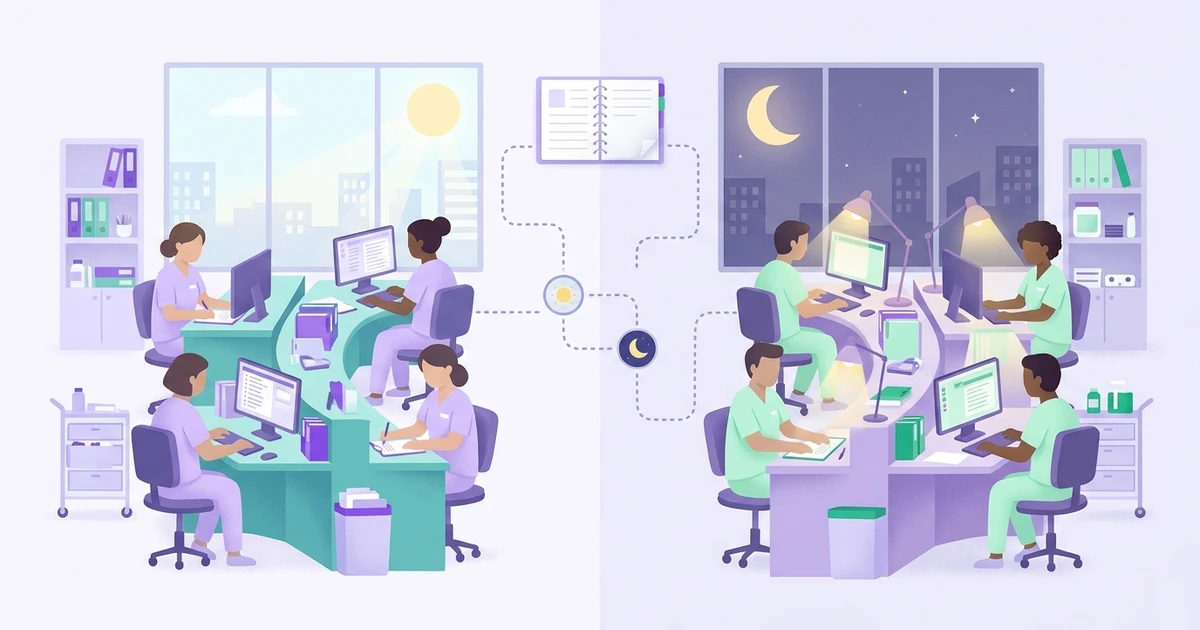
Shift changes the work. Day shift carries rounds, procedures, discharges and the highest density of interruptions. Nights have fewer people, more autonomy, more time spent documenting in long stretches, and a particular fatigue that changes what counts as a tolerable number of clicks. Handoff periods are a world of their own: two nurses, one patient record, and a time-pressured conversation the software rarely supports. A tool that feels fine at 3 a.m. can be unworkable at 7 a.m.
Specialty changes what documentation is for. In the ICU, charting is dense, continuous and tied to rapidly changing physiology. In the emergency department it is fragmentary and interrupted by design. On a med-surg floor it is about volume, with many patients and repetitive assessments. In labour and delivery the record is shared across two patients and has a medicolegal weight nurses feel constantly. A flowsheet design that is efficient in one setting is a nuisance in another, and nurses can usually tell you exactly why if you ask them in terms of their own unit.
Crossing those two axes gives you a sampling frame. It isn't a quota system for statistical claims. It is a way of making sure each combination that plausibly behaves differently gets enough voices for its pattern to show. Information power, in Malterud and colleagues' sense, is the useful idea here. A narrowly defined cell with a focused question needs fewer participants than a broad, vague one. Three health systems add a third dimension, because local configuration, staffing ratios and unit culture vary across systems even when the vendor is the same. That is the same multi-site logic we described for patient experience research across several facilities.
Designing the study
The order of these steps matters, because each one shapes what the next can find.
- Build the frame before you recruit. Lay out shift (day, night, rotating) against specialty (whichever units your product actually serves) and site. Decide which cells you need and which you can collapse. Write down why. That reasoning will be your defence later when someone asks why ED nights got as much attention as med-surg days.
- Recruit against the frame, not against availability. Nurses who answer research invitations quickly tend to be day-shift, at the better-resourced site, and comfortable with the tool already. Night nurses and float pool staff take deliberate effort to reach. If you skip that effort, your findings will lean the way we described in how the first people to schedule skew a study.
- Use a short survey to map, then interviews to explain. A brief survey across the whole frame tells you where the pain concentrates: which tasks, which hours, which units. Keep it short, because nurses are surveyed constantly and have good reason to be tired of it. Include one or two open-text questions about the worst moment in a recent shift. These answers are more valuable than the rating scales, and they are also where AI-assisted survey analysis most often goes wrong. Grouping them into tidy categories can flatten open text into generic themes, so read a good sample of them yourself before trusting any summary.
- Interview about a specific recent shift. "Walk me through your last night shift, from report onward" gets you sequence, interruption and workaround. "How do you find the charting system?" gets you a rating in sentence form. Ask for the moment they stopped charting in the tool and wrote something down elsewhere, and what was going on in the room when they did.
- Time the sessions to the work. Talking to a night nurse at 10 a.m., right after her shift, gets a different account than talking to her at 2 p.m. on a day off. Neither is wrong. Both are situated, and you should record which one you got. Asynchronous AI-moderated interviews help here because nurses can take them when it suits them, not when a moderator happens to be free.
- Plan the privacy handling before the first session. Nurses will describe patients. They can't help it, because that's what their work consists of. Treat incidental PHI as certain rather than possible, and make sure redaction and access controls are part of the workflow, not just a badge on the vendor's website. What a HIPAA-aware research workflow means in practice covers this in more detail.
Analysing with a jobs-to-be-done lens
Once the transcripts are in, the temptation is to code for complaints: too many clicks, slow load times, redundant fields. Those codes are real, but they lead to a feature list rather than an understanding. A jobs-to-be-done lens asks a different question: what is the nurse trying to get done at that moment, and what does documenting do for her or against her?
Framed that way, the same task often turns out to be several jobs. Charting a pain reassessment on day shift might be about getting the record right before the physician rounds. On nights it might be about leaving a clear trail for the morning team. In labour and delivery it might be mainly about protecting oneself if the outcome is bad. These are emic categories, the nurses' own ways of dividing up their work, and they rarely line up with the vendor's etic categories of modules and flowsheets. When they diverge, the divergence is usually where the time goes.
Coding by shift and specialty from the start lets you see whether a job is universal or local. Some will hold everywhere. Handoff, for example, tends to be a shared pain across units, even though the details differ. Others will belong to a single cell, and those are often the ones a product team can actually act on. Our guide to choosing a qualitative analysis lens sets out when jobs-to-be-done fits better than a straight thematic or journey-based approach. For clinical documentation it usually fits well, because the friction lives in the gap between the job and the tool's assumptions.
At 200 participants, the analysis has to change. You can't hold every transcript in your head, and you shouldn't pretend you can. That is the point where AI analysis earns its place: drafting codes against the frame, pulling every excerpt tagged to night-shift ICU handoff, and checking whether a theme from one site appears at the others. Qualz.ai does this work and keeps each claim tied back to the excerpts it came from. It doesn't decide which differences matter. That decision is still the researcher's, and so is the discipline of reading excerpts from the cells that don't fit the emerging story. We've written about what changes methodologically between 10 and 100 interviews, and most of it applies here at double the scale.
The researcher's part in what nurses say
Some reflexivity is owed here. Nurses being interviewed by a health tech company know the company built, or wants to sell, the thing they're being asked about. Some will soften their criticism out of politeness. Others will sharpen it, because a researcher who finally seems to be listening is a rare chance to vent years of frustration. Both responses are understandable, and neither is a neutral report. Demand characteristics in clinical research tend to point in both directions at once.
The interviewer also brings expectations. If the team arrives convinced that the problem is click count, every account of a bad shift will sound like a click-count story. One useful check is member checking at the level of the cell. Take the emerging account of, say, ED day shift back to a few ED day nurses and ask whether it describes their work. When they say "sort of, but you're missing the part where...", that is often the most useful sentence in the whole study.
What this approach doesn't do
Stratifying by shift and specialty won't settle the organisational questions that sit underneath documentation burden: regulatory requirements, institutional fear of litigation, and documentation policies written by committees that never chart. Research can show where those pressures land on a nurse's shift. It can't remove them. A product team that redesigns flowsheets beautifully while the hospital still requires duplicate attestations will see a smaller gain than the research suggested, and that should be said in the readout.
It also doesn't replace observation. Interviews and surveys give you nurses' accounts of their work, which are rich and reflective but still accounts. Where you can get access, even a few hours shadowing on each shift will show you the glove with vitals written on it, which nobody thought to mention in an interview.
The 200-nurse study, including how it was set up across its three health systems and what led to the 30% reduction in charting time, is on the Qualz.ai case studies page. If you're planning clinical workflow research and want to work through a shift-by-specialty frame for your own product, book a short information session and we'll go through it with you.