The Improv Move That Feels Like Great Interviewing
There is a moment in a good interview where a participant offers a half-formed idea and you, wanting to keep the energy alive, build on it. "Yes, and it sounds like that also made the whole handoff feel rushed?" They nod, they light up, they run with it. It feels like the best kind of research -- collaborative, warm, generative. You are not leading them, you tell yourself; you are helping them articulate what they already meant.
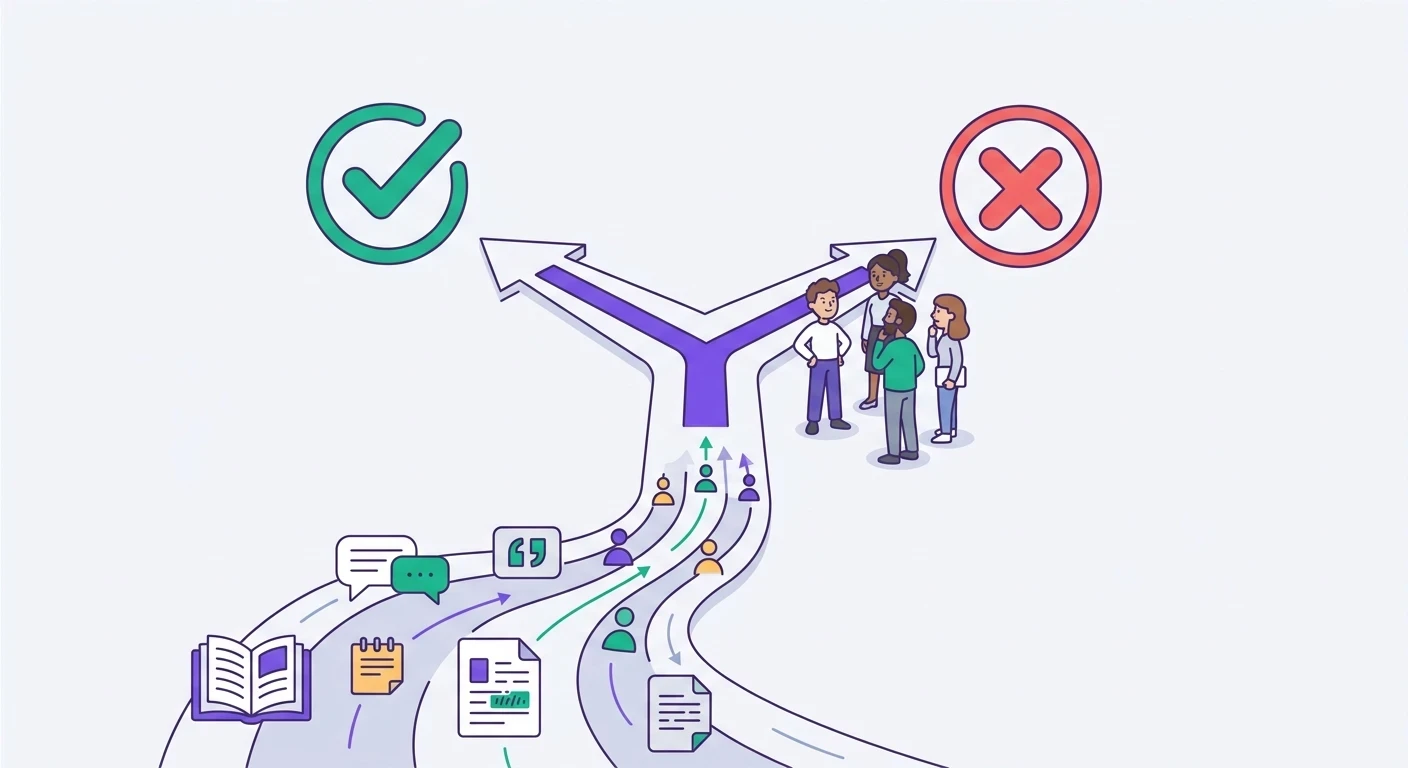
But watch what actually happened. They gave you a fragment. You returned a fully-formed proposition with new content attached -- the word "rushed," the frame of a "handoff," a causal link they never stated. When they agreed, you recorded their agreement as their insight. The yes-and trap is the interviewer habit of extending a participant's thought and then treating the extension as if the participant produced it. It is the improv principle borrowed into research, where it quietly turns a co-authored answer into a finding.
Why Building On Their Idea Backfires
Agreement is cheaper than authorship. Confirming a well-phrased proposition takes almost no effort; generating one from scratch takes a lot. When you hand a participant a finished thought, the path of least resistance is to accept it. This is the same dynamic behind the reassurance reflex, where softening a hard question erases the signal you needed -- the participant follows the easier social path rather than the truthful one.
Your extension imports your vocabulary. The moment you supply the word -- "rushed," "confusing," "seamless" -- you have framed their experience in your terms, and they will reason inside that frame for the rest of the session. This is the vocabulary mirroring effect running in reverse: instead of trapping them in their own first words, you trap them in yours.
Enthusiasm signals the right answer. The yes-and move is delivered with energy, and energy is directional. When you build eagerly on one idea and let another sit flat, you telegraph which answers earn your engagement -- a close cousin of the confidence contagion effect, where interviewer certainty leaks into participant answers.
The best-sounding co-authored quote wins the readout. A crisply phrased line that you helped construct is exactly the kind of quotable sentence that dominates synthesis, feeding the verbatim overweighting effect where one polished quote hijacks the whole study.
What the Yes-And Trap Costs You
The damage is that you can no longer tell your ideas apart from theirs. A transcript full of enthusiastic agreement reads like strong signal, but half the propositions originated with the interviewer. When you synthesize, you are partly analyzing your own hypotheses reflected back -- a feedback loop that manufactures the consensus it claims to discover. And because the participant genuinely agreed, there is no visible seam where your framing ends and their experience begins.
This is especially corrosive in discovery work, where the entire point is to learn the participant's model, not to confirm yours. It also compounds across a study: if you yes-and the same frame into every session, you will reach a false saturation, mistaking the echo of your own extensions for a pattern in the data.
Staying Generative Without Taking the Pen
Reflect, do not extend. Play back only what they said, in their words, and stop. "You said it felt rushed" is safe; "so it felt rushed and disorganized" is co-authorship. The discipline is to add nothing.
Hand the pen back with an open prompt. When a fragment appears, resist completing it. Ask "what happened next?" or "say more about that" and let the silence do the work, the same principle behind effective probing before you hit the depth ceiling.
Watch your own enthusiasm as data. Notice which answers you build on eagerly and which you let pass. That asymmetry is your bias made visible, and it maps directly onto the asymmetric probing problem, where researchers dig into expected answers and skim past surprising ones.
Tag co-authored moments in the transcript. When you did supply a frame, mark it, so synthesis can down-weight agreement you manufactured. This kind of provenance discipline is the qualitative analog of the model provenance gap in production AI, where you cannot prove which system produced a decision -- if you cannot trace where an idea came from, you cannot trust it.
The Harder Discipline
The yes-and trap is seductive precisely because it makes interviews feel productive. But research is not improv, and the goal is not a scene that flows -- it is a record of what the participant actually thinks, uncontaminated by how helpfully you finished their sentences. The most generative thing you can do is stay curious, reflect faithfully, and let them keep the pen.
Qualz.ai helps research teams separate participant signal from interviewer framing -- surfacing who introduced each idea, flagging leading extensions, and keeping your synthesis honest about where an insight actually came from. Book a demo to see how your team can stay generative without co-authoring the findings.