From Copilot to Colleague: The Agentic Shift
For the past three years, AI in qualitative research meant one thing: assistance. You uploaded a transcript, the AI suggested codes, you accepted or rejected them. The human remained the driver. The AI was a passenger offering directions — sometimes useful, sometimes distracting, always dependent on explicit instruction.
That model is already obsolete. In 2026, the conversation has shifted from AI-assisted research to AI-agentic research — systems that autonomously execute multi-step research workflows with minimal human intervention. Not replacing researchers, but operating as independent agents within researcher-defined parameters.
The distinction matters enormously. An AI assistant waits for your command. An AI agent identifies what needs doing, plans the approach, executes across multiple steps, monitors for problems, and reports back with results. The researcher becomes the architect and quality controller rather than the manual operator.
This is not speculative. Research teams at enterprise organizations are already deploying agentic workflows that handle participant screening, schedule interviews, conduct preliminary analysis passes, and flag anomalies — all before a human researcher touches the data.
What Makes a Research Workflow "Agentic"
Agentic AI systems share four characteristics that distinguish them from traditional AI tools:
Autonomy. The system makes decisions without step-by-step human instruction. Given a research brief, an agentic system determines what data to collect, from whom, in what sequence, and how to analyze it — within constraints the researcher defines upfront.
Planning. Rather than responding to individual prompts, agentic systems decompose complex goals into sub-tasks, sequence them appropriately, and adapt the plan when unexpected situations arise. A recruitment agent does not just screen one participant — it manages the entire pipeline from panel outreach through scheduling confirmation.
Tool use. Agentic systems interact with multiple external tools and data sources. They send emails, query databases, call APIs, write documents, and coordinate across platforms. This is fundamentally different from a chatbot that only processes text you feed it.
Reflection. Sophisticated agentic systems evaluate their own outputs, identify errors or gaps, and self-correct before presenting results. An analysis agent might code a transcript, review its own codes for consistency, identify conflicts with the established codebook, and resolve them — all autonomously.
As we explored in how AI-led interviews achieve peer-reviewed validation, the technical foundations for autonomous research interactions already exist. What is new in 2026 is the orchestration layer — the ability to chain these capabilities into complete workflows.
The Five Agentic Research Workflows Already in Production
1. Autonomous Recruitment Screening
Traditional workflow: Researcher writes screener → posts to panel → manually reviews responses → schedules qualified participants → sends reminders → handles rescheduling.
Agentic workflow: Researcher defines participant criteria and study parameters. The agent posts to recruitment channels, evaluates responses against criteria (including nuanced judgment calls about fit), schedules qualified participants into available slots, sends contextually appropriate reminders, handles rescheduling requests, and fills cancellation slots from a waitlist — all without researcher intervention.
The key innovation is not any single step. It is the end-to-end orchestration. The agent handles the entire recruitment pipeline as a continuous process, making judgment calls that previously required human attention. This directly addresses the participant recruitment challenges at scale that bottleneck most research programs.
2. Multi-Pass Autonomous Analysis
Traditional workflow: Researcher reads transcript → develops codes → applies codes → reviews for consistency → writes findings memo.
Agentic workflow: The analysis agent executes a multi-pass strategy autonomously. First pass: open coding to identify initial categories. Second pass: focused coding using the emerging framework. Third pass: consistency check across all transcripts for drift. Fourth pass: pattern identification across the coded dataset. Fifth pass: draft findings memo with supporting evidence. The researcher receives a complete analytical package to review, challenge, and refine.
This connects to the interpretation drift problem — agentic systems do not drift because they can hold the entire codebook in context simultaneously. They apply codes with mechanical consistency while still detecting novel patterns that warrant new codes.
3. Adaptive Interview Orchestration
Beyond simple AI-conducted interviews, agentic systems now manage the entire interview program adaptively. After each completed interview, the agent analyzes the transcript, identifies theoretical gaps (connecting to theoretical sampling principles), adjusts the interview guide for the next session, and modifies recruitment criteria to seek participants who can fill those gaps.
This creates a closed-loop research system that gets smarter with each data point — the kind of continuous discovery approach that was previously only possible with dedicated full-time researchers running ongoing programs.
4. Cross-Study Synthesis Agents
Organizational research repositories contain years of accumulated insights that no individual researcher can fully hold in mind. Synthesis agents continuously monitor new incoming data against historical findings, identifying confirmations, contradictions, and evolutionary patterns across studies separated by months or years.
When a new interview reveals a finding, the synthesis agent automatically checks: Does this confirm existing organizational knowledge? Does it contradict a previous finding? Does it represent a shift from what was true six months ago? This autonomous monitoring addresses research synthesis debt that accumulates when organizations conduct research faster than they can integrate findings.
5. Compliance and Quality Monitoring
Agentic systems monitor research processes in real-time for compliance violations, quality issues, and ethical concerns. Is a participant showing signs of distress? Did the interviewer inadvertently lead with a compound question? Has the consent protocol been followed? Are GDPR requirements being maintained throughout?
These monitoring agents operate as a background quality layer, flagging issues for human review rather than interrupting the research process. They provide the kind of continuous oversight that was previously only possible through expensive manual auditing.
The Architecture of Agentic Research Systems
Understanding the technical architecture helps researchers evaluate which systems are genuinely agentic versus those using the label as marketing.
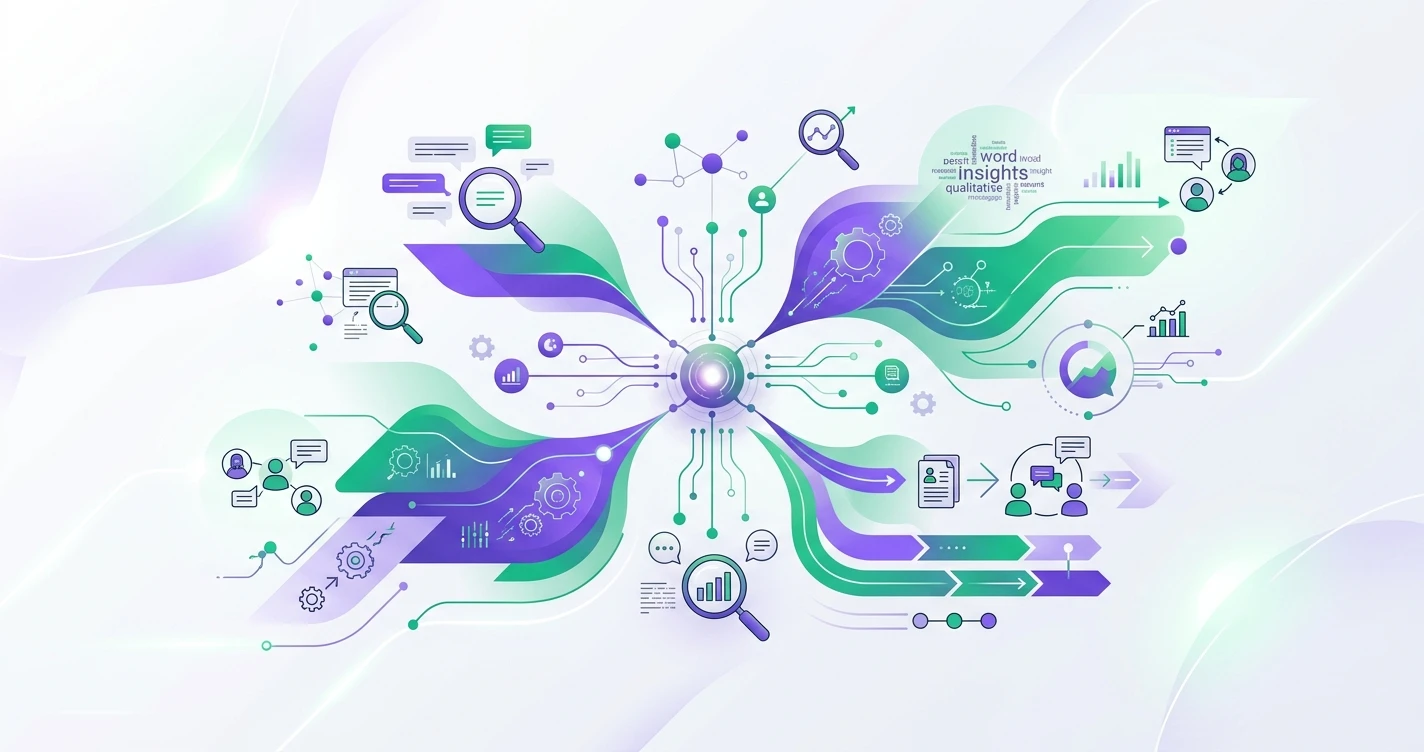
Orchestration layer. The brain of the system. Takes a high-level research objective and decomposes it into executable sub-tasks, managing dependencies, sequencing, and error handling. This is where the "planning" capability lives.
Specialized agents. Individual agents with focused capabilities — recruitment, scheduling, analysis, synthesis, reporting. Each is optimized for its domain and can operate independently or in coordination.
Memory systems. Agentic systems require both short-term memory (current study context) and long-term memory (organizational knowledge, past findings, codebook evolution). Without memory, each agent interaction starts from zero — useful for one-off tasks but inadequate for research programs.
Guardrails and constraints. Researcher-defined boundaries that limit agent autonomy. These might include: maximum participant count, approved recruitment channels, ethical review criteria, required human checkpoints before findings are shared externally. The guardrails are what make agentic systems trustworthy rather than unpredictable.
Feedback loops. Mechanisms for the system to learn from researcher corrections. When a researcher rejects an agent's coding decision or overrides a recruitment choice, that feedback improves future agent decisions. This creates systems that become more aligned with researcher judgment over time.
Why 2026 Is the Inflection Point
Three convergent factors make 2026 the year agentic research workflows become practical:
Context windows expanded dramatically. Current models can hold entire research programs in context — multiple transcripts, full codebooks, study histories. This eliminates the fragmentation that made previous AI tools feel disconnected from the broader research context.
Tool-use capabilities matured. Models can now reliably interact with external systems — scheduling tools, email platforms, databases, recruitment panels. The failure rate for tool-calling dropped below 2% in production systems, making autonomous multi-step workflows reliable enough for professional use.
Cost economics shifted. Running an agentic workflow that processes ten transcripts through multi-pass analysis costs less than one hour of a senior researcher's time. The economics now favor using AI agents for operational work and reserving human expertise for interpretation, stakeholder engagement, and strategic decision-making.
This is not unlike the shift described in the double diamond is dead — established process frameworks are being rebuilt around AI capabilities rather than human labor constraints.
The Researcher's Evolving Role
Agentic AI does not eliminate the need for qualitative researchers. It eliminates the need for qualitative researchers to spend 70% of their time on operational work.
The role shifts toward:
Architecture. Designing research programs, defining agent parameters, establishing quality criteria. The researcher becomes the architect who designs the system rather than the laborer who executes within it.
Interpretation. AI agents can identify patterns. They cannot determine what those patterns mean for a specific business context, strategic decision, or human experience. Interpretation remains irreducibly human — and becomes more valued as operational work is automated away.
Stakeholder translation. Converting research findings into organizational action requires understanding political dynamics, timing, framing, and audience. No agent handles this.
Ethical oversight. Ensuring research respects participant dignity, maintains consent standards, and produces findings that serve rather than exploit. This requires moral judgment that agents cannot provide.
Quality calibration. Continuously evaluating whether agent outputs meet the standard required for specific decisions. High-stakes decisions need human-verified analysis. Exploratory work can tolerate agent-level analysis. The researcher decides where on this spectrum each project falls.
Risks and Honest Limitations
Adopting agentic research workflows carries real risks that practitioners must acknowledge:
Black box analysis. When an agent produces a codebook or identifies patterns, the reasoning is not always transparent. Researchers must build verification practices — not trusting agent outputs without understanding the logic.
Homogenization of method. If everyone uses similar agentic systems, research approaches may converge toward what AI handles well rather than what the research question demands. Preserving methodological diversity requires intentional resistance to convenience.
Deskilling. Researchers who never manually code transcripts may never develop the analytical intuition that distinguishes competent from exceptional qualitative work. Training programs must balance efficiency with skill development.
Participant awareness. As participants learn that AI agents are processing their data, screening their responses, and potentially conducting their interviews, trust dynamics shift. The consent paradox intensifies when participants cannot know the full scope of autonomous processing their data undergoes.
Getting Started Without Getting Lost
For research teams considering agentic workflows:
Start with recruitment operations. This is the workflow with the clearest ROI, the most standardized processes, and the lowest risk of analytical error. Let an agent manage your recruitment pipeline while you retain full control over data collection and analysis.
Define explicit guardrails before deploying. What decisions can the agent make autonomously? What requires human approval? Where are the hard stops? Document these before launch, not after an incident.
Maintain parallel human processes initially. Run agentic workflows alongside manual processes for the first three months. Compare outputs. Calibrate. Build trust based on evidence rather than marketing claims.
Invest in evaluation infrastructure. You need mechanisms to assess agent quality over time. Track coding accuracy, recruitment quality scores, false positive rates for compliance flags. Without measurement, you cannot know if your agents are helping or harming.
Platforms like Qualz.ai are building these agentic capabilities into research workflows — not as experimental features but as production-ready systems designed for professional qualitative research. The autonomous research future is not three years away. It is deployable today for teams ready to work differently.
The Competitive Reality
Organizations that adopt agentic research workflows will produce insights faster, at lower cost, with greater consistency than those relying solely on manual processes. This is not a prediction — it is arithmetic. When your competitor's research team can run three concurrent studies with the same headcount that limits you to one, the strategic disadvantage compounds rapidly.
The question for research leaders is not whether to adopt agentic approaches but how quickly they can do so responsibly. Speed without rigor produces faster garbage. But rigor without speed produces irrelevant insights that arrive after decisions are already made.
The winning approach is the same one that has always defined excellent research: methodological rigor applied with pragmatic efficiency. Agentic AI simply shifts the efficiency frontier — making it possible to be both rigorous and fast in ways that were previously contradictory.
Ready to explore how agentic AI can transform your research operations? Book an information session to see how Qualz.ai is building autonomous research workflows for professional teams.