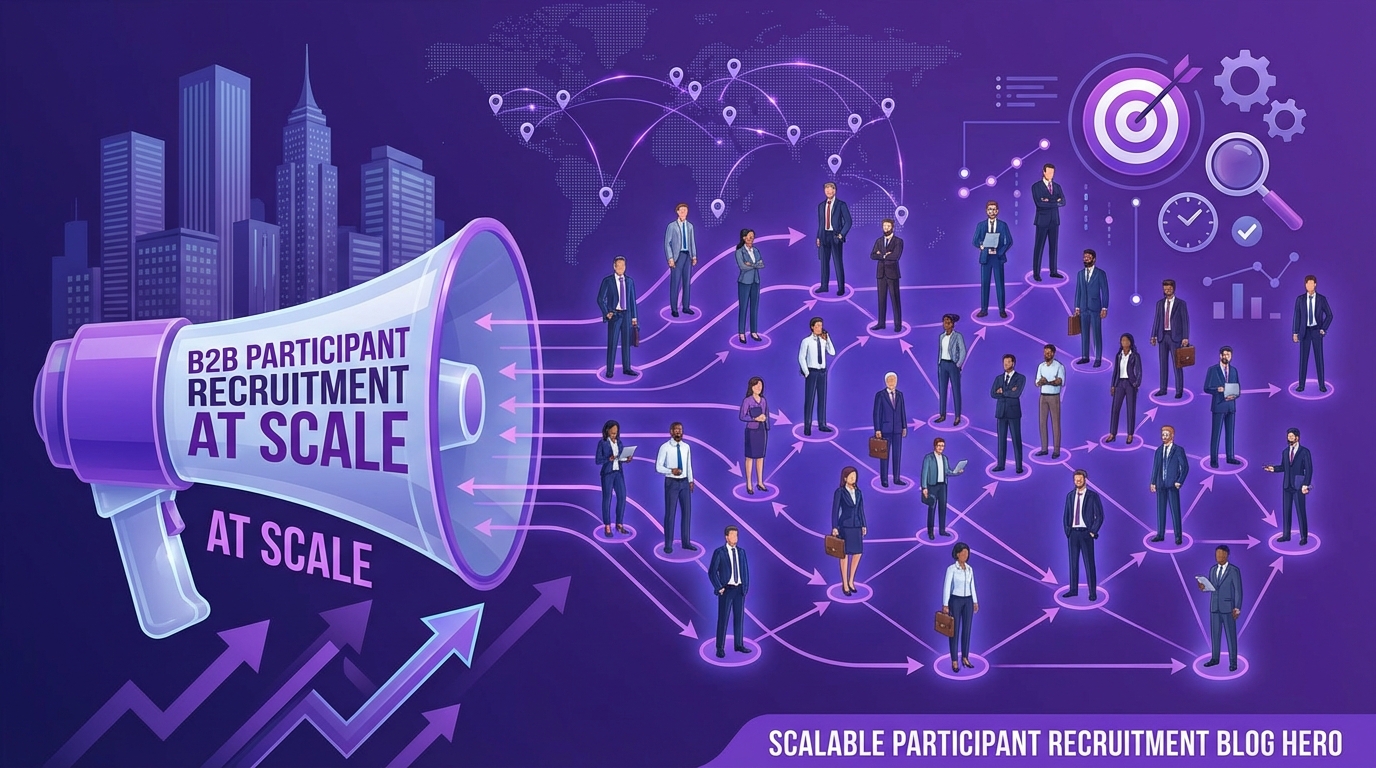
Consumer research has recruitment panels with millions of participants. Need 500 responses from US adults 25-45? Done in a day.
B2B research is different. Need 20 interviews with VP-level decision-makers at enterprise software companies? That might take months.
The asymmetry is dramatic, and it's the primary constraint on B2B qualitative research. Here's how to approach B2B recruitment strategically.
Why B2B Recruitment Is Hard
Several factors make business professionals harder to recruit:
Scarcity
There are far fewer VP-level enterprise software decision-makers than there are general consumers. Your target population might be thousands, not millions.
Time Constraints
Business professionals are busy. An hour-long interview is a significant commitment they're unlikely to make without compelling reason.
Gatekeeping
Many professionals have assistants managing their calendars, spam filters blocking outreach, and organizational policies limiting research participation.
Incentive Immunity
A $50 gift card that motivates consumer participation barely registers for a well-compensated professional. Money alone won't secure participation.
Professional Stakes
Business professionals are more cautious about sharing competitive information, even in research contexts.
Recruitment Channel Strategies
LinkedIn: The Primary Channel
LinkedIn remains the most effective channel for B2B recruitment, but approach matters:
Profile-based targeting
Use Sales Navigator or Recruiter to identify professionals matching your criteria. Look beyond title to verify:
- Current role (not just past experience)
- Company characteristics (size, industry, stage)
- Activity level (inactive profiles rarely respond)
Personalized outreach
Generic messages fail. Reference:
- Specific work they've done
- Mutual connections
- Content they've published
- Company news relevant to research topic
Value proposition clarity
Your message must answer "why should I spend time on this?" within seconds. Lead with what they'll gain, not what you need.
Example effective outreach:
"Hi [Name], I noticed your recent post about [topic]. We're researching how [their role] at [company type] are approaching [challenge]. Given your experience with [specific thing], your perspective would be valuable. It's a 30-minute conversation, and we'll share our findings afterward. Worth a brief chat?"
Customer Referrals
If you're researching for a company, that company's customers and prospects are potential participants:
Customer success introduction
Customer success managers have relationships with stakeholders at client companies. A warm introduction converts better than cold outreach.
Advisory board leverage
Companies with customer advisory boards have built-in research participants who've already agreed to ongoing engagement.
Win/loss follow-up
Recent sales wins and losses often involve decision-makers willing to discuss their evaluation process.
Industry Events and Communities
Where your target professionals gather:
Conference attendee lists
Event organizers sometimes share attendee information with sponsors or speakers. Timing outreach around events increases relevance.
Professional associations
Industry associations often facilitate research member participation in research, especially for academic or nonprofit research.
Online communities
Slack communities, Reddit groups, and industry forums contain engaged professionals discussing relevant topics.
Recruitment Panels with B2B Segments
General panels struggle with B2B, but specialized panels focus on business audiences:
Enterprise-focused panels
Some panels specifically recruit and verify business decision-makers. Expect higher costs but faster recruitment.
Industry-specific panels
Healthcare, financial services, and technology have dedicated research panels for professional participants.
Professional panel verification
Ensure panels verify participant credentials, not just self-reported titles. "VP of Marketing" on a general panel may be a small business owner who inflated their title.
Incentive Strategies
Traditional incentives often fail for B2B. Consider alternatives:
Insight Sharing
Professionals value insights relevant to their work. Offer:
- Summary of research findings
- Benchmarking data (how they compare to peers)
- Early access to reports or publications
Donation to Charity
Some professionals prefer charitable donations to personal payment:
- Offer donation to charity of their choice
- Match donations as additional incentive
- Appeals to professionals who can't accept personal gifts
Professional Development
- LinkedIn Learning subscriptions
- Conference registration discounts
- Book purchases
- Course access
Appropriate Cash Incentives
When cash is appropriate, calibrate to professional level:
- Individual contributors: $100-150/hour
- Managers: $150-250/hour
- Directors/VPs: $250-400/hour
- C-suite: $400-750/hour (or insight-based incentives)
These are guidelines—adjust for industry, company size, and research demands.
Scheduling Considerations
B2B participants have constrained schedules. Accommodate them:
Flexible Timing
- Early morning (before official workday)
- Lunch periods
- Late afternoon
- Weekends (some executives prefer)
Time Zone Sensitivity
Enterprise research often spans geographies. Coordinate carefully across time zones.
Calendar Integration
Send proper calendar invitations with video links. Don't make participants search through emails for connection details.
Buffer Time
Executives' previous meetings run over. Build 5-10 minute buffers into scheduling.
Cancellation Grace
Accept that business priorities will cause cancellations. Make rescheduling easy, not guilt-inducing.
AI-Assisted B2B Research
AI-moderated interviews particularly benefit B2B research by addressing key constraints:
Asynchronous Participation
Busy professionals can participate when convenient—early morning, late night, weekends—rather than coordinating live schedules.
Shorter Time Commitment
AI interviews can be completed in 15-20 minutes rather than the 45-60 minutes typical of live interviews.
Reduced Scheduling Friction
No back-and-forth to find mutual availability. Send the link; they complete it when ready.
Scale Without Proportional Effort
Recruiting and interviewing 50 B2B professionals live might take months. AI-assisted approaches can compress that significantly.
Recruitment Operations
Tracking and CRM
Treat recruitment like sales. Use CRM or spreadsheets to track:
- Outreach attempts
- Response rates by channel
- Conversion to scheduled
- Completion rates
- Participant demographics
Screening Efficiency
Don't spend recruitment effort on unqualified participants. Screen efficiently:
- LinkedIn profile review before outreach
- Short screener survey before scheduling
- Clear qualification criteria shared upfront
Relationship Building
B2B recruitment gets easier with relationships. Build ongoing panels:
- Keep in touch with past participants
- Create "research community" for willing ongoing participants
- Share findings to maintain engagement
Documentation
Track what works and doesn't:
- Which outreach messages perform best
- Which channels yield highest-quality participants
- What incentives drive participation
- Time-of-year patterns (vacation seasons, fiscal year timing)
Getting Started
If you're struggling with B2B recruitment:
- Narrow your criteria initially. "VP of Marketing at enterprise software companies" is easier than "VP of Marketing at Series B-C enterprise software companies in regulated industries."
- Start with warm connections. Exhaust referrals and introductions before cold outreach.
- Test AI-assisted approaches for asynchronous, lower-commitment participation options.
- Build for the long term. Each project is an opportunity to build relationships for future research.
- Consider professional recruitment help for high-stakes or high-volume projects. Specialized B2B recruiters exist for a reason.
Need to scale B2B research without scaling recruitment headaches? Explore Qualz.ai's recruitment solutions or request a demo to discuss your specific needs.