The Invisible Confirmation Machine in Your Interview Practice
Every researcher believes they probe consistently. Every researcher is wrong. Analysis of hundreds of moderated sessions reveals a persistent pattern: when participants say something that aligns with the researcher's existing mental model, follow-up questions multiply. When participants say something unexpected or contradictory, the researcher unconsciously moves on.
This is not deliberate bias. It is a cognitive efficiency mechanism. Your brain processes expected information more fluently, generating natural follow-up questions without effort. Unexpected information requires cognitive reorientation — and in the real-time pressure of an interview, that reorientation often does not happen before the conversation moves forward.
The result is transcripts where confirming themes have rich, multi-layered evidence (because you probed deeply) while disconfirming themes have thin, surface-level mentions (because you did not). When you later code these transcripts, the asymmetry looks like data strength rather than interviewer bias.
How Asymmetric Probing Manifests in Practice
The pattern operates at the micro-level of individual exchanges. Consider a study exploring why users abandon a checkout flow:
Confirming answer (researcher expects complexity is the issue):
Participant: "The form had too many fields."
Researcher: "Which fields specifically? How many is too many? At what point did you decide to leave? Had you encountered this before? What would fewer fields look like to you?"
Five follow-up probes. Rich, detailed data about form complexity.
Disconfirming answer (researcher does not expect trust as the issue):
Participant: "I did not recognize the payment processor."
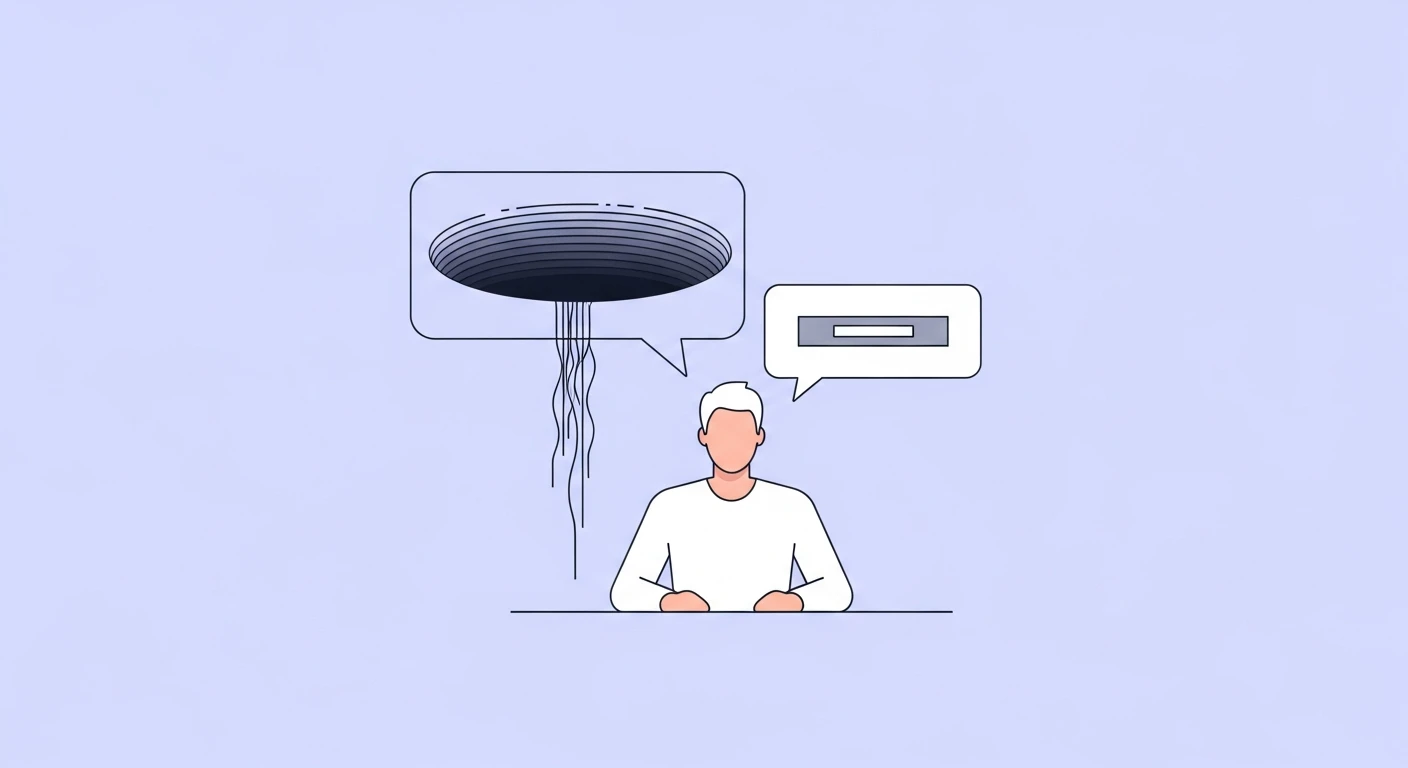
Researcher: "Interesting. So, going back to the form layout..."
Zero follow-up probes. A potentially critical insight about trust and payment security goes unexplored.
The researcher did not consciously dismiss the trust signal. But their mental model of "checkout abandonment = complexity" created a gravitational pull back toward expected territory. The articulation gap between what users experience and what researchers explore widens when probing patterns reinforce prior assumptions.
The Compounding Effect Across a Study
Asymmetric probing does not just affect individual interviews — it compounds across an entire study. By the third or fourth session, the researcher has heard confirming evidence explored in depth multiple times. This repetition strengthens the mental model further, making it even harder to generate spontaneous follow-up questions when disconfirming evidence appears.
The anchoring cascade in multi-study programs demonstrates how early findings bias subsequent research questions. Asymmetric probing is the mechanism through which this anchoring operates at the session level. Each interview reinforces the confirmation pattern from the previous one.
By study completion, the codebook reflects this asymmetry. Confirming themes have dense, multi-dimensional codes with rich exemplars. Disconfirming themes — if they survive at all — have thin codes with single-mention evidence that looks like outlier noise rather than systematic signal.
Why Training Alone Does Not Fix This
Researcher training programs typically address probing consistency in the abstract: "Probe all responses equally." This advice fails because asymmetric probing is not a knowledge problem — it is a cognitive load problem.
During a live interview, the researcher is simultaneously managing rapport, tracking the interview guide, monitoring time, formulating the next question, and processing the participant's response. When a response aligns with expectations, follow-up questions emerge automatically from the researcher's existing knowledge structure. When a response contradicts expectations, generating follow-ups requires active cognitive effort — effort that competes with all the other demands of live moderation.
The probing techniques that expert interviewers use include deliberate strategies for unexpected responses. But expertise does not eliminate the asymmetry; it merely reduces it. Even experienced researchers show measurable probing differentials between expected and unexpected responses.
Structural Countermeasures That Actually Work
The most effective countermeasures are structural rather than attentional:
Surprise-first probing protocols: Design interview guides with explicit instructions to probe unexpected responses with at least three follow-ups before moving on. Make the surprising response the trigger for deeper exploration, not the expected one.
Real-time probing audits: Have a second team member monitor the session specifically for probing asymmetry. Their only job is to flag moments where an unexpected response received fewer follow-ups than an expected one.
Post-session probe counts: After each interview, count the number of follow-up questions asked for each major theme. If confirming themes consistently receive more probes, adjust your approach for subsequent sessions.
Assumption reversal exercises: Before each session, explicitly state what you expect to hear and commit to treating those responses with skepticism while treating unexpected responses with curiosity.
AI-assisted probe detection: Tools that analyze interviewer behavior patterns can flag asymmetric probing in real-time, as explored in how AI is reshaping qualitative analysis by making previously invisible researcher behaviors visible and measurable.
The Organizational Dimension
Asymmetric probing becomes an organizational problem when research findings consistently confirm what stakeholders already believe. Product teams stop trusting research because it "never tells them anything new" — not realizing that the interview methodology is structurally biased toward confirming existing beliefs.
This creates a feedback loop: stakeholders provide research briefs that encode their assumptions. Researchers unconsciously probe in directions that confirm those assumptions. Findings validate the original brief. Stakeholders conclude that research merely confirms the obvious.
Breaking this cycle requires what amounts to negative case analysis applied to the interview process itself — deliberately seeking and deeply exploring the responses that challenge your emerging narrative rather than the ones that support it.
Measuring Your Own Asymmetry
The simplest diagnostic: record your next five interviews, then count follow-up probes per response. Categorize each participant response as "expected" or "unexpected" based on your pre-session assumptions. Calculate the average probe count for each category.
If expected responses receive 2-3x more probes than unexpected ones — and they almost certainly will — you have quantified the size of your asymmetric probing problem. The gap between those numbers is the gap between what you are learning and what you could be learning.
The goal is not zero asymmetry. Some differential is inevitable given how human cognition works. The goal is awareness and structural correction — building interview practices that compensate for the cognitive tendency rather than pretending it does not exist.
As organizations adopt AI-powered research tools, understanding the governance frameworks that ensure AI systems remain accountable becomes critical — because AI tools can either amplify human probing biases by learning from asymmetric transcripts, or help correct them by flagging the pattern in real-time.