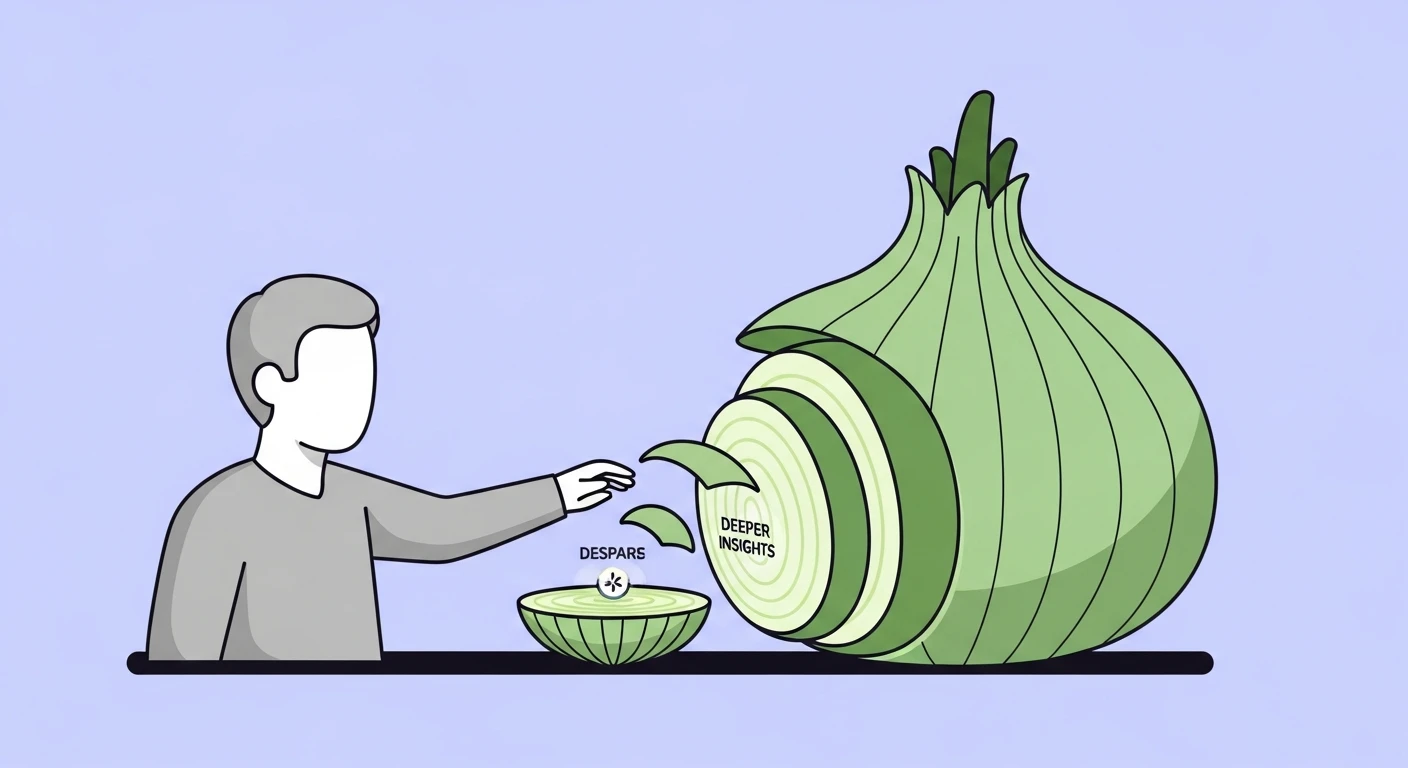
Why Probing Separates Novice From Expert Interviewers
Every researcher has experienced the gap between what their interview guide promises and what the transcript actually delivers. The guide contains thoughtful, well-structured questions. The transcript contains shallow responses, missed opportunities, and moments where depth was available but never accessed.
The missing ingredient is almost always probing technique. Primary questions open doors. Probes walk through them. Without deliberate, skilled probing, interviews remain at the surface level regardless of how sophisticated the guide design is.
The challenge with probing is that it cannot be fully scripted. Effective probes respond to what the participant actually says — they require active listening, pattern recognition, and the judgment to know when a response contains unexplored depth. This makes probing the hardest interviewing skill to teach and the most impactful to master.
The Taxonomy of Probing Techniques
Research methodology literature identifies several distinct probe types, each serving a different analytical purpose:
Elaboration Probes
These invite the participant to expand on what they have already said. They signal that the initial response was valuable but incomplete.
- "Tell me more about that."
- "What happened next?"
- "Can you walk me through that in more detail?"
Elaboration probes work best when the participant has offered a promising thread but stopped short of the specificity you need. They are low-risk — participants rarely resist being asked to continue talking about something they voluntarily raised.
Clarification Probes
These address ambiguity in the participant's response. They ensure you understand what was actually meant rather than projecting your interpretation.
- "When you say 'difficult,' what specifically do you mean?"
- "You mentioned 'the team' — which team are you referring to?"
- "Can you give me an example of what that looks like?"
Clarification probes are essential because participants often use vague language that feels meaningful in the moment but becomes uninterpretable in analysis. The discipline of detecting where contradictions signal deeper truths often begins with clarification probes that reveal the participant meant something different than you assumed.
Contrast Probes
These ask participants to distinguish between related concepts or compare experiences, which surfaces the dimensions they use to evaluate their world.
- "How was that different from the previous time?"
- "What makes that worse than the alternative?"
- "If you compare this tool to what you used before, what stands out?"
Contrast probes are particularly powerful because they force participants to articulate their evaluation criteria. When someone says a product is "better," a contrast probe reveals whether "better" means faster, more reliable, less stressful, or something else entirely.
Reflective Probes
These mirror the participant's language back to them, often with a subtle reframe that invites deeper reflection.
- "You described that as 'frustrating.' What makes it frustrating rather than just annoying?"
- "You said you 'gave up.' At what point did you decide to stop trying?"
- "You mentioned feeling 'stuck.' What would un-stuck look like?"
Reflective probes work because they validate the participant's experience while gently pushing toward greater precision. They are the foundation of what practitioners call the silence technique in user interviews — creating space for participants to think more deeply about what they actually mean.
Structural Probes
These ask participants to organize their experience in ways that reveal underlying mental models.
- "If you had to rank those three factors, which matters most?"
- "Walk me through the steps in order."
- "Who else is involved in that decision?"
Structural probes are particularly valuable for understanding how mental models shape user behavior and decision processes. They move beyond what happened to how the participant conceptualizes the experience.
The Three-Level Depth Model
Expert interviewers operate with an internal model of response depth:
Level 1: What happened. The participant describes events, actions, behaviors. This is the surface layer that most interviews capture adequately.
Level 2: What it meant. The participant explains their interpretation, emotional response, or evaluation of what happened. This requires at least one probe beyond the initial response.
Level 3: Why it matters. The participant reveals values, priorities, identity connections, or systemic implications. This level is where genuine insights live — and it almost never emerges without deliberate, skilled probing.
Most qualitative interviews remain at Level 1 with occasional dips into Level 2. Expert interviewers consistently reach Level 3 because they probe systematically until they hear responses that reflect values rather than just descriptions.
Probing Failures: The Anti-Patterns
Several common probing mistakes actively reduce data quality:
Leading probes that contain the answer: "Was that because the interface was confusing?" This gives participants an easy out and contaminates their response with your hypothesis.
Compound probes that ask multiple things simultaneously: "Was that frustrating, and if so, what did you do about it?" This creates the same data quality destruction as compound primary questions — the participant answers whichever part is easiest.
Premature probes that interrupt a participant mid-thought. The instinct to probe immediately when you hear something interesting often cuts off richer material that would have emerged if you simply waited.
Formulaic probes that sound rehearsed: asking "Tell me more" twelve times in a session signals that you are following a script rather than genuinely engaging. Vary your probe language to match the conversational tone.
Building a Probing Practice
Probing skill develops through deliberate practice, not just interview experience. Here's a development framework:
Transcript review with probe mapping. After each interview, review the transcript and mark every point where you could have probed deeper but did not. Identify what probe type would have been appropriate. This builds recognition of missed opportunities.
Probe planning by response type. Before interviews, anticipate likely response patterns and pre-plan probe pathways. If a participant says "it was fine," what are your three options for going deeper? Having these ready prevents the blank-mind moment that leads to moving on too quickly.
Partner practice with feedback. Conduct practice interviews where an observer focuses exclusively on probing quality. The observer tracks depth level reached, probe variety, and missed opportunities. This external perspective reveals habits you cannot see yourself.
The principles of reflexive note-taking apply directly here — documenting your probing decisions during interviews creates material for later reflection and improvement.
How AI Changes the Probing Equation
AI-assisted interview platforms introduce new possibilities for probing that human interviewers cannot replicate:
Real-time depth detection. AI can monitor response specificity in real-time and flag when responses remain at Level 1, prompting the interviewer (or the AI moderator) to probe deeper.
Pattern-matched probes. Across hundreds of interviews, AI identifies which probe types yield the deepest responses for specific topics and participant types. This creates an evidence base for probe selection that individual researchers build only through years of experience.
Consistency tracking. AI tracks what a participant said earlier in the interview and identifies contradictions or gaps in real-time — surfacing probe opportunities that human working memory would miss.
These capabilities enhance rather than replace human probing skill. The insights from how AI adaptive interviews maintain engagement suggest that the highest-quality data comes from human-AI collaboration in the probing process, not from either alone.
As the broader shift toward AI-native research operating models accelerates, probing technique remains one area where human judgment and AI assistance combine to produce outcomes neither could achieve independently.
The ROI of Better Probing
Teams that invest in probing skill development consistently report:
- Fewer interviews needed to reach analytical saturation (because each interview produces deeper data)
- Stronger evidence for product decisions (because insights are grounded in values and motivations, not just behaviors)
- Higher stakeholder confidence in research findings (because quotes and evidence carry more weight when they reach Level 3 depth)
- Reduced synthesis time (because deep, specific data requires less interpretive work than shallow, ambiguous data)
The compound effect is significant: better probing makes every interview more valuable, which means smaller sample sizes deliver equal or greater insight density. In an era of research operations optimization and tool sprawl management, probing skill is the highest-leverage investment a team can make — because it multiplies the value of everything else in the research stack.