The Sort That Confirmed What You Already Believed
A product team runs an open card sort to redesign a bloated navigation menu. Forty-two content items, thirty participants, a clean tool. The results come back beautifully clean: participants converged on six categories that map almost perfectly onto the team's proposed structure. Everyone exhales. The IA gets shipped. Three months later, support tickets for "I cannot find X" are up, not down.
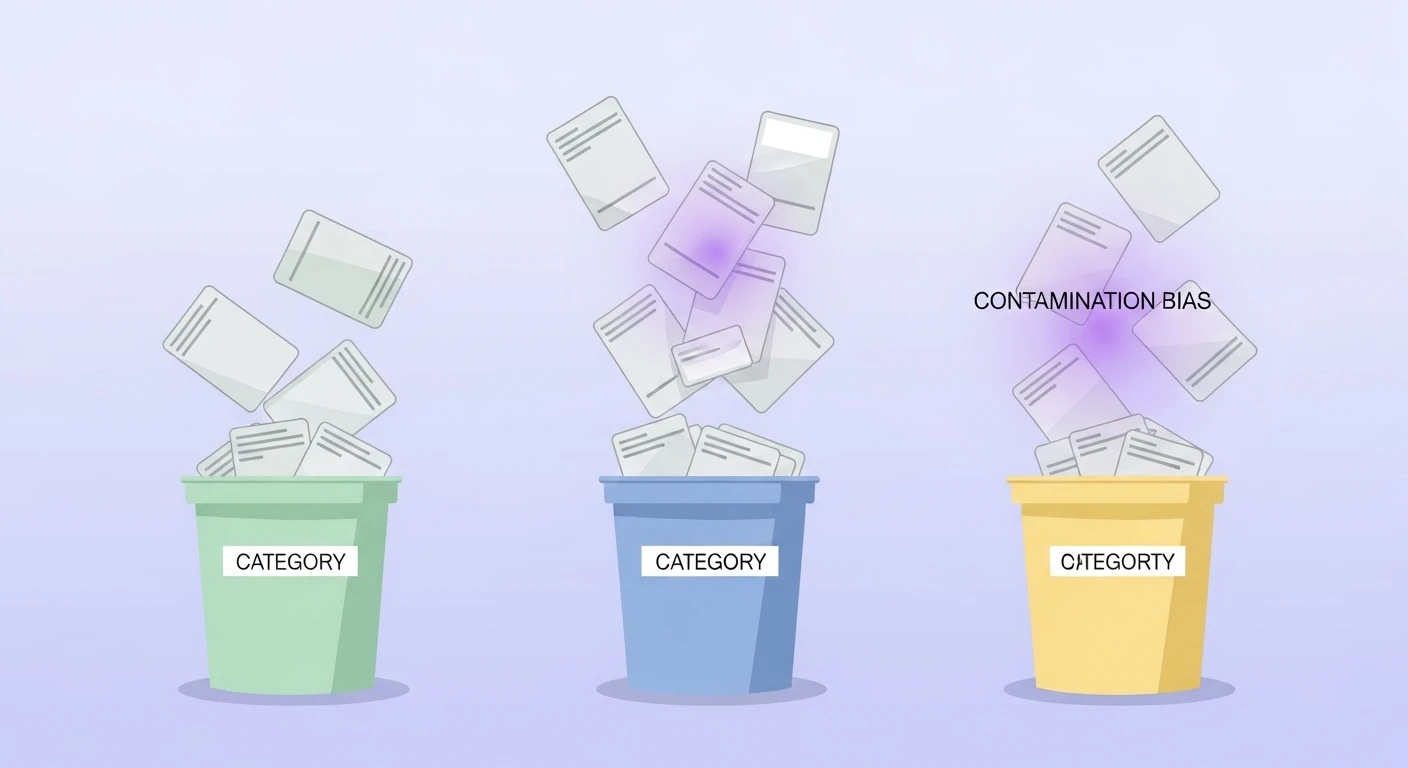
What happened is one of the most common and least discussed failures in information architecture research: the sort was contaminated before it began. The team had pre-seeded the exercise with suggested category names "to help participants get started." Participants did not reveal their mental model -- they sorted cards into the buckets the team handed them. The convergence was not discovery. It was compliance dressed as insight.
What an Open Card Sort Is Actually Supposed to Measure
The entire value of an open card sort is that participants create their own categories. You hand them a stack of unlabeled items and they group and name the groups however makes sense to them. The output is a window into how users structure the domain in their own heads -- which things belong together, what they call the clusters, where the boundaries fall.
The instant you provide categories, you have converted an open sort into a closed one without admitting it. Closed sorts are legitimate for validation, but they answer a completely different question: "can users fit items into these predefined buckets?" not "how would users organize this at all?" Confusing the two is the root of most card sort contamination, and it is a close cousin of the assumption smuggling problem, where leading questions hide inside neutral-sounding wording. A pre-labeled bucket is a leading question with a drag-and-drop interface.
The Three Vectors of Category Contamination
1. Explicit starter categories
The most obvious form: the tool or facilitator provides named groups "as examples." Participants anchor hard on whatever they see first. Even labeling starter categories as optional does not help -- their mere presence establishes the frame, and the effort of inventing a competing structure feels like defying the researcher. This is the vocabulary mirroring effect operating at the level of structure rather than words: adopting the researcher's categories traps participants in a framing that was never theirs.
2. Ordering and grouping of the cards themselves
More subtle: how you present the cards leaks structure. If related items appear adjacent in the initial stack, participants perceive an implied grouping and preserve it. Cards should be randomized per participant. A fixed order is a form of priming contamination -- the sequence itself suggests the answer before the participant has formed one.
3. The facilitator's live reactions
In moderated sorts, the facilitator's micro-responses -- a nod when a "sensible" group forms, a pause when an unexpected one does -- steer participants toward the expected structure. This is the asymmetric probing problem in a spatial task: researchers unconsciously reinforce the groupings they anticipated and let the surprising ones drift.
Why Contaminated Sorts Are Worse Than No Sort
A team that skips card sorting knows it is guessing. A team that runs a contaminated sort believes it has evidence. The false confidence is the damage. You ship an IA blessed by "research" that merely reflected your own starting assumptions back at you -- a closed loop that feels like validation but is really an echo. The card sort becomes theater: an activity performed to justify a decision already made, not to inform one still open.
The production failure mode is predictable. The structure tests clean in the artificial sort and collapses in the wild, because real users navigating a real product carry their own model, not the one you seeded. The gap between the two is exactly the insight the contaminated sort was supposed to surface -- and destroyed.
How to Run a Sort That Actually Surfaces the Mental Model
- Start truly open. No starter categories, no examples, no suggested count. "Group these however makes sense to you, and name each group." Tolerate the messiness -- messy output is real output.
- Randomize card order per participant. Kill the implied adjacency structure.
- Separate generation from validation. Run the open sort first to discover categories, then a closed sort in a later round to validate the structure you derived. Do not collapse both into one contaminated exercise.
- Watch for premature convergence. If every participant produces near-identical groups, treat it as a contamination alarm, not a success signal. Real mental models vary; suspicious uniformity usually means you leaked the answer.
- Probe the boundaries, not the centers. The interesting data lives in the items participants hesitated over or placed differently from everyone else -- the same reason negative case analysis matters more than the comfortable consensus.
Where This Connects to Building Systems
Card sort contamination is a specific instance of a general engineering truth: the structure you impose on inputs shapes the outputs you get back, whether the system is a research participant or a production model. Teams building AI-driven information systems hit the same wall when they let their assumed taxonomy dictate how data is grouped before the data has spoken -- which is why disciplined data contracts for AI pipelines insist on making the schema an explicit, negotiated agreement rather than an unexamined default. The same rigor that keeps a card sort honest -- separating what you assume from what you observe -- is what keeps an AI system's audit trails and explainability trustworthy: in both cases, you have to be able to show that the structure came from the evidence, not from the frame you smuggled in.
The Bottom Line
An open card sort is only as valuable as its emptiness at the start. The blank stack is the instrument. The moment you fill it with your categories, your ordering, or your reactions, you stop measuring the user's mind and start measuring their deference. Run the sort open, tolerate the mess, and treat clean convergence as a warning rather than a win. The mental model you are trying to find only shows up when you stop handing participants yours.
Ready to run card sorts and IA research that surface real mental models instead of your own assumptions? See how Qualz.ai helps teams design uncontaminated research or book a demo to see it in action.