The Method That Requires a Room
Contextual inquiry has always been UX research's most powerful and least practical method. You go to where the work happens. You watch someone do their actual job, in their actual environment, with their actual tools. You ask questions as they work. You build an understanding of the context that shapes behavior -- the sticky notes on the monitor, the workaround spreadsheet pinned to the taskbar, the colleague they shout questions to across the cubicle.
The method was formalized by Beyer and Holtzblatt in the 1990s when work happened in offices. The researcher's job was physical: fly to the site, badge in, sit beside the participant, observe for two to four hours, take notes, fly home. The logistics were expensive but the premise was simple -- context is where behavior makes sense.
Then remote work happened. Not as a temporary pandemic adjustment, but as a permanent restructuring of how knowledge work gets done. The 2024 data is unambiguous: roughly 30% of US knowledge workers are fully remote, another 30% are hybrid. The physical office where contextual inquiry was designed to happen is, for a large portion of the workforce, optional at best.
This creates a genuine methodological crisis. You cannot observe someone's physical workspace if they work from a kitchen table in Portland on Monday and a coffee shop in Seattle on Tuesday. You cannot see the sticky notes if the sticky notes are digital. You cannot hear the shouted question to a colleague if communication happens in Slack threads you do not have access to.
The question is not whether contextual inquiry is still relevant -- it is. The question is how to preserve its core value in an environment it was never designed for.
What You Actually Lose in Remote Observation
Before adapting the method, you need to be honest about what remote observation sacrifices. Not everything transfers.
The biggest loss is environmental context. In a physical contextual inquiry, the researcher absorbs information passively -- the cluttered desk, the dual monitor setup with twelve browser tabs open, the printed reference guide propped against the keyboard, the lighting, the noise level, the interruptions from colleagues walking by. This ambient data shapes interpretation of everything the participant says and does.
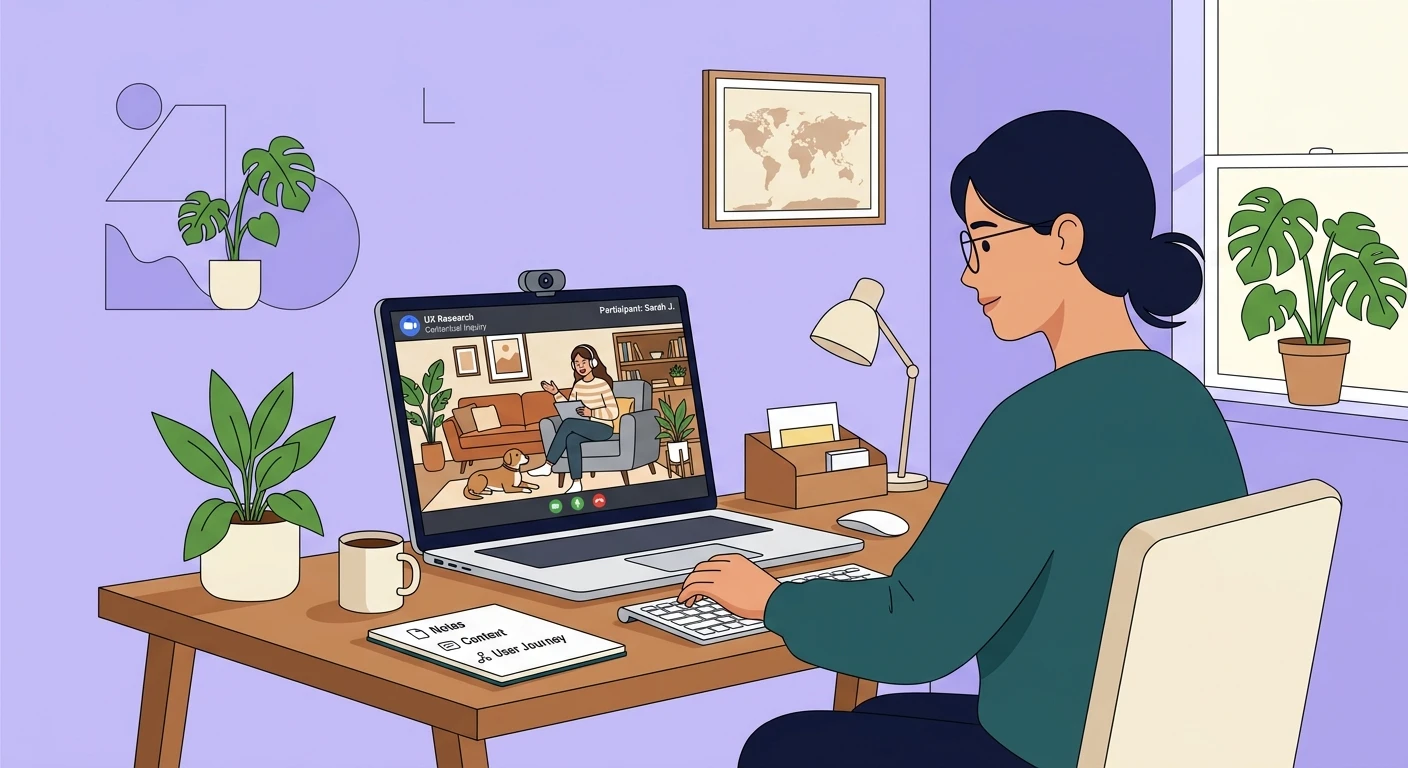
Remote observation through screen sharing gives you the digital workspace but strips the physical one. You see the application windows but not the posture, not the environment, not the physical artifacts. Some researchers compensate by asking participants to show their physical setup via webcam, but this is performative -- people tidy up when the camera turns on. The natural environment observation that makes contextual inquiry distinctive is fundamentally compromised.
The second loss is interruptibility. In physical contextual inquiry, you can observe what interrupts the participant's workflow -- a phone call, a colleague's question, a notification on another screen, a trip to the printer. These interruptions reveal workflow dependencies and pain points that participants never think to mention because they are so routine they become invisible. In remote observation, you only see interruptions that happen on the shared screen. The Slack ping they glance at on their phone, the doorbell, the child asking a question -- these happen off-camera and break the observational model.
The third loss is rapport quality. Sitting beside someone for two hours while they work builds a different kind of relationship than watching their screen through Zoom. Physical presence creates a shared experience. Remote observation, no matter how well facilitated, maintains a distance that affects the depth of in-the-moment questioning -- the kind of probing that reveals what standard interviews miss.
The Remote Contextual Inquiry Framework
Accepting these losses does not mean abandoning the method. It means redesigning it for the environment that actually exists. Here is what works.
Pre-session environment mapping. Before the observation session, ask participants to document their work environment. Not a staged photo -- a diary study approach where they photograph their workspace at three random points during the day before the session. These photos capture the natural state: the second monitor borrowed from the living room, the standing desk that is actually a kitchen counter with a box under the laptop, the headphones used to block out household noise. This is not as good as being there, but it provides environmental context that screen sharing alone cannot.
Multi-channel observation. Do not limit observation to screen sharing. Ask participants to keep their webcam on (with clear consent and the option to decline) so you can observe physical behavior -- leaning back in frustration, reaching for a phone, looking away from the screen to think. If the participant consents, ask them to share their notification panel or second screen for short segments to see what competes for their attention during the task.
Extended asynchronous capture. Physical contextual inquiry is bounded by the researcher's presence -- typically two to four hours. Remote observation can extend the window through asynchronous tools. Ask participants to record themselves working on specific tasks over several days using screen recording with audio narration. This captures natural workflow variations that a single observation session misses. A participant who is organized and focused during your live session might be scattered and interrupted on a typical Tuesday -- the recording catches the reality.
Tool archaeology. In a physical office, the researcher can see the tools. Remotely, you need to ask. But do not ask "what tools do you use" -- that produces a sanitized list. Instead, during the observation, ask participants to open their browser history, their recent files, their most-used applications. The browser history reveals the workarounds. The recently closed tabs reveal the abandoned attempts. This is digital equivalent of the sticky-note-covered monitor, and it often surfaces the kind of workflow friction that participants never voluntarily report.
Distributed team communication observation. For distributed teams, a huge portion of contextual behavior happens in communication tools. If the organization permits it, request view-only access to relevant Slack channels, project boards, or shared documents for the duration of the study. Watching how a participant interacts with their team asynchronously -- how long messages sit before responses, which channels get ignored, where miscommunications happen -- provides the contextual richness that replaces the physical-proximity observations of traditional contextual inquiry.
The AI-Assisted Analysis Advantage
Here is where remote contextual inquiry has an unexpected advantage over its physical predecessor: the data is natively digital, which means AI-assisted analysis can operate on it directly.
Physical contextual inquiry produces handwritten notes, photographs, sketches, and the researcher's memory. These need to be transcribed, organized, and interpreted manually. Remote contextual inquiry produces screen recordings, chat logs, webcam footage, diary entries, and structured digital artifacts. All of this can be processed by AI-powered qualitative analysis tools that identify patterns across participants faster than any manual coding process.
The screen recordings can be transcribed and coded for task sequences, error patterns, and tool-switching behavior. The diary entries can be analyzed for temporal patterns -- when do participants report frustration, what time of day do workarounds cluster, how does workflow change between home and office days. The communication logs can be mapped to identify dependency bottlenecks and information flow gaps.
A research team running remote contextual inquiry with five participants generates more analyzable data than a physical study with ten participants, because the capture is continuous and multi-channel rather than limited to a researcher's real-time observation capacity. The challenge shifts from "how do we observe enough" to "how do we analyze everything we captured" -- and that is exactly the challenge that AI-augmented analysis solves.
Hybrid Contextual Inquiry for Hybrid Work
The most common work arrangement is now hybrid -- some days in the office, some days remote. This is actually the hardest scenario for contextual inquiry because the context itself is variable. The same person doing the same task behaves differently at their office desk versus their home setup. The interruptions are different. The tools are sometimes different. The communication patterns shift.
The solution is to observe both contexts. Run one session in-office and one session remote with the same participant. The comparison reveals context-dependent behavior that neither observation alone would surface. You might find that the participant uses a whiteboard for planning in the office but skips that step entirely at home -- not because the planning is less important, but because the tool is not available. That is a design opportunity that single-context observation would miss.
This paired observation approach doubles the session count but the insights per session are disproportionately valuable. The contrast between contexts surfaces the aspects of the work environment that actually matter versus the ones that are incidental. When a participant does the same workaround in both contexts, you know it is a genuine tool problem. When the workaround only appears in one context, you know the environment is a factor.
Making It Work in Practice
Remote contextual inquiry is harder to facilitate than traditional in-person sessions, but it scales better and produces richer digital artifacts. The practical requirements are straightforward.
Schedule longer sessions. Physical contextual inquiry benefits from the efficiency of co-location -- you are already there, so extending the session is low-friction. Remote sessions need explicit time blocks, and participants fatigue faster on video calls. Plan for ninety-minute sessions with a break, rather than trying to replicate the marathon physical sessions.
Invest in consent frameworks. Remote observation generates more data types -- screen recordings, diary photos, communication logs, webcam footage -- each of which requires specific consent. Build a modular consent form that lets participants opt in to each data channel independently. Some will share their screen but not their webcam. Some will share Slack but not browser history. The research design needs to accommodate partial data gracefully, a skill that also applies to inclusive research with diverse participants.
Use the right tools. Screen sharing through video conference software works for basic observation, but purpose-built tools that support annotation, timestamping, and participant-controlled recording produce better data. The less friction in the capture, the more natural the observation.
Contextual inquiry's core insight -- that behavior only makes sense in context -- has not changed. The context has. The method needs to follow.