The Interview Paradox
Here is a truth that every experienced researcher knows but rarely admits out loud: interviews are fundamentally limited.
When you sit someone down — whether in person, over Zoom, or through an AI-moderated session — you are capturing a *reconstruction*. A narrative the participant assembles in real-time, filtered through memory bias, social desirability, and the artificial framing of being "studied."
This is not a knock on interviews. They remain one of the most powerful tools in qualitative research. But they answer the question *"What do people say they do?"* — not *"What do people actually do?"*
Ethnography answers the second question. And until recently, doing it well meant embedding a researcher in someone's life for days or weeks. Expensive. Unscalable. Often impractical.
That is changing fast.
What Remote Ethnography Actually Looks Like
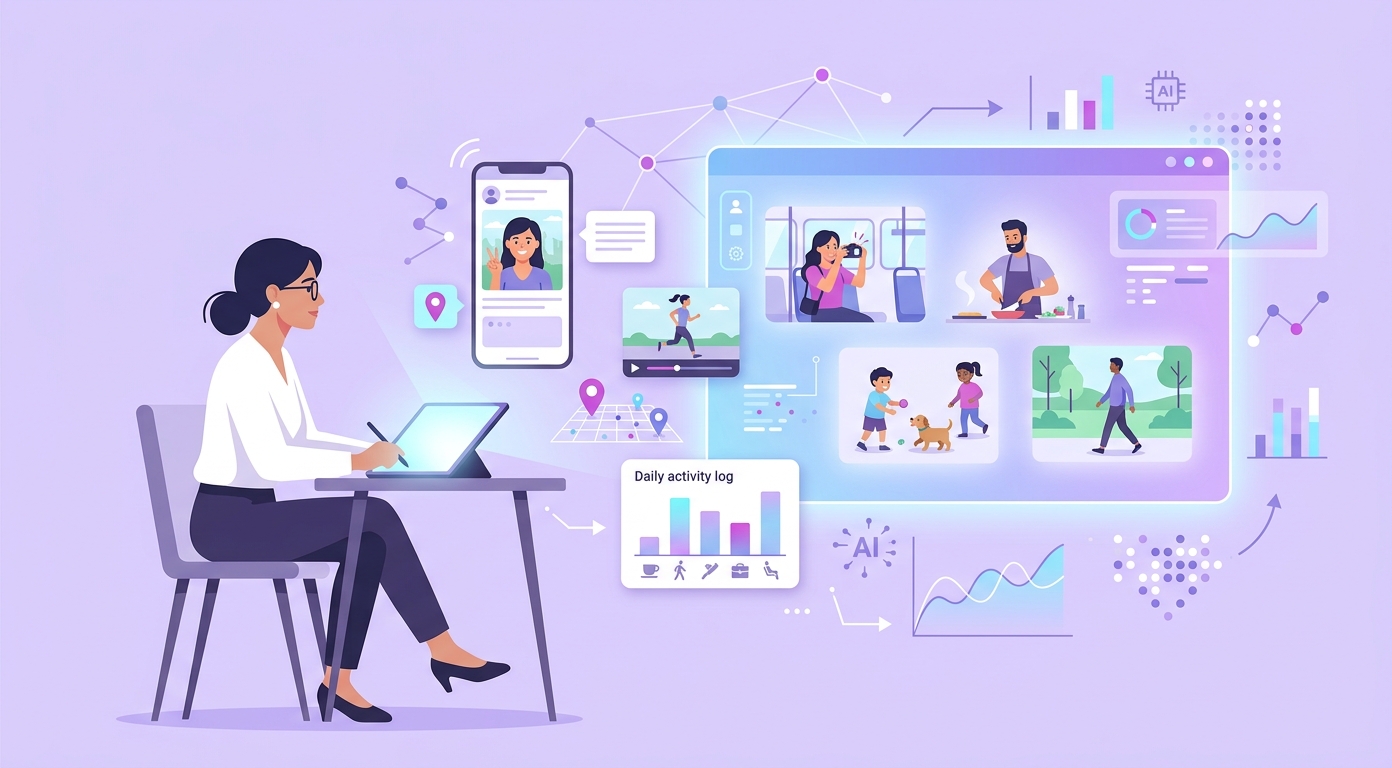
Traditional ethnography meant following people around with a notepad. Remote ethnography — sometimes called digital or mobile ethnography — uses participants' own devices to capture behavior in context.
The core toolkit:
- Photo and video diaries — participants document moments throughout their day
- Screen recordings — capture actual digital behavior, not recalled behavior
- Location-tagged entries — understand where activities happen, not just what
- In-the-moment prompts — triggered by time, location, or activity to capture fresh reactions
- Passive data collection — app usage patterns, movement data, environmental context
The shift is significant. Instead of a researcher observing 3-5 participants intensively, you can run remote ethnographic studies with 20-50+ participants simultaneously, collecting data over days or weeks.
As we explored in our practitioner's guide to diary studies and longitudinal UX research, the longitudinal dimension alone reveals behavioral patterns that single-session methods simply cannot surface.
The AI Layer That Makes This Practical
Here is the problem with remote ethnography at scale: you end up drowning in data. Fifty participants, seven days each, multiple entries per day — you are looking at thousands of photos, videos, and text entries. Traditional analysis would take weeks.
This is where AI transforms the method from "academically interesting" to "practically deployable."
Automated Pattern Recognition
AI can process visual and textual ethnographic data to identify recurring patterns across participants. A researcher uploading hundreds of photo diary entries can get initial thematic clusters in minutes rather than days.
This is not about replacing researcher judgment. It is about compressing the time between "data collected" and "patterns visible" — the same principle behind context engineering approaches in AI-driven development where structuring the right context dramatically improves output quality.
Multimodal Analysis
Modern AI does not just read text. It interprets images, understands spatial relationships in photos, detects emotional cues in video diaries, and correlates across modalities. A participant's verbal diary entry saying "my morning routine is pretty simple" paired with photos showing a chaotic kitchen counter and three different devices tells a richer story.
Real-Time Synthesis
Instead of waiting until data collection ends to begin analysis, AI-powered tools can surface emerging themes as data flows in. This enables researchers to:
- Adjust prompts mid-study based on what is emerging
- Identify outlier behaviors worth probing deeper
- Spot data saturation earlier and close collection when appropriate
Contextual Coding at Scale
The principles of testing and evaluating AI systems rigorously apply directly here. AI-generated ethnographic codes need validation against researcher expertise. The best workflow treats AI as a first-pass analyst that surfaces candidates for human review — not an oracle that delivers final answers.
Where Remote Ethnography Outperforms Interviews
1. Habitual Behavior
People cannot accurately describe habits. They will tell you they "check email first thing in the morning" when screen recordings show they actually open Instagram, scroll for 12 minutes, then check email. Remote ethnography captures the real sequence.
2. Environmental Context
A participant describing their home office in an interview says "it is pretty organized." A photo diary reveals sticky notes covering their monitor, three half-empty coffee cups, and a child's drawing taped to the wall. Context changes interpretation.
3. Emotional Micro-Moments
The frustration of a failed login. The satisfaction of completing a task. The confusion at a poorly designed checkout flow. These moments are fleeting and rarely survive the retrospective reconstruction of an interview. In-the-moment capture preserves them.
4. Workarounds and Hacks
Users build ingenious workarounds for product failures. They rarely think to mention these in interviews because the workaround has become invisible to them — it is just "how I do it." Observational data reveals the hacks.
5. Social and Physical Context
Who else is present? What else is happening simultaneously? Is the participant multitasking? These contextual factors shape product usage in ways that decontextualized interview settings strip away.
The Hybrid Model: Ethnography-Informed Interviews
The most powerful approach combines both methods.
Phase 1: Remote ethnographic data collection (5-14 days)
Participants capture their natural behavior through diaries, photos, videos, and passive data. AI processes incoming data in real-time, surfacing themes and identifying interesting behaviors.
Phase 2: AI-synthesized analysis
Before any follow-up, AI produces per-participant behavioral summaries and cross-participant pattern maps. Researchers review and refine.
Phase 3: Targeted follow-up interviews
Now, instead of asking generic questions, researchers can show participants their own behavioral data and probe specifically. "I noticed you switched between these three tools during task X — walk me through what was happening there."
This approach produces dramatically richer insights because the interview is grounded in observed behavior, not reconstructed memory.
Ethical Considerations That Actually Matter
Remote ethnography raises real ethical questions that researchers cannot hand-wave away.
Informed consent is more complex. Participants need to understand exactly what they are capturing and sharing. Consent should be ongoing, not one-time — with easy mechanisms to redact specific entries.
Privacy boundaries must be explicit. Photo diaries might accidentally capture other people, sensitive documents, or private spaces. Clear guidelines and participant training are essential.
AI analysis adds another layer. When AI processes ethnographic data, the principles of AI guardrails and production safety become directly relevant. How is participant data stored? Who has access? What happens to the trained models? Researchers need clear answers.
Power dynamics shift. Traditional ethnography has a researcher present who can read social cues and adjust. Remote methods lack this. Building in regular check-ins and easy opt-out mechanisms is not optional — it is ethical practice.
Making It Work: Practical Setup
Study Design
- Duration: 5-14 days for most product research; longer for lifestyle or health research
- Participants: 15-30 for pattern identification; 8-12 for deep individual analysis
- Entry frequency: 2-4 prompted entries per day, plus ad-hoc captures
- Modalities: Mix text, photo, and video to reduce participant fatigue on any single format
Participant Onboarding
- Provide a 15-minute video orientation (not just written instructions)
- Include example entries showing the level of detail you want
- Set up a quick communication channel for questions
- Send a test prompt on Day 0 and provide feedback before the study begins
Analysis Framework
- Run AI-powered initial coding within 24 hours of collection start
- Assign a human researcher to review AI-generated themes every 2-3 days
- Track emerging patterns in a shared synthesis document
- Use behavioral clusters (not individual stories) as the primary analytical unit
Deliverables That Drive Decisions
- Behavioral journey maps grounded in observed (not reported) behavior
- Video highlight reels organized by theme
- Comparative matrices: what people said vs. what they did
- Opportunity maps: unmet needs surfaced through workarounds and pain points
The Bottom Line
Remote ethnography with AI is not a replacement for interviews — it is the missing complement that makes interviews dramatically more valuable.
The teams producing the best product insights in 2026 are not choosing between methods. They are layering them: ethnographic observation for behavioral truth, AI-powered analysis for speed and scale, and targeted interviews for depth and meaning.
If your research practice is still interview-only, you are working with half the picture. The other half is waiting in the moments between questions — in the messy, contextual reality of how people actually live and work.
The tools exist. The methods are proven. The only question is whether you are ready to see what your participants are not telling you.