The Paradox Nobody Discusses
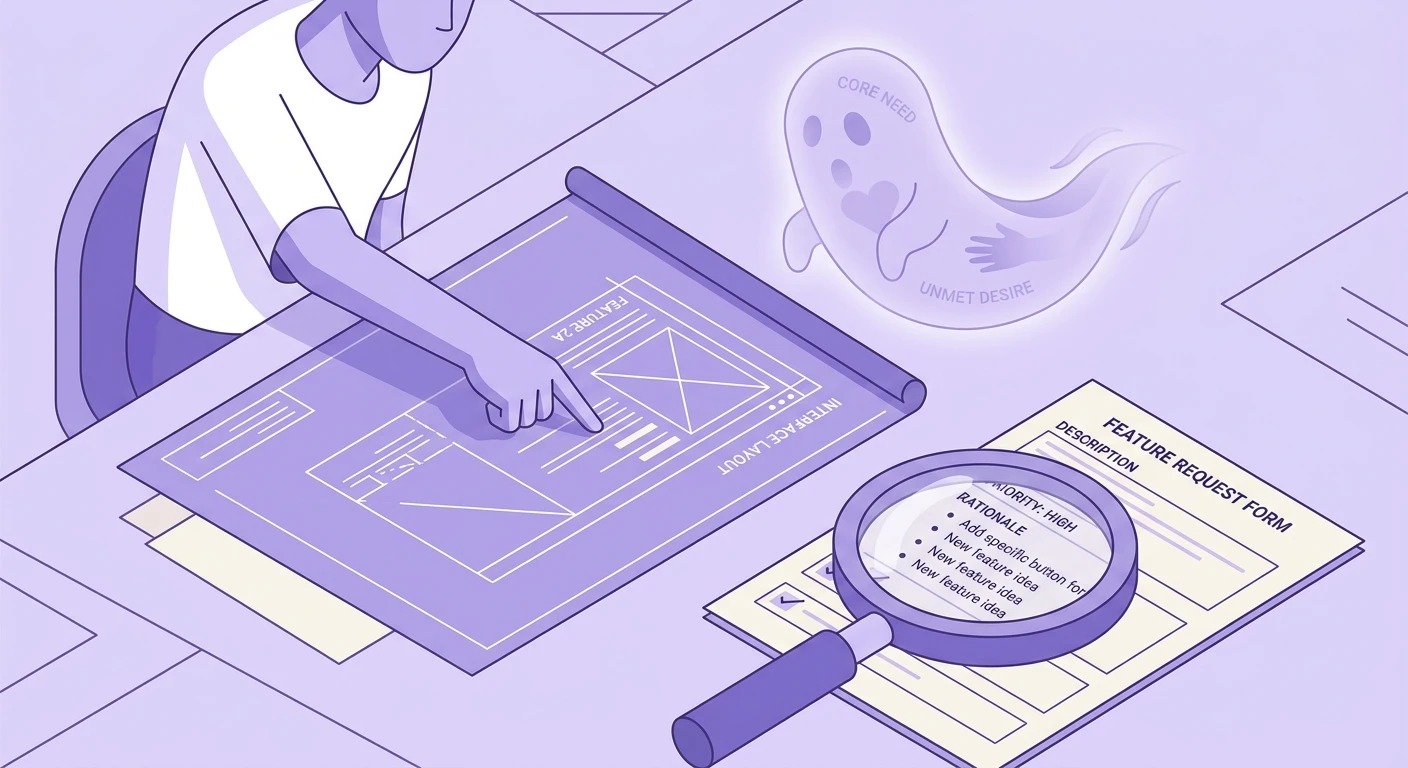
There is a cruel irony at the heart of user research practice: the more you know about a domain, the worse you become at understanding how newcomers experience it. You have spent years studying fintech onboarding flows. You know the vocabulary, the mental models, the regulatory constraints. And precisely because of this knowledge, you can no longer perceive the confusion that a first-time user encounters when they see "KYC verification required" with no explanation of what those letters mean.
This is not a theoretical concern. It operates in every research session where a seasoned researcher designs interview guides, defines screener criteria, or interprets behavioral data. Your expertise becomes a filter that removes the very signals you are trying to detect.
The expertise paradox manifests differently from the projection problem where researchers see their own assumptions in data. Here, the problem is more subtle: you do not even notice what you are missing because your brain has automated the understanding that novices lack.
How Domain Knowledge Corrupts Research Design
Screener questions assume baseline knowledge. When you recruit for a study on "document collaboration tools," you unconsciously frame the screener using concepts that only experienced users understand. A truly novice user might not even categorize their need as "document collaboration" — they think of it as "working on the same file as my teammate." Your screener language pre-filters for sophistication, eliminating the very users whose struggles would be most informative.
Interview guides skip foundational confusion. An expert researcher studying a healthcare patient portal will ask about "navigating appointment scheduling" without probing whether the participant understands the difference between a portal and a website. The assumption audit becomes critical here because it forces teams to surface what they consider "too obvious to ask about" — which is exactly where novice confusion lives.
Task scenarios embed expert framing. When you write a usability test task like "Find the API documentation for the webhooks integration," you have already assumed the participant knows what APIs, documentation sections, and webhooks are. A novice user might approach the same need as "I want my app to know when something changes" — a fundamentally different entry point that your task design never accommodates.
Analysis frameworks miss confusion signals. Expert researchers code data using sophisticated categories. A participant saying "I just clicked around until something worked" gets coded as "exploratory navigation" rather than what it actually represents: complete confusion about the information architecture. The analytical framework imported from your expertise imposes order on what is genuinely disordered experience.
The Compound Effect in Longitudinal Research
The expertise paradox compounds over time. As noted in discussions of how AI makes longitudinal research possible, tracking user experience over weeks or months requires researchers to maintain sensitivity to evolving competence levels. But expert researchers unconsciously benchmark all participants against their own understanding, creating a moving baseline that obscures the actual learning curve.
A researcher studying a project management tool over eight weeks might note that participants "quickly adapted to sprint planning views" without recognizing that three of those weeks involved participants misunderstanding what a sprint even means. The expert researcher's timeline for "quick adaptation" is calibrated against their own instant comprehension, not against the genuine cognitive work the participant performed.
Structural Solutions That Work
Pair expert researchers with naive observers. Include a team member who has never used the product category in analysis sessions. Their questions — "Why would the user know to scroll down there?" — surface the blind spots that experienced researchers cannot see. The principles behind collaborative analysis sessions apply here with a specific twist: you need cognitive diversity in domain knowledge, not just analytical perspective.
Design screeners with zero-knowledge language. Before finalizing your screener, test it with someone who has never heard of your product category. If they cannot understand every question, you are pre-filtering for expertise. Replace jargon with behavioral descriptions: instead of "Do you use project management software?" ask "Do you use any tool to track tasks or deadlines with your team?"
Build confusion-first interview protocols. Start every session by asking participants to explain concepts you take for granted. "What does this screen mean to you?" before "How would you complete this task?" The progressive disclosure approach works here — begin at a level that feels absurdly basic to you, because that is where novice truth lives.
Record and analyze navigation dead ends. Most expert-designed usability tests measure task completion and efficiency. Add a protocol for capturing every moment a participant pauses, backtracks, or re-reads. These micro-moments of confusion are invisible to expert eyes during live observation but reveal the true novice experience when analyzed systematically.
Implement the "explain like I am five" debrief. After each research session, require the lead researcher to explain their findings to someone with zero domain context. Every point where the explanation requires background knowledge represents a potential blind spot in the research design.
When Expertise Becomes an Asset
The expertise paradox does not mean domain knowledge is always harmful. Expert researchers excel at recognizing patterns across studies, designing methodologically sound protocols, and interpreting complex organizational dynamics. The key is knowing when your expertise helps (pattern recognition, methodological rigor) versus when it hurts (perceiving novice confusion, designing unbiased stimuli).
The solution is not to abandon expertise but to systematically create counterweights. Build processes that force you to see through novice eyes, even when your expert brain resists the effort. Every research program that serves users across the competence spectrum needs structural safeguards against the expertise paradox — because the most experienced researchers are the most susceptible to it, and the least likely to notice.
Practical Implementation
Start with your next study. Before finalizing your research plan, answer one question honestly: "What do I assume every participant already knows?" Write that list. Then design at least three questions or tasks that probe whether those assumptions are actually true. You will be surprised — the experts on your team always are.
The organizations producing the most valuable research about enterprise AI governance frameworks understand this principle intuitively: the people closest to the technology often cannot see the adoption barriers that matter most to newcomers. The same principle applies to every domain where researchers study users who know less than they do — which is to say, every domain.