The Question That Sets the Ceiling
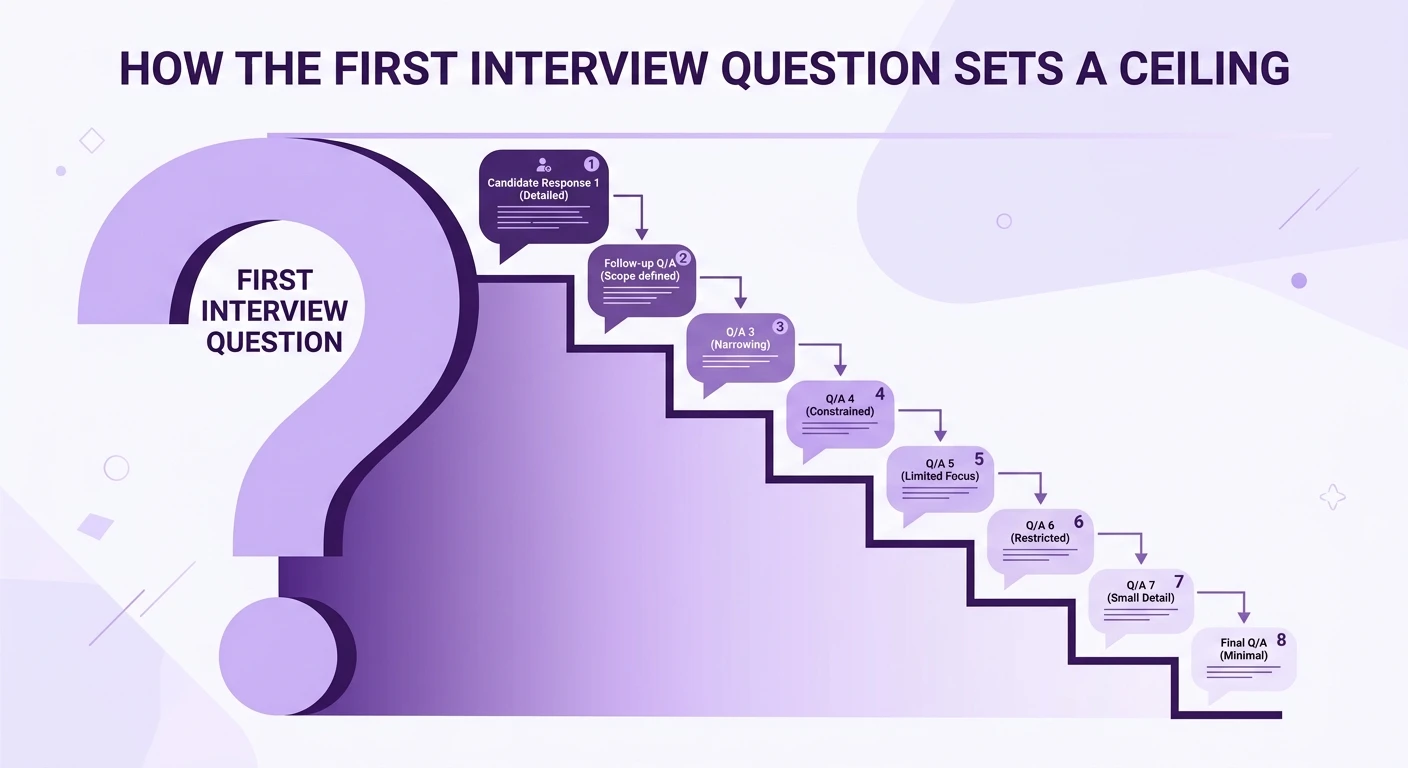
Every interview has a first real question, and researchers tend to treat it as throat-clearing -- a warm-up before the important stuff. That is a mistake. The first substantive question is not the floor of the session; it is the ceiling. It establishes the frame the participant will use to interpret everything that follows, the vocabulary they will borrow for the rest of the hour, and the emotional register they assume you want. Ask it carelessly and you have quietly capped how deep the entire interview can go, no matter how skilled your later probing.
The first-question anchor is the disproportionate, path-setting influence of your opening substantive question on the shape of all subsequent answers. It is an anchoring effect operating not on a number, but on the entire mode of the conversation.
Why the Opening Question Casts a Long Shadow
It fixes the level of abstraction. Open with "How do you think about your team's productivity?" and you have invited an hour of abstract theorizing. Open with "Walk me through the last time you tried to get something done and couldn't" and you get concrete episodes. The first question sets the altitude, and participants rarely descend on their own -- the dynamic behind the specificity gradient, where abstract questions produce performative answers while concrete questions unlock real experience.
It hands the participant your vocabulary. If your first question uses your product's internal terms or a loaded frame, the participant will mirror that language back to you for the rest of the session, and you will mistake your own words for their thoughts. This is the vocabulary mirroring effect, where adopting a participant's words -- or handing them yours -- traps them in a first framing.
It can smuggle in the hypothesis. A first question phrased around what you hope to hear presupposes the answer before the participant has said a word, the assumption smuggling problem where leading questions hide inside neutral-sounding wording. And because it comes first, there is no earlier answer to counterbalance it.
It sets the emotional register. A brisk, evaluative opener signals "give me tidy, confident answers." A curious, exploratory opener signals "messy and honest is welcome." The former primes the acquiescence and polish you were trying to avoid, and warmth in the opener can overcorrect into the interviewer warmth overcorrection, where being too likable kills honest feedback.
The Compounding Problem
The anchor does not just bias the first answer -- it compounds. Once a participant has framed the topic abstractly, borrowed your vocabulary, and settled into a confident register, every subsequent question inherits that frame. Your probes dig deeper into the wrong seam. This is why a mediocre opener cannot be rescued by great follow-ups: you hit the probe depth ceiling where your fifth follow-up gets worse data than your third faster, because you are probing within a frame that was wrong from the first minute. Worse, a poorly chosen opener is the kind of defect you only discover mid-study if you skipped the pilot study escape hatch, which guarantees you find your broken questions during fieldwork.
How to Choose a First Question That Raises the Ceiling
Open concrete, always. Anchor on a specific recent episode -- "Tell me about the last time..." -- not an abstract stance. Concrete beginnings license concrete, truthful detail for the rest of the session.
Use the participant's world, not yours. Strip product terms and internal jargon from the opener. Let the participant supply the vocabulary so you learn their real mental model.
Make the first question hypothesis-neutral. It should be answerable in a way that would surprise you. If every plausible answer confirms your prior, rewrite it.
Pilot the opener specifically. Test the first question on two or three people and listen for the altitude and register it produces. The opener earns more pretesting attention than any other line in your guide.
Set an exploratory register deliberately. Signal early that uncertainty and revision are welcome, so participants do not default to confident performance -- and pair it with the discipline of research triangulation before you act on any single session.
The Takeaway
The first question is the most consequential sentence you will speak in an interview. It sets the altitude, the vocabulary, the register, and the honesty ceiling for everything after -- and no amount of skilled probing can lift a session above the frame its opener established. Choose it concrete, neutral, and in the participant's own world, and pretest it harder than anything else in your guide. Qualz.ai helps researchers design and pressure-test discussion guides so the first question opens the session up instead of quietly closing it down.
*Want interview guides that raise the ceiling instead of capping it? Explore Qualz.ai.*