The Sequence Problem Nobody Controls For
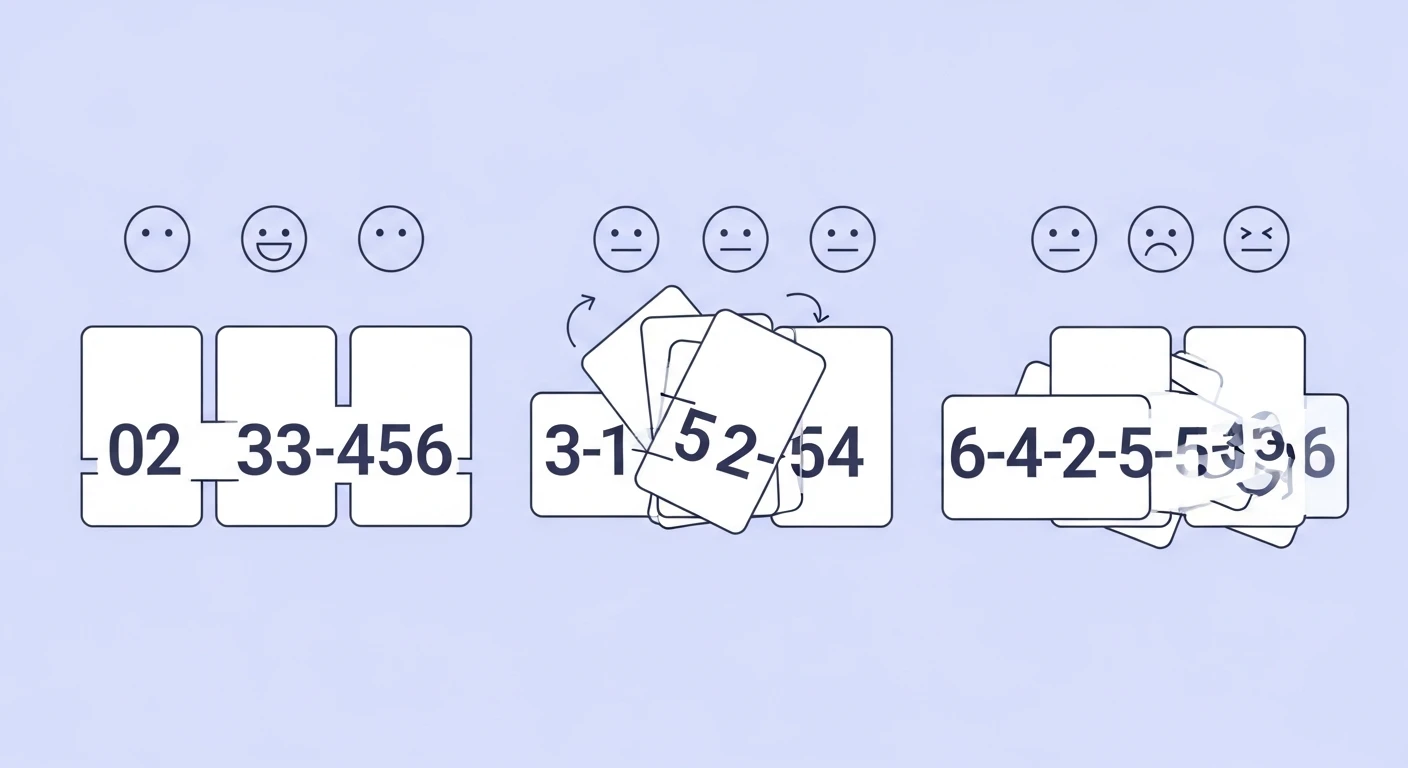
You have three concepts to test. You show Concept A first, then B, then C. Participants consistently prefer B. You celebrate and build Concept B.
But here is what actually happened: Concept A set the evaluative frame. Participants used it as their mental baseline -- not because it was presented as the baseline, but because it was first. Concept B looked good by contrast. Concept C suffered from decision fatigue and the "already found my answer" effect.
If you had shown them in reverse order -- C, B, A -- there is a meaningful probability that participants would have preferred A. Not because A is objectively better, but because the sequence itself created the preference.
This is not a minor methodological footnote. In concept testing, where abstract ideas already create cognitive load, adding sequence effects on top means you are measuring a compound artifact rather than genuine user preference.
How Sequence Effects Manifest in Research
The Anchoring Cascade
The first stimulus does not just get evaluated. It becomes the implicit standard against which everything else is measured. Research on anchoring bias shows that initial exposure creates reference points that persist even when people are told to ignore them.
In concept testing, this means:
- First concept defines "normal" -- Subsequent concepts are evaluated as deviations from the first, not independently
- Features in the first concept become expected -- If Concept A has a collaboration feature, participants notice its absence in Concepts B and C
- Emotional tone carries forward -- An exciting first concept raises the bar; a confusing first concept makes everything after seem clearer by comparison
The Contrast Effect
Concepts shown immediately after a weak option appear stronger than they would in isolation. Concepts shown after a strong option appear weaker. This is the same psychological mechanism that makes a $50 bottle of wine seem reasonable after you have seen the $200 options.
In practice, this means strategic ordering can manufacture preference -- whether intentionally or accidentally. The principles behind how question order shapes what you hear apply equally to stimulus presentation.
Decision Fatigue Degradation
By the third or fourth concept, participants are not evaluating with the same cognitive resources they applied to the first. Their responses become shorter, less nuanced, and more likely to default to the path of least resistance -- which usually means either "this is fine" or reverting to an earlier preference that requires less mental energy to justify.
The Research on Order Effects in Evaluation
The literature on this is unambiguous. Studies in jury decision-making show that evidence presented first and last receives disproportionate weight (primacy and recency effects). Consumer research demonstrates that products evaluated first in a sequence receive 15-20% higher ratings than the same products evaluated fourth.
In qualitative concept testing specifically, order effects compound because participants often rationalize their preferences post-hoc. They construct narratives explaining why they prefer Concept B that sound like genuine product reasoning but are actually anchoring artifacts dressed up as insight.
This connects directly to how participants construct logical stories from chaotic experiences -- the same mechanism that makes retrospective accounts unreliable also makes sequence-influenced preferences sound legitimate.
Practical Counterbalancing Strategies
Latin Square Rotation
The minimum viable approach: if you have N concepts, create N different presentation orders and randomly assign participants to sequences. This does not eliminate order effects -- it distributes them evenly so they cancel out in aggregate analysis.
For three concepts (A, B, C), the rotation sequences would be:
- Group 1: A then B then C
- Group 2: B then C then A
- Group 3: C then A then B
This ensures each concept appears first, second, and third an equal number of times.
Paired Comparison Design
Instead of showing all concepts sequentially, present them in pairs. Participants evaluate A vs. B, then B vs. C, then A vs. C. This dramatically reduces the sequence contamination because each evaluation has only one comparison frame rather than a cumulative stack.
The tradeoff: you need more evaluation time per participant, and the data analysis shifts from rank-ordering to calculating relative preference strengths from the paired comparisons.
The Two-Phase Protocol
Phase one: show all concepts briefly (titles and one-line descriptions) to establish the full solution space. Let participants absorb that multiple options exist.
Phase two: deep-dive into each concept individually, but randomize which concept gets explored first for each participant.
This separates the "what exists" frame from the "detailed evaluation" frame, reducing the probability that deep engagement with the first concept contaminates evaluation of subsequent ones.
Baseline Calibration
Before showing any test concepts, present a "calibration stimulus" -- an existing product or familiar reference point that is not being tested. This gives participants an anchoring point that is consistent across all groups, preventing the first test concept from becoming the uncontrolled anchor.
When Sequence Effects Are Data, Not Noise
Sometimes the order effect is the insight. If Concept B consistently performs better when shown after Concept A, that tells you something about the value proposition architecture. Concept B might genuinely work best as a "next step" from something like A -- which has implications for product positioning and go-to-market sequencing.
The key is distinguishing between accidental sequence contamination (methodological noise) and genuine sequential preference (market signal). You can only make this distinction if you have systematically varied the presentation order.
AI-Assisted Sequence Analysis
Modern analysis tools can help detect sequence effects in your existing data without requiring re-running studies. By comparing preference patterns across different presentation orders, AI can flag when a concept's performance correlates more strongly with its position in the sequence than with participant demographics or use-case fit.
This kind of pattern detection -- spotting contradictions and inconsistencies across sessions -- is precisely where computational analysis outperforms human intuition, which tends to notice confirming patterns and miss position-dependent artifacts.
The Minimum Standard for Concept Testing
Any concept test involving more than one stimulus that does not explicitly counterbalance for order effects should be treated as exploratory, not evaluative. The findings can generate hypotheses but cannot justify product decisions.
The operational framework for building reliable research processes, as explored in effective research operations approaches, demands that methodological rigor scales with decision stakes. For concept tests that will determine where engineering resources go next quarter, counterbalancing is not a luxury -- it is a requirement.
Practical Takeaways
- Always counterbalance. No exceptions. Even with two concepts, half your participants should see A first and half should see B first.
- Report sequence alongside preference. Include presentation order as a variable in your analysis. If preferences shift dramatically with order, that is a finding worth reporting.
- Use calibration stimuli. Ground participants with a reference point before testing begins. This reduces the outsized influence of whichever concept happens to be shown first.
- Watch for fatigue signals. If response quality drops after the second concept, consider splitting your test into multiple shorter sessions rather than cramming four concepts into one hour.
- Separate exploration from evaluation. Let participants see the full landscape before asking them to evaluate individual options deeply.
Sequence effects are not exotic edge cases. They are present in every multi-stimulus study ever conducted. The only question is whether you controlled for them or let them silently determine your product roadmap.