The Storytelling Instinct
Ask someone why they switched from one product to another. You will get a story: a clear inciting incident, a logical evaluation process, and a decisive moment of action. It sounds rational. It sounds sequential. And it almost certainly did not happen that way.
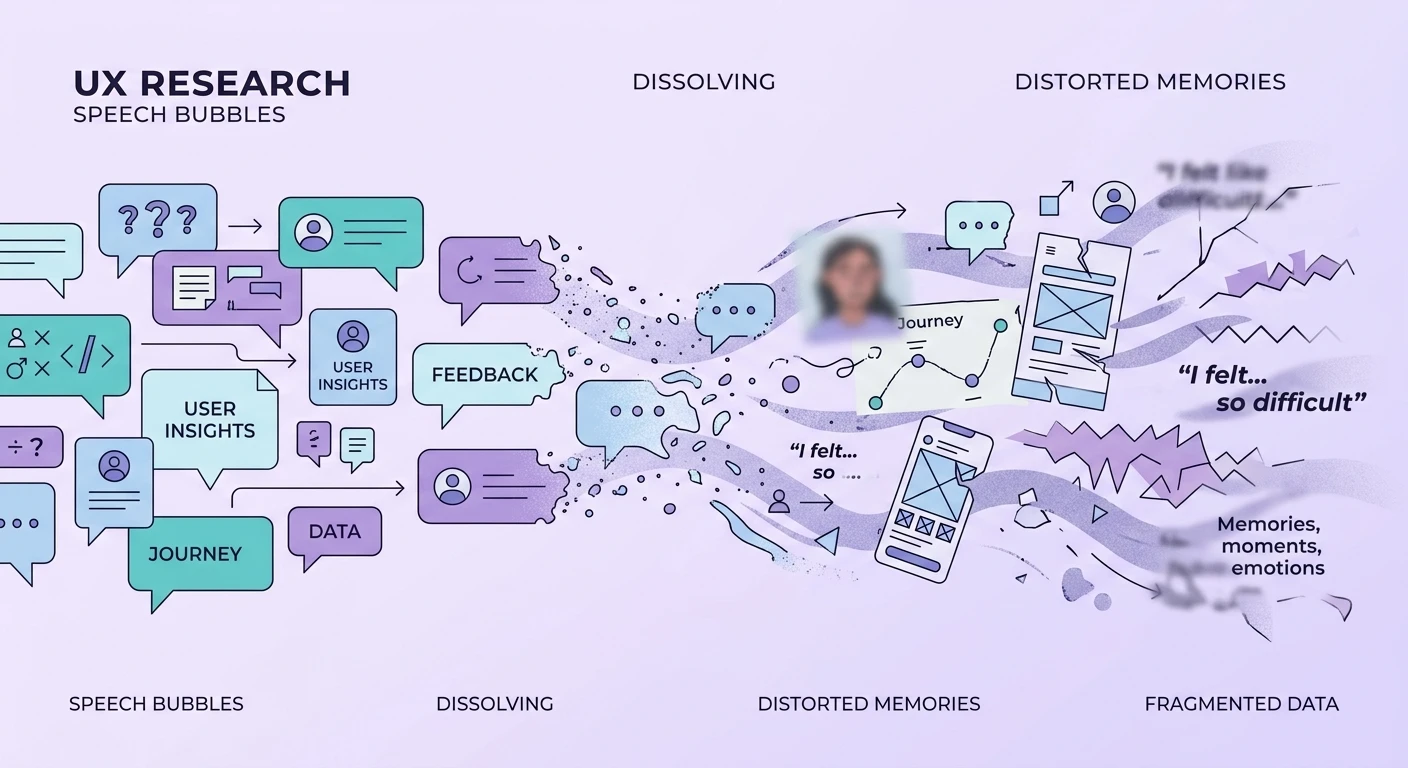
Humans are narrative creatures. When asked to explain past behavior, we do not retrieve memories -- we reconstruct them. The reconstruction follows narrative conventions: causation, chronology, and coherence. Messy realities get smoothed into clean arcs. Contradictory impulses get resolved into singular motivations.
This is the narrative coherence bias: the systematic tendency for research participants to impose logical structure on experiences that were actually fragmented, contradictory, and emotionally driven.
Why Narrativization Distorts Research Data
Post-hoc rationalization dominates recall. When participants explain decisions made weeks or months ago, they are not remembering -- they are theorizing about their own behavior. The theory they construct privileges rationality over emotion, linearity over chaos, and singular causes over complex interactions.
Social performance shapes the story. Interview contexts prime storytelling behavior. Participants unconsciously construct narratives that present them as competent, rational actors. The chaotic reality -- where they clicked randomly, got frustrated, abandoned the task, came back two weeks later for unrelated reasons -- does not make for a satisfying story.
Coherence feels like truth. Both participants and researchers mistake narrative coherence for accuracy. A well-structured story feels more credible than a fragmented account. But coherence is a property of narrative craft, not a signal of experiential accuracy. As we explored in why the articulation gap makes users unable to explain their own behavior, what people say and what they do are fundamentally different data streams.
Detecting Narrative Coherence Bias
The bias reveals itself through several signatures:
Suspiciously clean causation. Real decision-making involves multiple interacting factors, dead ends, and reversals. When a participant presents a single, clean causal chain ("I saw the pricing page, compared features, and chose the best value"), narrative smoothing is likely at work.
Absence of contradiction. Real experiences contain contradictions. A participant who loved a feature but also found it frustrating. Someone who was loyal to a brand but also actively exploring alternatives. When accounts lack any tension or contradiction, the narrative engine has resolved complexities that actually existed. Understanding why contradictions are your most valuable signal helps researchers actively surface these smoothed-over tensions.
Temporal precision that exceeds memory capacity. "First I did X, then I realized Y, which led me to Z." Human memory does not reliably preserve the sequence of micro-decisions. When participants provide confident chronologies of complex processes, they are constructing rather than recalling.
Borrowed frameworks. Participants who work in product or design often unconsciously frame their experiences using professional frameworks ("I was basically doing a jobs-to-be-done analysis in my head"). These borrowed narratives overlay professional models onto what was actually intuitive, messy behavior.
The Research Consequences
When researchers accept narrativized accounts as accurate descriptions of experience, several problems cascade:
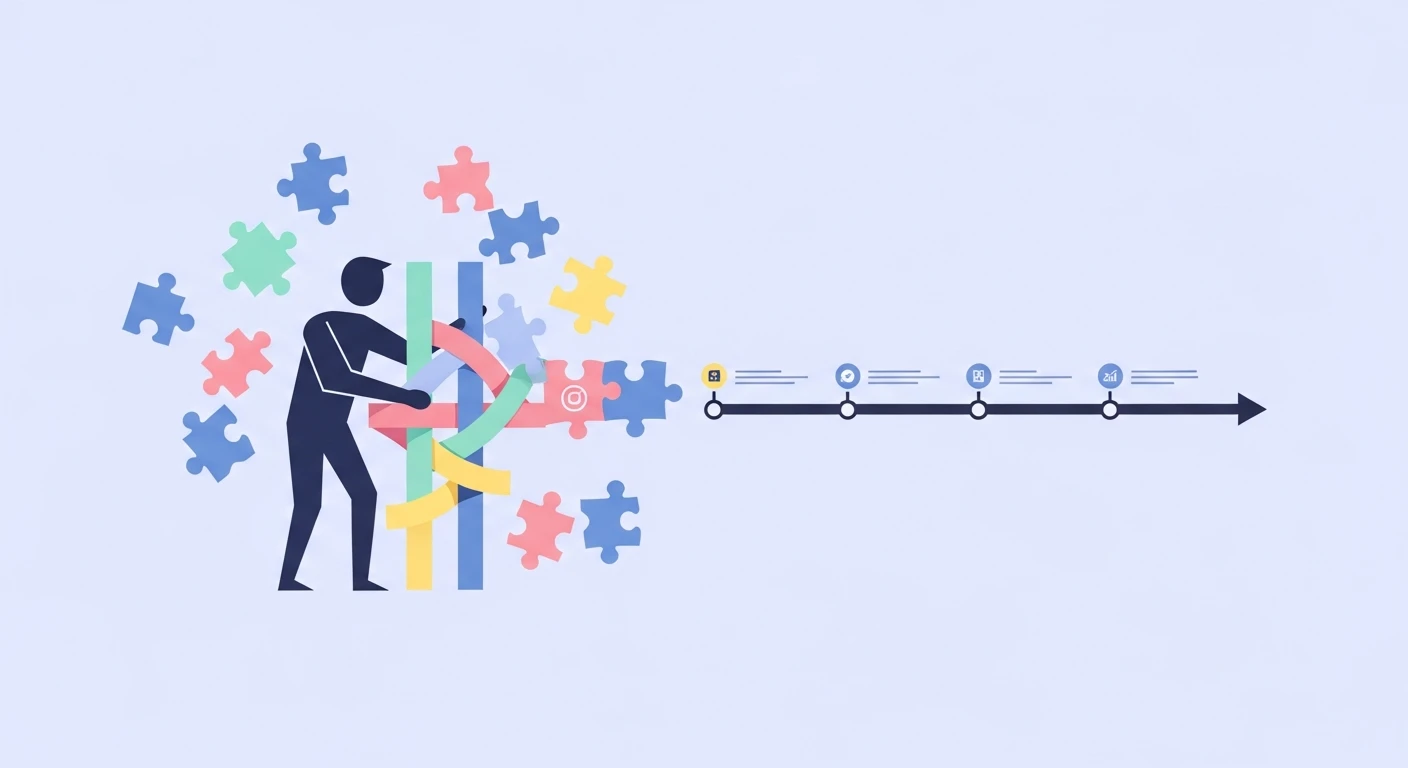
Journey maps reflect narrative logic, not actual journeys. Maps built from participant stories inherit their narrative coherence. The resulting artifacts show idealized paths that no real user actually follows, leading teams to optimize for fictional sequences.
Personas become characters. When built from narrativized self-descriptions, personas reflect how users think about themselves, not how they actually behave. The gap between self-narrative and behavioral reality produces personas that are psychologically satisfying but empirically hollow.
Causal models inherit false simplicity. "Users churn because they cannot find the feature they need" sounds like a clean finding. But the actual causal structure might involve fifteen interacting factors, none sufficient alone. Narrativized accounts privilege the factor that makes the best story, not necessarily the most impactful one.
Methodological Countermeasures
Use behavioral probes before narrative prompts. Before asking "why did you switch?" ask "walk me through what you did last Tuesday afternoon." Behavioral specificity anchors accounts in observable actions rather than narrative reconstructions. This approach draws from principles of micro-ethnography and contextual observation that prioritize what happened over why it happened.
Triangulate accounts with behavioral data. Compare what participants say they did with what logs, analytics, or diary entries show they actually did. The divergence between narrative accounts and behavioral traces reveals exactly where coherence bias has operated.
Probe for abandoned alternatives. Ask about paths not taken. "What else did you consider? What almost happened instead?" These questions surface the complexity that narrative smoothing eliminates. Real decision processes involve dead ends and reversals that clean stories erase.
Separate the temporal from the causal. When participants present "A led to B which caused C," gently separate the claim. "Did B happen because of A, or did they happen around the same time?" Often, participants conflate temporal proximity with causation because sequence is a narrative convention.
Interview closer to the event. Narrative coherence increases with temporal distance. The further from an experience, the more polished and coherent the story becomes. Approaches that capture experience in real time -- like diary studies and experience sampling -- reduce the opportunity for narrative reconstruction.
Using Narrative Bias Productively
Narrative coherence bias is not purely a contaminant to eliminate. The stories participants construct reveal their mental models, values, and self-concepts. The key is distinguishing between two different valid research questions:
- What actually happened? Here, narrative bias is a distortion to correct for.
- How do users understand their own experience? Here, the narrative itself is the data.
Product teams that need to understand actual behavior should correct for narrative bias. Teams that need to understand how users think about themselves -- for messaging, positioning, or identity design -- should analyze the narrative structure as primary data.
The sophisticated researcher treats every participant account as simultaneously: a partially accurate report of events, and a fully authentic expression of how someone makes sense of their world. Both are valuable. Confusing one for the other is where the bias becomes dangerous.
Building Narrative-Aware Research Practice
Developing sensitivity to narrative coherence bias requires deliberate practice:
Record where in an interview participants shift from fragmented recall to smooth narrative. The transition point often marks where genuine memory gives way to construction. These patterns become visible through reflexive note-taking practices that track interviewer observations alongside participant responses.
Compare early-interview accounts (typically more fragmented and contradictory) with late-interview summaries (typically more coherent and clean). The difference reveals the degree of narrative smoothing occurring in real time.
In analysis, flag findings that rest entirely on narrativized accounts without behavioral corroboration. These findings are hypotheses about user experience, not evidence of it. They require triangulation before driving product decisions.
The goal is not to distrust participants. It is to understand that the stories they tell are constructions -- meaningful, revealing constructions that nonetheless differ from the underlying experiences they describe. Research rigor means honoring both the story and the reality behind it.