The Debrief as Data Filter
You finish a 60-minute user interview. Within the hour, your team gathers — researcher, designer, PM, maybe an engineer. Everyone shares what stood out. The conversation is energetic. Insights feel fresh. You leave with a shared understanding of what mattered.
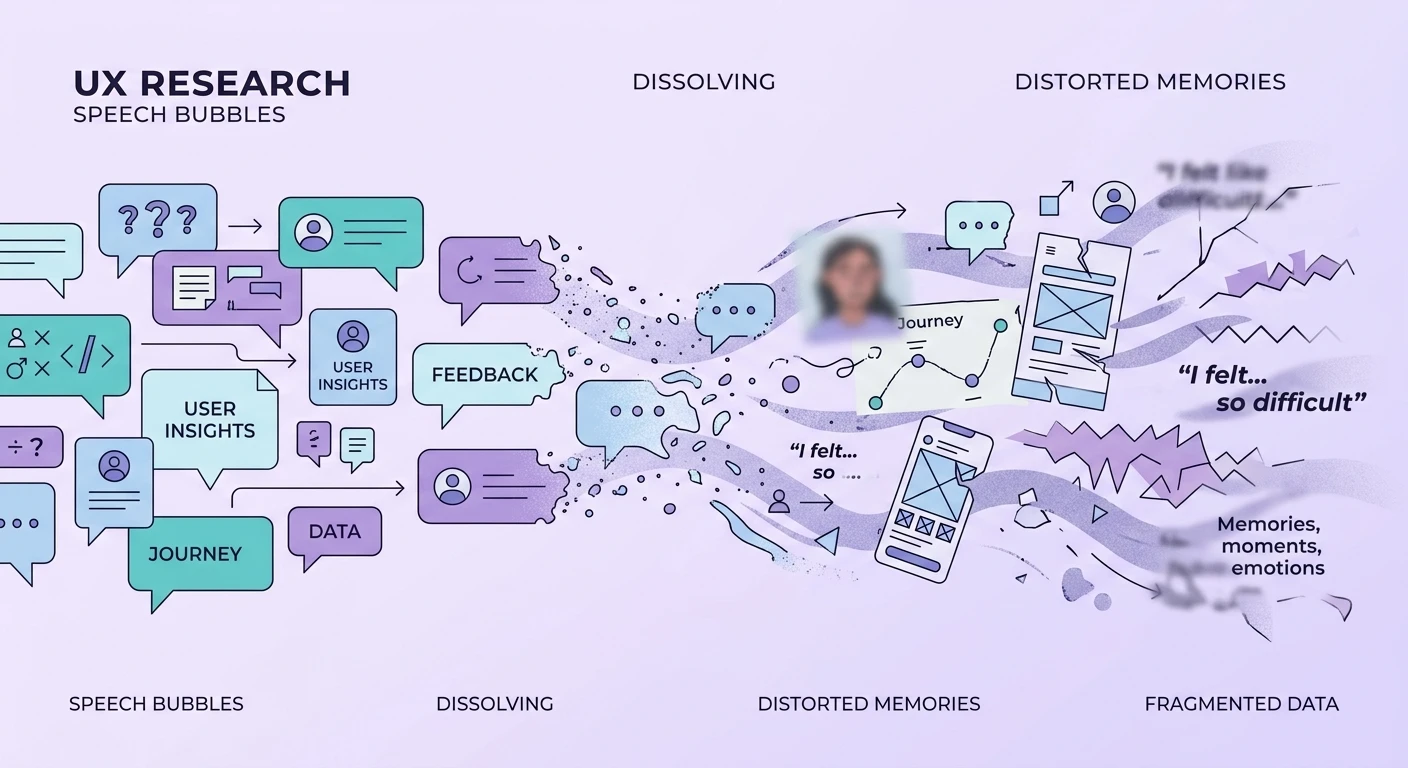
Except that shared understanding was manufactured by social dynamics, not analytical rigor. What happened in that debrief was not synthesis — it was a filtering process driven by confidence, narrative coherence, and status. The observations that survived are not necessarily the most important. They are the most articulable, the most dramatic, and the ones voiced by the most confident person in the room.
This is debriefing bias: the systematic distortion of research findings through the social process of discussing them. It operates invisibly because debriefs feel like rigorous practice. They are prescribed in every UX research textbook. But without structural safeguards, they introduce bias at the exact moment when raw observation should be preserved.
How Debriefing Distorts Memory
Narrative smoothing. When you verbalize an observation, you unconsciously shape it into a coherent story. The hesitation in the participant's voice, the context that preceded their statement, the qualifier they added — these get dropped because they complicate the narrative. By the time you finish describing what happened, you have already edited your memory. The research on reflexive note-taking during user interviews shows how documentation during the session preserves nuance that post-session recall cannot.
Social reinforcement loops. When a colleague says "Yes, I noticed that too!" your confidence in that observation inflates. Observations that get social validation become "key findings." Observations that get blank stares get abandoned — not because they are wrong, but because they lacked social support. This mirrors the facilitator paradox in focus groups where group dynamics override individual truth.
Anchoring to the first speaker. Whoever speaks first in a debrief anchors the entire conversation. Their framing becomes the lens through which everyone else interprets their own observations. If the PM leads with "The user was clearly frustrated by the navigation," every subsequent observation gets evaluated against that frame — even observations that might have suggested something entirely different.
Confidence asymmetry. Experienced team members speak with more certainty. Junior researchers defer. But confidence correlates with experience, not accuracy of observation. A junior researcher who noticed a subtle behavioral contradiction may stay silent because their observation does not fit the narrative being constructed by more senior colleagues.
The Memory Contamination Window
Research on memory consolidation shows that the first 30 minutes after an experience are critical for how memories solidify. During this window, external input — including other people's interpretations — actively reshapes your own memory. This is not metaphorical. Your neural representation of what happened physically changes based on what you hear others say about it.
This means a debrief held immediately after a session does not just filter which observations get discussed — it literally alters what individual team members remember observing. After the debrief, you cannot recover the original observation. It has been overwritten.
The research debriefing practices post-interview literature acknowledges the importance of the post-interview hour but rarely addresses how social debriefs during that window contaminate individual recall.
Structural Safeguards
Silent writing before speaking. Before any verbal discussion, every observer spends 5-10 minutes writing their observations independently. Use sticky notes, a shared doc with hidden responses, or individual forms. This preserves pre-contamination observations that can be compared to post-discussion consensus.
Structured observation frameworks. Give observers specific lenses before the session: one watches for emotional responses, another for task completion behaviors, another for verbalized reasoning. When the debrief happens, each person reports from their assigned lens rather than competing for airtime on "the most interesting thing."
Delayed synthesis. Separate observation capture (immediately post-session) from synthesis (hours or days later). Individual observations get documented while fresh. Synthesis happens after everyone has independently recorded their notes, preventing social dynamics from filtering raw data.
Devil's advocate rotation. Assign one person in each debrief to challenge the emerging consensus. Their job is to ask: "What did we not discuss? What observation contradicts what we are agreeing on? What would change our interpretation if true?" Rotate this role to prevent it from being dismissed.
Observation confidence scoring. Ask each observer to rate their confidence in each observation (1-5) before sharing it. Low-confidence observations are often the most interesting — they represent things people noticed but cannot yet explain. Without explicit solicitation, these disappear in debriefs. This connects to how AI-powered analysis detects signals that human pattern-matching overlooks in complex systems.
When Debriefs Help vs. Hurt
Debriefs are not universally harmful. They serve legitimate functions:
Legitimate: Identifying logistical issues for the next session. Flagging emotional reactions the researcher needs to process. Noting technical failures (recording issues, prototype bugs). Sharing contextual knowledge that helps interpretation ("That feature they mentioned was actually deprecated last month").
Dangerous: Reaching consensus on what the findings "mean." Deciding which observations are "important." Constructing a narrative of the session. Determining whether the participant "liked" or "disliked" something.
The rule: debriefs should share information, not construct interpretation. Interpretation requires the full dataset, not a single session discussed while memories are still malleable.
The AI Mitigation Path
AI transcription and analysis can partially mitigate debriefing bias by creating an objective record that does not degrade through social discussion. When the full transcript exists with timestamps and behavioral annotations, the debrief becomes less about "what happened" (the transcript shows that) and more about "what might it mean" (where collaborative interpretation adds value).
Platforms that provide real-time transcription during interviews reduce reliance on human memory for factual recall, freeing debriefs to focus on interpretation rather than reconstruction. The key insight: separate the what (objective, captured by technology) from the so-what (interpretive, improved by collaboration).
Further, as the compound AI system architecture enables more sophisticated research tooling, AI can flag observations that no team member verbalized in the debrief — things present in the transcript that the social filtering process excluded. This creates a safety net for debriefing bias, surfacing what the group missed.
Measuring Debriefing Bias in Your Team
Run this experiment: After your next three research sessions, have all observers write individual notes BEFORE the debrief. Then run the debrief normally. Afterward, compare individual pre-debrief notes to the post-debrief consensus. Count:
- Observations present in individual notes that disappeared from consensus
- Observations absent from individual notes that appeared in consensus (socially constructed)
- Observations that changed meaning between individual notes and consensus
If more than 30% of individual observations disappear, your debriefs are functioning as lossy filters rather than analytical tools. The solution is not eliminating debriefs — it is restructuring them to preserve rather than destroy observational diversity.