Why Observation Beats Asking
Interviews tell you what users think they do. Observation tells you what they actually do. This gap between reported and actual behavior is not a minor discrepancy — it is often the difference between building something useful and building something that sounds useful in a conference room.
The problem is that traditional ethnographic observation requires hours or days of immersion. Product teams operating on two-week sprints cannot afford week-long field studies for every design question. So they default to interviews alone, accepting the reported-behavior limitation as the cost of moving fast.
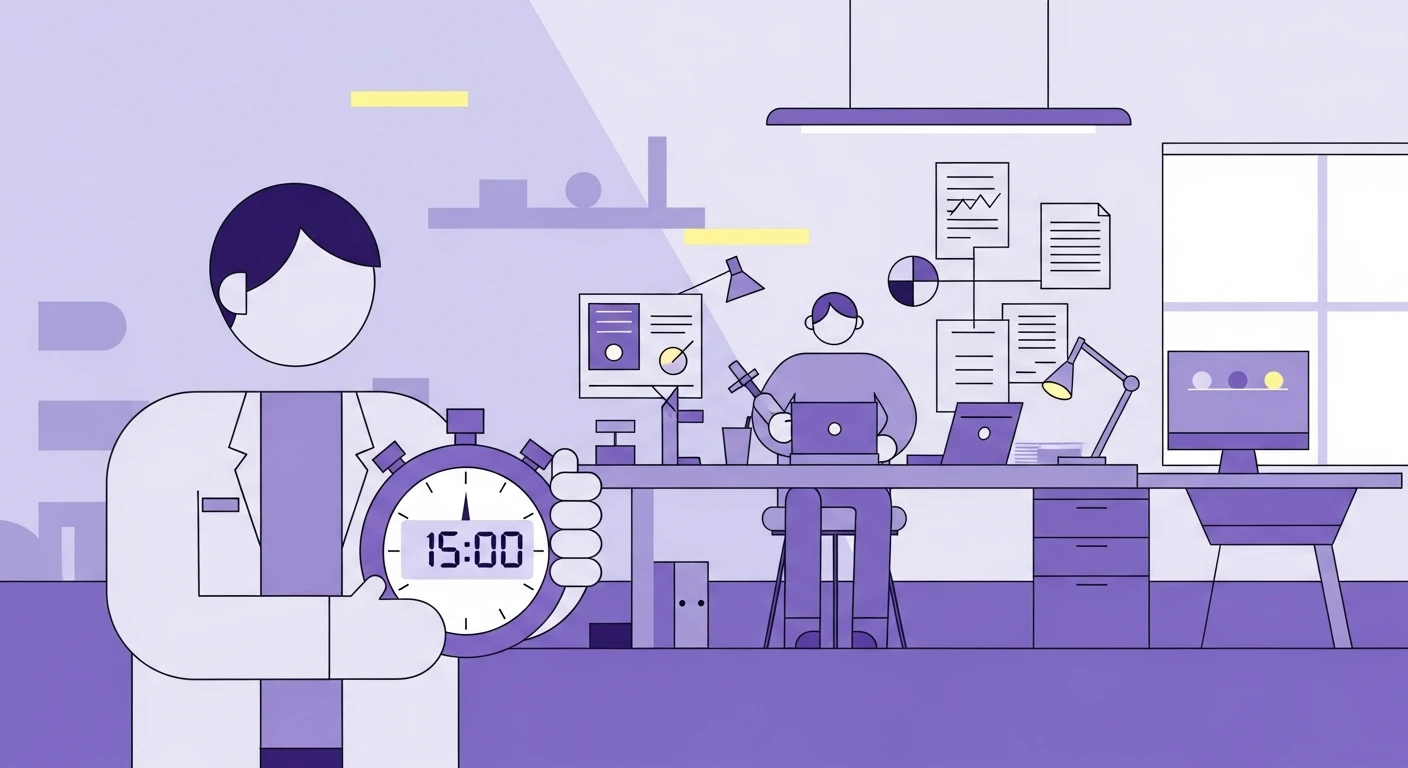
Micro-ethnography offers a third path: structured 15-minute observation sessions that capture behavioral context without the time investment of full ethnographic immersion. It is not a replacement for deep ethnography — it is a practical tool for teams that need contextual signal faster than traditional methods allow.
The 15-Minute Observation Framework
Micro-ethnography works by constraining scope radically while maintaining observational rigor:
Pre-session focus definition (5 minutes before). Choose one specific behavior or workflow moment to observe. Not "how does the user work" but "what happens in the 3 minutes after they receive a notification from our product." Narrow focus prevents the observation from becoming overwhelming or unfocused. You are looking for one thing deeply, not everything broadly.
Silent observation phase (10 minutes). Watch the participant perform their natural workflow without interruption. Note physical environment, screen layout, interruptions, tool switching, body language, and pauses. Do not ask questions during this phase. The moment you ask "why did you do that," you break the naturalistic frame and the participant starts performing rather than behaving.
Targeted debrief (5 minutes). After the observation, ask 2-3 specific questions about moments you noticed. "I saw you switch to Slack before completing that form — what triggered that?" These questions are grounded in observed behavior, making them resistant to the retrospective distortion that plagues open-ended interview questions.
What 15 Minutes Reveals
Even brief observation sessions consistently reveal patterns invisible to interviews:
Environmental interference. A user reports they "always complete the weekly report on Monday morning." Observation reveals they start it Monday, get interrupted three times by colleagues, complete 60% by Tuesday, and finish it Thursday from a different device. The workflow you designed for single-session completion is fighting a multi-session reality.
Tool ecosystem context. Users describe your product in isolation during interviews. Observation reveals it exists within a constellation of 8-12 tools, browser tabs, sticky notes, and Slack channels that all participate in the workflow your product touches. The integrations you have not built are not optional — they are the environment your product must survive in.
Workaround behaviors. Participants never mention workarounds in interviews because workarounds become invisible through habit. But observation catches the spreadsheet that supplements your dashboard, the screenshot workflow that compensates for missing export features, and the manual copy-paste that bridges your product gap. These are your strongest feature signals.
The principles behind visual elicitation techniques extend naturally to micro-ethnography — both leverage concrete artifacts and observed reality rather than reconstructed memory.
Scaling Micro-Ethnography Across Teams
The power of micro-ethnography emerges at scale. One 15-minute session is anecdotal. Twenty sessions across diverse users reveal robust behavioral patterns that no amount of interviewing would surface.
Rotation schedules. Assign team members (designers, PMs, engineers) rotating 15-minute observation sessions weekly. This distributes the cost across the team and — crucially — gives engineers direct exposure to user behavior without requiring formal "research projects" that teams deprioritize.
Structured observation templates. Create simple templates that standardize what observers record: environment layout, interruption count, tool switches, emotional signals (frustration, confusion, satisfaction), and unexpected behaviors. Standardization enables pattern identification across observers with different experience levels.
Synthesis cadence. Run 30-minute synthesis sessions biweekly where observers share surprising findings. The value compounds when observations from different contexts collide — similar workarounds appearing across unrelated users signal genuine product gaps rather than individual quirks.
This approach aligns with how cross-functional research workshops build shared understanding through collaborative exposure to data rather than second-hand insight reports.
Common Pitfalls and Corrections
Observer intervention. The strongest impulse during observation is to help or explain when users struggle. Resist it. Struggle is data. If you fix the problem during observation, you lose the opportunity to understand its frequency, severity, and the workarounds users develop independently.
Narrow environmental frame. Observing only the screen misses half the context. Physical workspace, posture changes, glances at phones, conversations with colleagues — these are all part of the behavioral system your product exists within.
Confirmation observation. Going into sessions looking for evidence that supports your hypothesis produces exactly that evidence. Define your observation focus around behaviors, not outcomes. "Watch what happens after the user receives a notification" not "confirm that users find notifications helpful."
Insufficient consent framing. Participants must understand they are being observed behaving naturally, not evaluated on performance. Frame it as "we are studying how our product fits into real workflows" not "we are watching how you use our product." The former invites natural behavior; the latter triggers performance anxiety.
When to Combine With Interviews
Micro-ethnography and interviews serve different functions and are strongest in sequence:
Observe first, interview second. Use observation to identify surprising behaviors, then use targeted interview questions to explore the reasoning behind those behaviors. This sequence grounds interviews in observed reality rather than hypothetical questions.
The combination produces what neither method achieves alone: behavioral truth (from observation) plus motivational depth (from interviews). As the work on research triangulation demonstrates, the strongest product insights emerge from multiple methods converging on the same finding from different angles.
Micro-ethnography will not replace your interview program. But it will ensure your interviews start from what users actually do rather than what they think they do — and that difference is where the best product decisions hide.