The Methodological Collision
Generative research asks: what exists? What do people need, want, struggle with? What opportunities are we missing? It is deliberately open, deliberately undirected, deliberately receptive to surprise.
Evaluative research asks: does this work? Is this solution effective? Does this concept resonate? It is deliberately focused, deliberately structured around specific stimuli, deliberately seeking judgment.
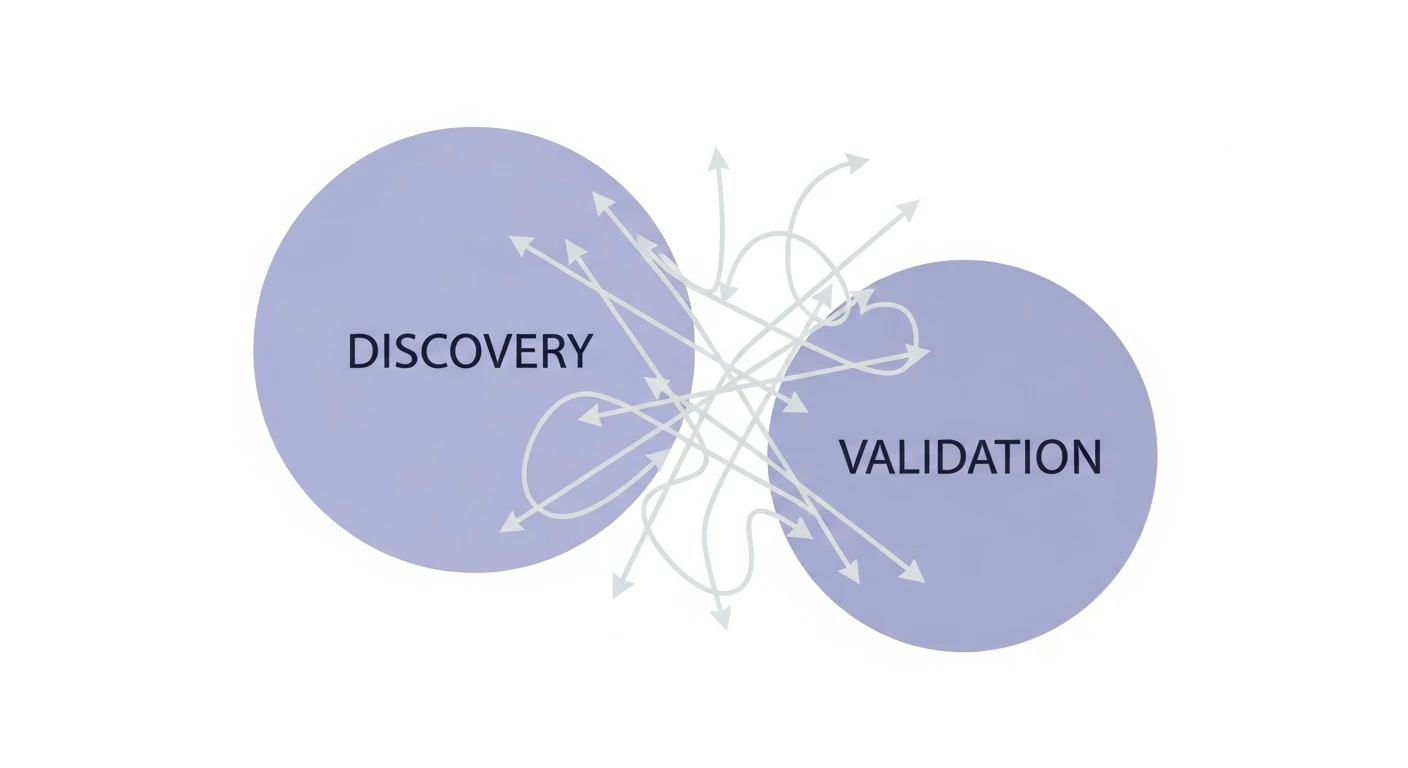
These are fundamentally different epistemic orientations. They require different interview structures, different probe strategies, different analytical frameworks, and different relationships with the participant. Mixing them in a single study does not save time -- it compromises both.
How the Mixing Happens
The Concept Introduction Trap
A team begins generative interviews exploring workflow friction. In interview three, a participant describes a workaround that sounds like a product opportunity. The researcher sketches the concept. By interview five, they are showing participants a rough concept and asking what they think. The study has silently transitioned from generative to evaluative without adjusting anything else.
The problem: once you introduce a concept, you have permanently altered the participant's frame. They are no longer thinking generatively about their problems -- they are thinking evaluatively about your solution. You cannot go back. The subsequent generative questions are contaminated by the concept exposure. Participants anchor on what you showed them rather than exploring their own experience freely.
The Validation Creep Pattern
Product managers commission generative research but carry evaluative expectations. "Discover what users need" comes with an implicit "and confirm that our roadmap is right." The researcher, sensing the stakeholder's real question, begins inserting evaluative elements: "What if a tool could do X?" "How would you feel about a feature that Y?"
Each evaluative insertion seems minor. Collectively, they shift the study's center of gravity from open discovery to directed validation. The findings feel generative because the study started that way, but they are contaminated by evaluative framing -- participants responded to researcher-introduced concepts rather than generating their own needs organically.
The Efficiency Rationalization
Timelines pressure researchers to combine phases. "We do not have budget for two separate studies, so let us do discovery and concept testing in the same sessions." This rationalization treats research phases as interchangeable modules that can be combined without interaction effects. They cannot.
Combining phases does not produce a study that is 50% generative and 50% evaluative. It produces a study that is 0% rigorous for either purpose because the methodological requirements of each undermine the other.
Why Mixing Fails
Framing Contamination
Generative research requires a clean cognitive canvas. The participant should be thinking about their own experience, their own problems, their own world. Evaluative elements introduce the researcher's world -- specific concepts, solutions, and possibilities that reshape what the participant notices and reports.
Once a participant sees your concept sketch, they cannot unsee it. Their subsequent descriptions of problems are filtered through the lens of "is this the kind of problem that tool would solve?" Their workflow descriptions become organized around the concept rather than around their actual experience. You have replaced their authentic frame with yours.
Demand Characteristic Shifts
In generative research, the implicit message to participants is: "You are the expert. Tell me about your world." In evaluative research, the implicit message is: "I have something. Tell me what you think of it." These create different demand characteristics -- different social pressures about what constitutes a good response.
When you mix them, participants receive conflicting signals about their role. Are they the expert or the judge? Are they generating or reacting? The uncertainty produces responses that serve neither role well: too directed to be authentically generative, too unfocused to be useful evaluation.
Analytical Impossibility
Generative data requires inductive analysis: building themes and patterns from the data without predetermined categories. Evaluative data requires deductive analysis: assessing responses against specific criteria related to the concept being tested.
Mixed data cannot be analyzed cleanly with either approach. Inductive analysis of evaluative responses produces themes that are artifacts of the concept you introduced, not genuine patterns in user experience. Deductive analysis of generative responses forces rich, open data into narrow evaluative categories that miss most of its value.
This connects to why assumption auditing before research matters so much. When teams map their assumptions first, they can clearly distinguish which assumptions need generative exploration (where they do not know enough to have a hypothesis) versus which need evaluative testing (where they have a specific solution to validate).
The Mid-Study Pivot Problem
Some researchers argue that qualitative methodology legitimizes mid-study pivots: grounded theory adjusts sampling based on emerging data, iterative design refines instruments based on early findings. This is true -- but pivoting from generative to evaluative is not methodological refinement. It is a paradigm change that invalidates the study's internal consistency.
Adjusting your sampling strategy based on early generative findings is good methodology. Shifting from discovery to validation within the same participant sessions is not adjustment -- it is abandoning one study and starting another while pretending it is the same study.
The distinction matters for how eval-driven development tests AI systems -- even in engineering, the principle holds that discovery (what should this system do?) and evaluation (does this system work?) require different methodologies, different metrics, and different stages.
Recognition Patterns
Your Guide Has Two Halves
Look at your discussion guide. If the first half is open questions ("Tell me about...", "Walk me through...") and the second half is reaction questions ("What do you think of...", "How would you rate..."), you have a mixed study. The transition point is where contamination begins.
Findings Sound Like Both Discovery and Confirmation
"Users struggle with X" (generative finding) followed immediately by "and they responded positively to our proposed solution" (evaluative finding) in the same report suggests mixing. Real generative findings should be surprising; real evaluative findings should be specific. Mixed findings are neither.
Participants Reference Your Concepts When Describing Their Problems
If participants in "discovery" interviews start using language from concepts you introduced ("Yeah, I would use that dashboard thing you showed me to..."), the generative phase has been contaminated. Their problem descriptions are no longer authentic -- they are organized around your solution.
The Separation Principle
Sequential, Not Simultaneous
Generative and evaluative research should be sequential phases with a clear boundary between them. Generative research produces understanding of the problem space. That understanding informs concept development. Concept development produces stimuli. Evaluative research tests those stimuli with fresh participants.
The boundary matters. Different participants for each phase prevents contamination. Time between phases allows for proper concept development informed by -- not contaminated by -- generative findings.
The Minimum Viable Separation
When budget truly constrains, the minimum viable separation is: generative questions first, complete them fully, then and only then introduce evaluative stimuli -- with explicit framing that resets the participant's role. "Now I am going to shift gears and show you something. This is separate from what we have been discussing."
This is a compromise, not best practice. It mitigates but does not eliminate contamination. The participant's generative responses are still authentic because concepts had not been introduced. But their evaluative responses may be influenced by the generative discussion that preceded them.
The Architecture of Separation
Just as context engineering in AI development requires careful architectural separation between different types of information to prevent contamination, research methodology requires architectural separation between generative and evaluative phases to prevent one from corrupting the other. The principle is identical: mixed inputs produce confused outputs.
Practical Takeaways
- Name the mode. Every study should be explicitly labeled generative OR evaluative. If you cannot choose one, you need two studies.
- Never introduce concepts in generative research. Once a concept enters the conversation, generative discovery is over. Everything after is reaction, not generation.
- Use different participants for each phase. The strongest protection against contamination is ensuring evaluative participants never went through generative sessions.
- Audit your discussion guide for mode mixing. Open exploration questions and concept reaction questions should never coexist in one guide.
- Resist the efficiency rationalization. One rigorous generative study plus one rigorous evaluative study costs less than one mixed study that produces nothing usable.
- Separate analysis approaches. Generative data gets inductive coding. Evaluative data gets deductive analysis. Never apply one approach to the other's data.
- Communicate the distinction to stakeholders. Stakeholders who understand the difference will stop asking for "discovery plus validation" in one project -- because they understand they are requesting methodological incoherence.
The generative-evaluative confusion persists because it looks efficient: one study, one budget line, one timeline, two kinds of answers. But methodological hygiene is not bureaucratic overhead. It is the difference between producing knowledge and producing noise that resembles knowledge. In research, cutting corners on methodology does not save time -- it wastes all of it.