Why Visual Methods Outperform Verbal-Only Interviews
Every researcher has experienced the moment when a participant struggles to articulate something they clearly feel. They pause, gesture vaguely, say "it's hard to explain." This isn't a failure of the participant — it's a failure of the method. We're asking people to convert complex, multi-sensory experiences into linear verbal narratives, and the translation loss is enormous.
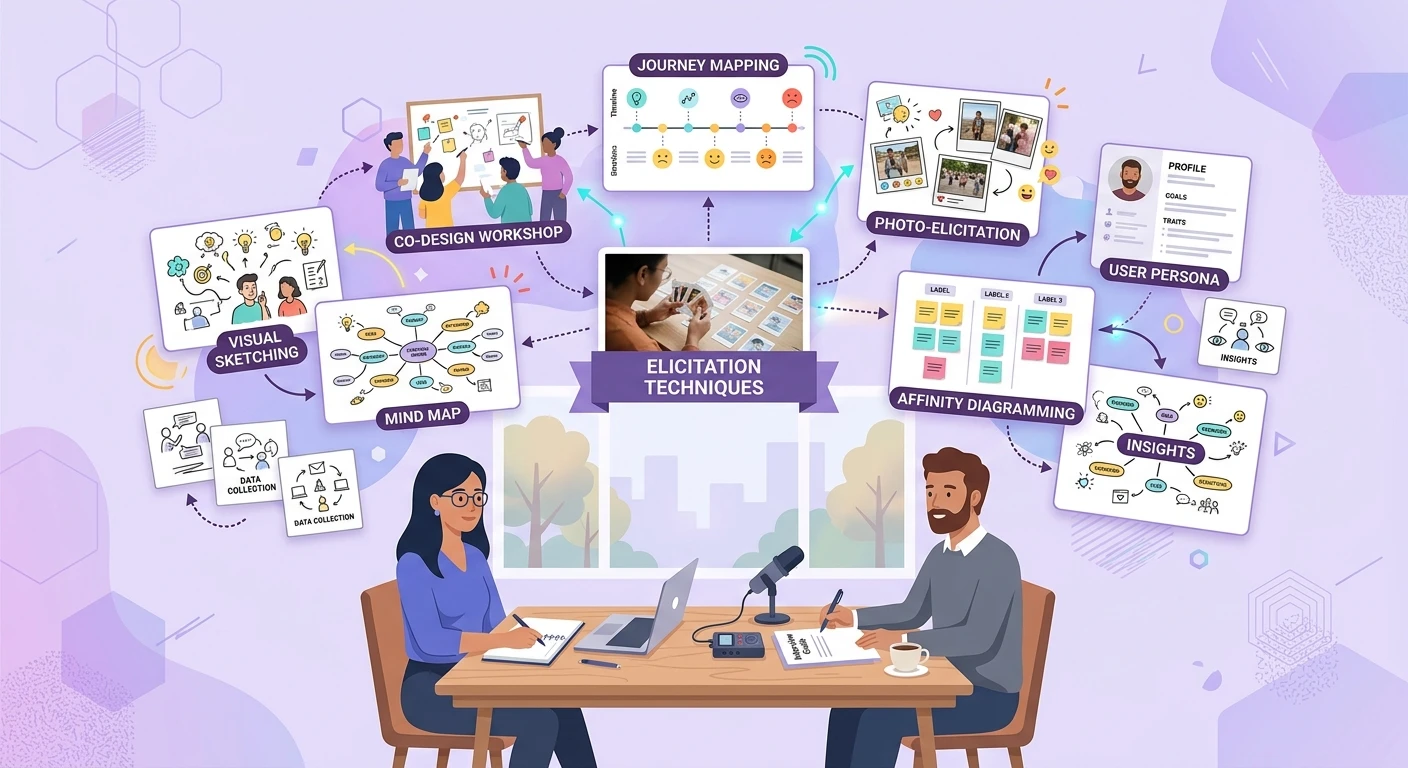
Visual elicitation solves this by giving participants alternative channels for expression. But most teams stop at photo elicitation — asking participants to bring photos or take screenshots. That's a starting point, not the full toolkit.
The broader visual elicitation repertoire includes participant-drawn diagrams, physical artifact walkthroughs, collaborative mapping exercises, timeline sketching, and spatial layout activities. Each unlocks different cognitive processes and produces different kinds of data.
The Cognitive Science Behind Visual Methods
Dual coding theory explains why visual methods work: humans process information through both verbal and imagistic systems simultaneously. When you ask someone to draw their workflow, you activate spatial reasoning, procedural memory, and relational thinking that verbal questions bypass entirely.
Research from cognitive psychology shows that visual-spatial tasks access different memory stores than verbal recall. A participant who cannot articulate why a particular interface feels "off" can often point to the exact moment in a sketched journey map where friction occurs. The visual representation serves as an external scaffold for internal knowledge.
This matters for UX research methodology because it means visual methods don't just produce "more data" — they produce fundamentally different data that verbal methods cannot access.
Diagrams: Making Mental Models Visible
Participant-drawn diagrams are perhaps the most underused visual technique in UX research. The power lies not in the final artifact but in the drawing process itself.
How to Facilitate Diagram Drawing
Give participants simple materials — blank paper, a few colored markers, sticky notes. Frame the task clearly: "Draw how information flows through your team when a customer complaint arrives." Then stay quiet. Resist the urge to clarify or guide.
What happens next is revelatory. Participants begin talking through their thinking as they draw. They cross things out, add arrows, circle important nodes. The verbal narration during drawing often contains insights that would never surface in a standard interview — because the drawing forces participants to confront gaps in their own mental models.
This approach works particularly well for understanding complex organizational workflows and decision-making processes that participants have never been asked to externalize before.
Remote Diagram Techniques
For remote research, digital whiteboard tools like Miro or FigJam work, but physical drawing via phone camera often produces richer results. Ask participants to grab any paper and pen, draw while you watch via video call, and photograph the result. The slight friction of physical drawing slows thinking in productive ways that drag-and-drop digital tools don't replicate.
Artifact Walkthroughs: Objects as Interview Prompts
Physical artifacts — the sticky notes on someone's monitor, the worn notebook they carry, the screenshot folder on their desktop — are condensed repositories of practice. An artifact walkthrough asks participants to show you these objects and narrate their significance.
Unlike photo elicitation where you assign a photo task in advance, artifact walkthroughs happen in-context. You might say: "Show me the tools you actually reach for when this situation arises" or "Walk me through what's currently open on your screen right now."
The artifacts reveal workarounds, improvised systems, and unspoken priorities that participants would never think to mention in a conventional interview. A Post-it note on a monitor tells you more about actual workflow than any process document.
When combined with reflexive note-taking practices, artifact walkthroughs produce data that bridges the gap between what people say they do and what they actually do.
Collaborative Mapping Exercises
Mapping exercises — journey maps, ecosystem maps, relationship diagrams — work especially well in dyadic or group settings. The collaborative aspect means you capture negotiation, disagreement, and shared understanding in real time.
Journey Map Co-Creation
Instead of creating journey maps from interview transcripts after the fact, co-create them during the session. Lay out a timeline (physical or digital) and ask participants to place key moments, pain points, emotions, and decisions along it. Let them argue about sequence. Let them add branches for different paths.
The resulting map is messier than a polished deliverable — and far more accurate. Disagreements about sequence reveal where experience diverges from institutional narrative.
Ecosystem Mapping
For understanding complex stakeholder relationships or tool ecosystems, ask participants to draw circles representing all the people, tools, or systems they interact with for a specific task. Then draw lines showing information flow, influence, or dependency.
This is especially valuable for understanding how research democratization plays out in practice — you can see exactly where non-researchers engage with research artifacts and where gaps exist.
When to Choose Which Visual Method
| Method | Best For | Cognitive Access |
|---|---|---|
| Photo elicitation | Environmental context, emotional associations | Episodic memory, affect |
| Participant diagrams | Mental models, system understanding | Spatial reasoning, procedural knowledge |
| Artifact walkthroughs | Actual practice vs. stated practice | Embodied knowledge, tacit routines |
| Collaborative mapping | Shared understanding, disagreements | Social cognition, negotiated meaning |
| Timeline sketching | Process, sequence, critical incidents | Temporal reasoning, narrative memory |
The choice depends on what kind of knowledge you're trying to access. If you need to understand how participants feel about an experience, photos and artifacts work. If you need to understand how they think about a system, diagrams and maps work.
Practical Implementation Tips
Warm up participants. Not everyone is comfortable drawing. Start with low-stakes sketching — "just boxes and arrows, nothing artistic" — to reduce performance anxiety.
Record the process, not just the product. The conversation during drawing contains as much insight as the final artifact. Screen-record digital sessions; video-record physical ones.
Analyze visually. Don't immediately transcribe visual data into text. Lay out diagrams side-by-side across participants. Look for spatial patterns — where do people place certain elements? What gets drawn first? What gets crossed out?
Combine with verbal probes. Visual methods work best as springboards for follow-up questions: "I notice you drew this step much larger than the others — tell me about that" or "You hesitated before adding this connection — what were you thinking?"
When integrated with AI-powered analysis tools, visual elicitation data can be systematically coded alongside verbal transcripts, creating richer thematic networks than either source alone.
The ROI of Visual Methods
Teams who incorporate visual elicitation report three consistent outcomes: interviews run shorter (participants communicate faster visually), insights are more actionable (spatial data translates directly to design decisions), and participant engagement is higher (people enjoy drawing more than talking).
For research operations teams measuring program impact, visual methods also produce artifacts that are inherently more shareable with stakeholders than transcript excerpts. A participant-drawn diagram on a research wall generates more stakeholder engagement than any quote card.
Getting Started
You don't need to overhaul your research practice. Start by adding one visual prompt to your next interview guide. Ask participants to sketch something — their workflow, their decision process, their tool ecosystem. Notice what emerges that you wouldn't have heard through questions alone.
The goal isn't to replace verbal interviews. It's to recognize that human experience is multi-modal, and our research methods should be too.