You Are Analyzing a Translation, Not an Interview
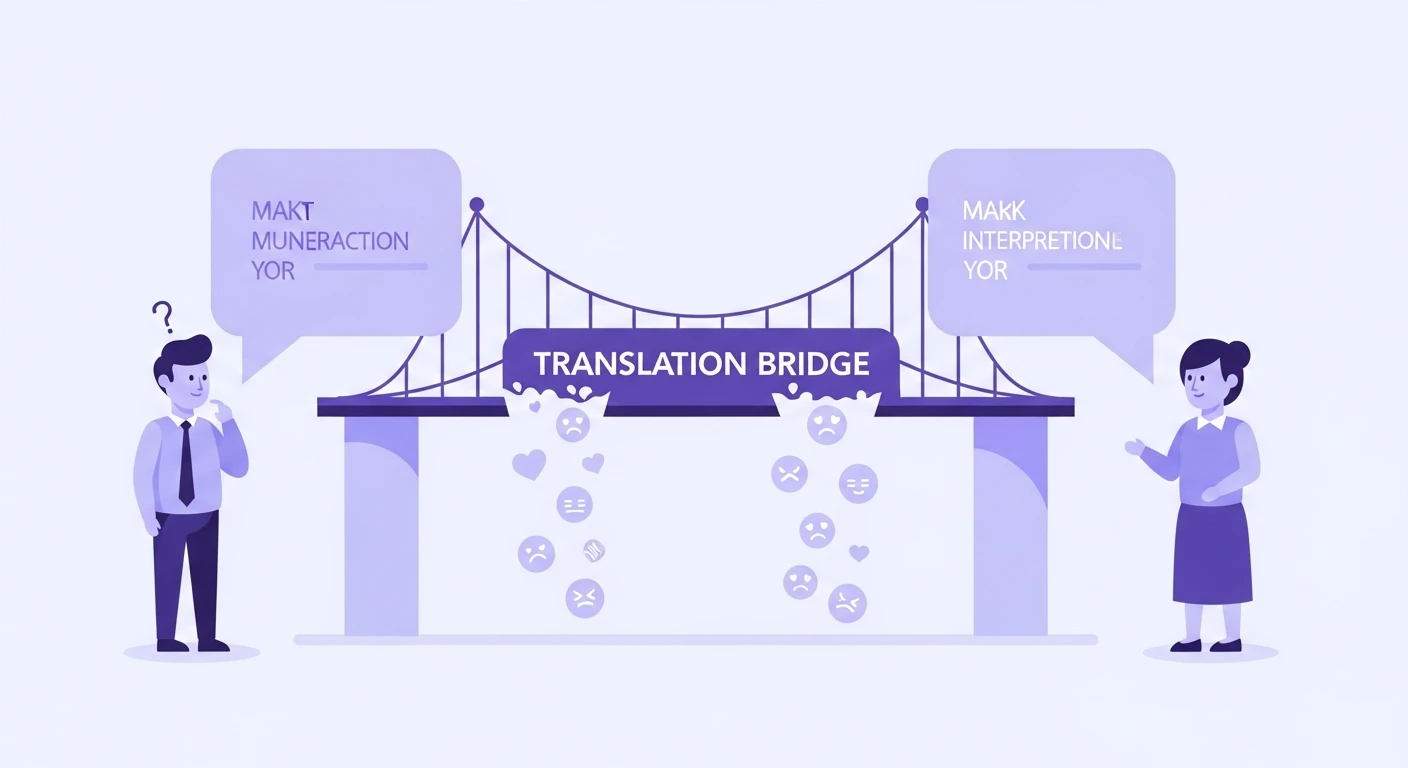
Global products demand global research, and global research runs into a wall the moment your participant speaks a language you do not. The standard fix is an interpreter -- someone who listens to the participant and relays a translated version to you in real time. It feels like a clean solution. It is not. What you receive is not the participant's answer; it is the interpreter's compressed, real-time reconstruction of the answer, and everything that gets lost in that compression is lost to your analysis before you ever touch the data.
The interpreter effect is the systematic distortion introduced when a human intermediary stands between the participant's words and the researcher's ears. It is not incompetence -- good interpreters are extraordinary. It is structural. Interpretation under time pressure requires constant decisions about what to keep, what to drop, and how to render meaning that does not map cleanly across languages, and every one of those decisions quietly reshapes your data. The participant said something with hedges and false starts and a culturally specific idiom; you heard a fluent, confident, decontextualized paraphrase.
What Falls Through the Gap Between Languages
The first casualty is hesitation. A participant who says the equivalent of "well... I mean, I guess it was fine, sort of" is telling you something important through the hedging itself -- but interpreters, trained to be clear, routinely render that as "she says it was fine." The uncertainty that was the finding gets translated into false confidence, a close cousin of the confidence calibration gap where certain-sounding participants are often the least accurate -- except here the certainty was manufactured by the translation, not the participant.
The second casualty is idiom and metaphor, which is where mental models live. When a participant reaches for a culturally specific comparison to explain how they think about your product, they are handing you exactly the kind of data that metaphor elicitation is designed to surface. An interpreter under pressure will translate the meaning and drop the metaphor -- delivering "he finds it frustrating" instead of the vivid image the participant actually used. The insight was in the image, and the image did not survive.
The third casualty is contradiction. Participants reveal the most when they say something that undercuts what they said earlier, and detecting those contradictions is one of the highest-value moves in qualitative analysis. But an interpreter smoothing for coherence will reconcile the contradiction on your behalf -- resolving the tension into a single tidy statement and deleting the friction that would have told you where the real story was.
The Loss Is Invisible Because It Reads Fluently
What makes the interpreter effect so dangerous is that the output looks better than the input. The translated version is more fluent, more confident, and more quotable than the halting original -- so it inspires more trust, not less. You cannot audit what you never heard, and the participant's actual words are gone the instant the interpreter paraphrases them. This is the same structural problem as the decontextualization problem, where quotes lose their meaning once extracted from the surrounding conversation -- the interpreter effect just does the extracting live, in another language, with no transcript of the original to check against.
And when AI transcription or summarization runs on top of the interpreted feed, it compounds. The machine treats the interpreter's paraphrase as ground truth and builds fluent findings on a foundation that was already a lossy reconstruction -- the confabulation risk where machine-written findings invent coherence that was never in the data, now stacked on top of a human paraphrase. Enterprise AI teams know this failure mode well: garbage that enters the pipeline confidently gets treated as signal downstream, which is exactly why they insist on data contracts that pin down what each layer is actually allowed to assume about its inputs. Multilingual research has no such contract between the participant's words and your notes.
Running Multilingual Research Without Losing the Insight
You cannot eliminate the interpreter effect when you do not share a language, but you can stop treating the interpreted feed as the raw data and build a workflow that preserves the original.
- Record and back-translate the source language. Keep the original-language audio and have a second translator produce a full transcript afterward, so the hedges, idioms, and contradictions that live-interpretation dropped are recoverable rather than gone forever.
- Brief interpreters to preserve, not polish. Ask explicitly for hesitations, false starts, and hedges to be relayed rather than smoothed, and for idioms to be rendered literally with a note rather than translated away. Interpreters optimize for what you tell them matters.
- Prefer native-language moderators where the stakes justify it. When a study will drive a real decision, a moderator who shares the participant's language removes the intermediary entirely -- the same logic behind treating research design handoffs as a place where insight quietly dies in translation.
- Keep the source traceable end to end. Every finding should map back to the original-language moment it came from, not just the interpreter's rendering of it -- the qualitative version of the audit trails enterprise AI systems use to trace any output back to its evidence.
Multilingual research is not optional for a global product, and interpreters are not the enemy -- working blind is. A study that preserves the source language, briefs for fidelity over fluency, and keeps every insight traceable to the words the participant actually used is a study where the meaning survives the trip between languages, instead of getting quietly left behind in it.
Qualz.ai preserves source-language recordings and transcripts alongside translations, so your analysis stays anchored to what participants actually said -- in any language. See how global research teams keep the insight in multilingual studies with Qualz.ai.