The Participant Who Said All the Right Things and Meant None of Them
The transcript looks great. The participant was articulate, cooperative, gave you complete-sentence answers to every question, never went quiet, never got confused. On paper it was one of your cleanest sessions. And it is almost entirely worthless, because for most of that hour the participant was answering you with the front third of their attention while the rest of their mind was on a work thread, a second browser tab, and the phone face-up beside the keyboard.
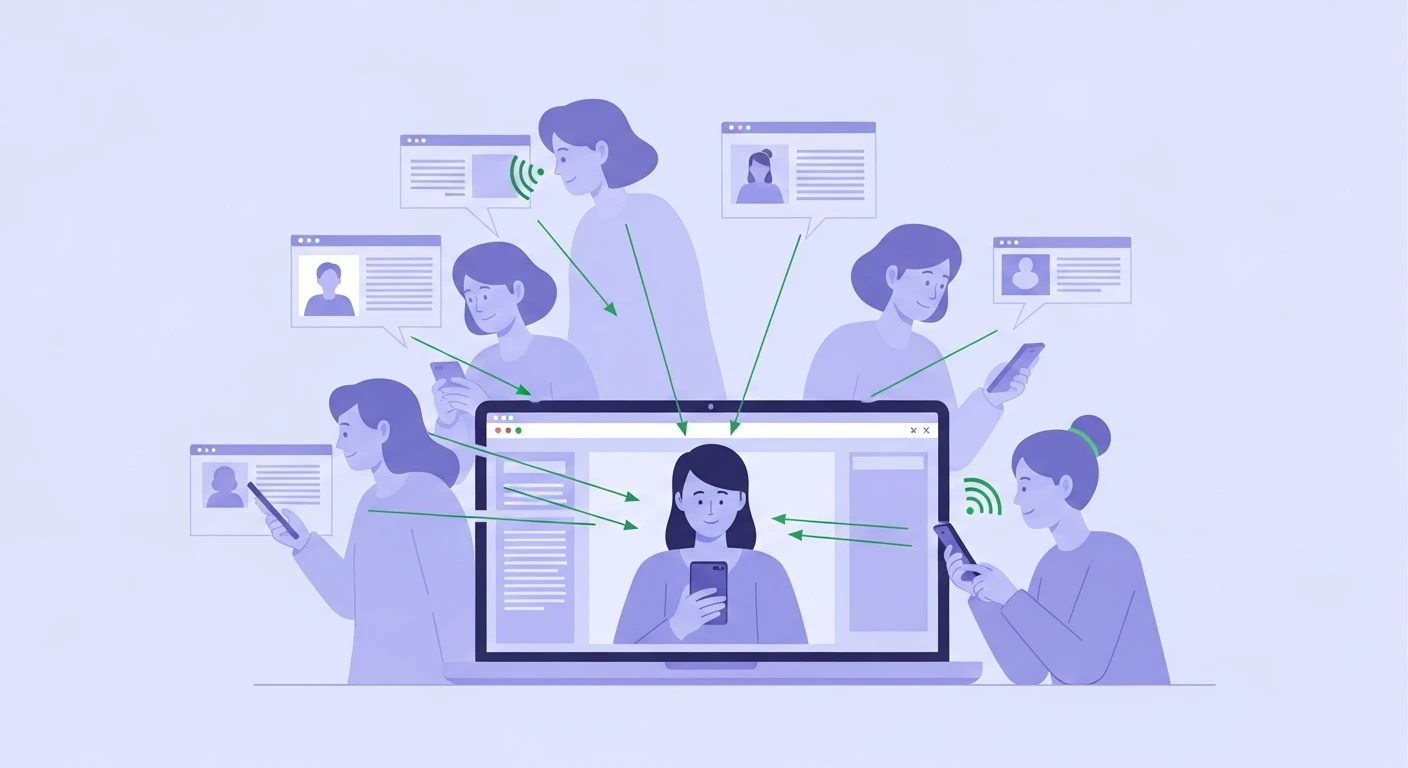
Remote research quietly traded one problem for another. It solved recruitment friction and geographic reach, and in exchange it handed participants a home-office environment engineered for continuous partial attention. The multitasking participant is not being difficult. They are doing what remote knowledge work has trained everyone to do -- and the fluent, agreeable, low-effort answers that divided attention produces are the most dangerous data in your study, because they pass every surface check for engagement while carrying almost no real cognitive access to the experience you are asking about.
Why Divided Attention Produces Fluent Nonsense, Not Silence
The intuitive fear is that a distracted participant will go quiet or say "sorry, can you repeat that." The opposite is true. Under divided attention, the mind falls back on its cheapest, most automatic response mode: it pattern-matches the question to a plausible-sounding answer and produces it without deep retrieval. You get fluency without access -- confident sentences generated by the linguistic autopilot while the effortful work of actually consulting memory and experience never happens.
This is why a distracted participant is more dangerous than a confused one. Confusion is a signal you can see and respond to. Fluent autopilot looks exactly like engagement. It is closely tied to the confidence calibration gap, where the most certain-sounding participants are frequently the least accurate -- and divided attention widens that gap, because autopilot answers arrive with unearned fluency and zero hesitation.
Worse, when you ask a distracted participant about behavior or intent, they will not admit they did not really think about it. They will construct something coherent on the spot, which is the narrative coherence bias operating at full strength -- and under divided attention the constructed narrative is even further from real experience, because there is no cognitive budget left to check the story against what actually happened.
The Environments That Manufacture Divided Attention
Back-to-back calendars
A participant who joined your interview from a meeting and has another meeting after it is not present. They are context-switching through your session, treating it as one more item to survive. Their answers carry the residue of the previous call and the anticipation of the next -- a personal-scale version of the contamination that shows up in the context switching cost of same-day interviews on the researcher's side; the participant suffers the identical degradation.
The second screen
The single biggest tell in remote research is eye movement toward a second monitor. When a participant is reading email while answering you, their responses become shorter, more generic, and more agreeable -- agreement is the lowest-effort way to keep a conversation moving while attention is elsewhere. This amplifies the acquiescence bias already documented in video interviews, where remote participants agree more than in-person ones; divided attention is one of the mechanisms behind that effect.
The unmoderated illusion of engagement
In unmoderated remote studies the problem is unbounded, because no one is watching for attention at all. A participant can complete an entire task while barely engaging with the product, producing a full record that looks like data and is mostly compliance -- the exact dynamic of the satisficing threshold in unmoderated research, where participants complete tasks without actually engaging.
How to Detect Divided Attention in the Moment
Watch latency, not just content. An engaged participant retrieving a real memory pauses before answering. An autopilot answer arrives instantly and generically. Counterintuitively, the fast fluent answer is the suspect one; the thoughtful pause is the sign of genuine access.
Plant specificity probes. Ask for a concrete instance -- "walk me through the last actual time this happened, step by step." Autopilot cannot fake episodic detail. A participant who was truly engaged supplies texture; a distracted one produces a generic summary and cannot descend to specifics. This is the specificity gradient used as a diagnostic instrument.
Introduce a deliberate contradiction. Gently restate their previous answer slightly wrong. An attentive participant corrects you immediately; a distracted one agrees with the misstatement, revealing they were not tracking their own responses.
How to Design Against It
Contract for attention explicitly, up front. "This needs your full attention for 40 minutes -- can you close other tabs and silence your phone now, on the call, before we start?" Naming it and doing it together on camera works far better than a line in the consent form nobody reads.
Shorten ruthlessly. Divided attention compounds with duration. A focused 30-minute session beats a distracted 60-minute one, which is the deeper lesson of adaptive interview termination -- ending while attention is intact produces better data than completing the full guide on autopilot.
Instrument attention as signal, not just content. Treating engagement as a measurable dimension of data quality -- rather than assuming a completed session equals a valid one -- is the research analog of what mature engineering teams do with observability for production AI systems, where you monitor the health of the process and not only the final output. A transcript without an attention signal is an output with no telemetry behind it.
Schedule for presence. Ask participants to book a slot with buffer on both sides, from a quiet space, not wedged between meetings. When you cannot control the environment, at least surface it -- and weight the data accordingly, the way governance-minded teams keep an audit trail of the conditions under which a result was produced.
The Standard: Attention Is Part of Data Quality
We spend enormous effort on sampling, screening, and question design, and then quietly assume that whoever shows up will be fully present. Remote research broke that assumption, and most teams have not updated their quality model to account for it. A fluent transcript from a divided mind is not a good session with minor noise -- it is a fundamentally different, and largely fictional, kind of data.
Treat attention as a first-class variable. Detect it, design for it, and be willing to discard or discount the sessions where it was absent. The alternative is a repository full of articulate, agreeable, confidently-worded answers that describe an experience the participant was never actually attending to.
Running remote research at scale? Qualz.ai helps teams design interviews that hold participant attention and surface the sessions where it slipped -- so your insights rest on genuine engagement, not fluent autopilot. Book a demo to see how.