Same Room, Two Studies
The comforting story about note-taking is that it captures what happened. A participant said something, the researcher wrote it down, and the note is a faithful shard of the session preserved for later. Under that story, two competent researchers observing the same interview should produce roughly the same notes, give or take handwriting speed.
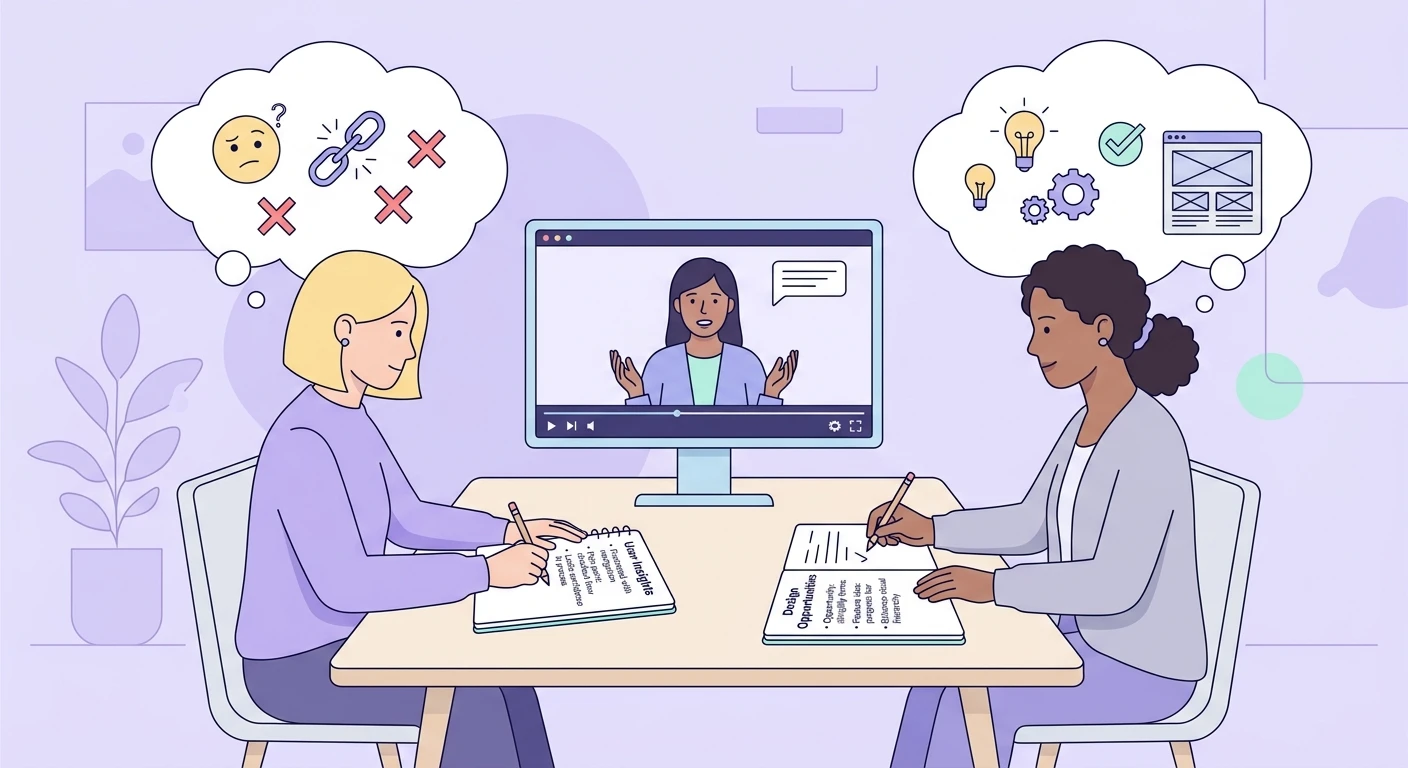
They do not. Ask any team that has actually run this comparison. One researcher's page is dense with quotes about pricing hesitation; the other's is dense with observations about where the participant's cursor hovered and stalled. One flagged a moment of visible frustration as the headline of the session; the other did not record it at all, because they were mid-sentence capturing a workaround the participant described. Both were paying close attention. They were simply paying attention to different studies.
The note-taking divergence is the systematic tendency for observers to record non-overlapping subsets of the same session, filtered by what they already expected to find. It is not sloppiness. It is the unavoidable consequence of the fact that notes are selective by nature, and selection is driven by prior frames. The danger is that we treat the resulting notes as raw data when they are already an interpretation -- and two interpretations wearing the costume of one transcript.
Notes Are a Model of Attention, Not a Recording
A note is written in real time, under load, while the session keeps moving. You cannot write everything, so you write what registers as important in the instant it happens. What registers as important is governed by the mental model you walked in with. A researcher hunting for onboarding friction hears friction everywhere; a researcher scoping a pricing study hears cost signals in the same sentences. The transcript is identical. The salience map is not.
This is the same underlying failure as the articulation gap between what users say and what they actually do, pushed up one level. There, the participant's report diverges from their behavior. Here, the observer's record diverges from the full session. In both cases a partial, self-serving account gets mistaken for the ground truth, and decisions get built on the shard rather than the whole.
It also compounds a problem we have written about in machine analysis. When a fluent summary reads as authoritative, teams stop asking what it left out -- the exact risk in the confidence calibration gap, where certain-sounding accounts are often the least accurate. A clean, confident set of notes projects completeness it never had. The gaps do not announce themselves; they are simply the things nobody wrote down, and therefore the things nobody will ever debate.
Where the Fork Does Its Damage
Analysis inherits the split. When two researchers bring divergent notes to synthesis, the themes that survive are the ones both happened to capture. Everything one person saw and the other missed becomes a single-source claim -- easy to dismiss, easy to forget. The team converges not on what mattered most in the sessions, but on the accidental intersection of two attention patterns.
Debriefs launder the divergence. The first researcher to speak in a debrief sets the frame everyone else's notes get sorted against, a dynamic we have called the availability cascade in stakeholder debriefs, where the first insight shared becomes the one everyone remembers. The second researcher's non-overlapping observations now sound like tangents rather than the other half of the study.
Counting gets corrupted. If you tally how many notes mention a theme, you are really tallying how many observers were tuned to that theme -- not how prevalent it was in the sessions. This is the counting trap in qualitative analysis, where theme frequency measures your capture process, not reality, and note-taking divergence is one of its quiet engines.
Single-observer studies hide it entirely. With one note-taker, there is no second page to reveal what was missed. The divergence still happened -- against the full session -- you just have no way to see it. Solo studies do not escape the problem; they only remove the evidence of it.
Closing the Gap Without Pretending It Does Not Exist
Capture the session, not just the notes. The single most effective move is to stop treating notes as the record. Record audio and video, and treat notes as an index into it, not a replacement for it. Reading transcripts instead of returning to the source has its own failure mode -- the transcription substitution effect, where reading strips the paralinguistic meaning you needed most -- so the discipline is to keep the raw session recoverable and go back to it in synthesis, not to trust any secondhand artifact.
Assign complementary lenses on purpose. If divergence is inevitable, direct it. Before the session, give each observer an explicit remit -- one on behavior, one on language, one on emotion -- so the coverage is designed rather than accidental. You will still get non-overlapping notes, but now the union is comprehensive instead of the intersection being impoverished.
Separate observation from interpretation on the page. Train note-takers to record what happened in one column and what they think it means in another. The interpretation column is where the prior frame does its filtering; making it visible lets the team challenge it instead of inheriting it silently.
Reconcile before you synthesize. Hold a short structured pass where observers compare notes against the recording specifically to surface what one saw and the other missed. The goal is not consensus; it is recovering the full session before the analysis forks for good. This is the same instinct behind negative case analysis, deliberately hunting the observations that contradict the emerging story.
Use structured capture to widen the aperture. Consistent prompts and shared observation frameworks reduce how much each researcher's private priors drive what gets recorded. This is where Qualz.AI helps: sessions are captured in full, notes and highlights are anchored to the source moment rather than floating free, and synthesis works from the whole session instead of one observer's filtered page -- so the divergence becomes visible and correctable instead of baked silently into your findings.
The Takeaway
Notes feel like data. They are actually a record of where each researcher's attention was already pointed. Two people watching one interview will write two studies, and if you never reconcile them against the full session, you will ship the accidental overlap and lose everything only one person happened to see. Treat the recording as the record, design your observation lenses on purpose, and reconcile before you synthesize -- because the fork in your analysis happens the moment the notes do, long before anyone opens a spreadsheet.
Want your team working from the whole session instead of divergent notebooks? See how Qualz.AI captures and anchors qualitative research so nothing that mattered depends on who was watching.