The Observer You Built Into the Method
Diary studies exist to escape the fundamental problem of interviews: that you are asking people to reconstruct experiences long after the fact, in an artificial setting, from unreliable memory. Instead of interviewing someone about their week, you have them capture moments as they happen -- a photo, a voice note, a quick entry -- so you get behavior in context instead of a retrospective story about it. It is one of the most powerful tools in the qualitative arsenal, precisely because diary studies reveal what interviews miss.
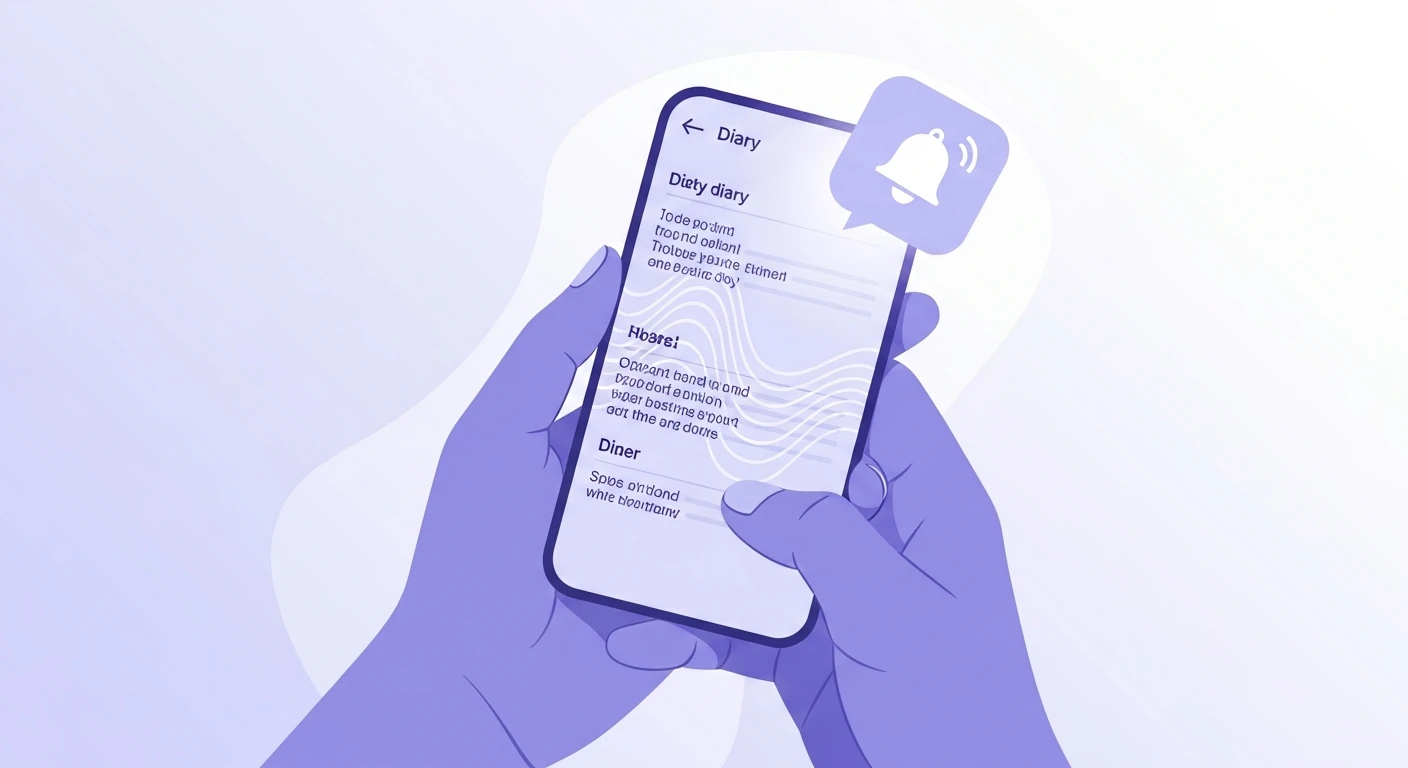
But there is a mechanism buried in the method that most teams never examine: the prompt. Participants do not spontaneously remember to log every relevant moment; they need reminders, and those reminders arrive as notifications. Each notification is a small act of intervention. It interrupts whatever the participant was actually doing, pulls their attention out of the lived experience, and asks them to become an observer of themselves. The moment you were trying to capture unobtrusively has now been altered by the act of capturing it.
Prompting Does Not Record Behavior -- It Creates It
The core problem is that a prompt is not a passive trigger. When a participant receives a notification asking "what are you doing right now and how do you feel about it?", several things happen at once. Their attention shifts from the task to the meta-task of reporting. They begin monitoring themselves in a way they were not moments before. And critically, the repeated prompting trains them to notice and frame experiences in the categories your study cares about -- which means by day three, they are no longer behaving naturally; they are living inside your research instrument.
This is a close cousin of the observer effect, where the awareness of being watched changes how people behave -- except in a diary study the observer is not in the room, it is in their pocket, firing on a schedule you set. The frequency of your prompts becomes a hidden variable in your data. Prompt rarely and you get sparse, retrospective entries that reintroduce the memory distortion you were trying to escape. Prompt often and you saturate the participant's attention, making them hyper-aware of a behavior that, unprompted, they would have performed without a second thought. There is no neutral prompting frequency; every choice shapes the behavior.
The Prompts Themselves Prime the Answers
Beyond interruption, the wording and timing of a prompt actively steer what gets recorded. A notification that asks "how frustrating was that experience?" has already told the participant that frustration is the expected frame, and they will dutifully look for something frustrating to report. This is the diary-study form of priming contamination, where the framing embedded in a question shapes the response before the participant even engages with it. The participant is not reporting their experience; they are completing the frame you handed them.
Timing compounds it. A prompt that fires at a fixed hour catches whatever is happening at that hour, systematically over-sampling routine moments and missing the irregular, unpredictable ones that often carry the real insight. And when AI tooling ingests these prompted entries and rolls them into a tidy summary, it treats every entry as an equivalent, spontaneous observation -- flattening the enormous difference between a moment the participant volunteered and a moment your notification manufactured. It is the same failure enterprise teams design against when they demand observability that distinguishes real signal from artifacts the monitoring system itself introduced. A diary study without that distinction cannot tell you which of its own entries it caused.
Running Diary Studies That Measure Behavior, Not Prompting
You cannot run a diary study with zero prompting -- participants will simply forget. But you can design the prompting so it disturbs the behavior as little as possible and so you can see its footprint in the data.
- Vary prompt timing randomly instead of on a fixed schedule. Randomized, experience-sampling-style triggers avoid systematically over-sampling the same hour and catch the irregular moments that fixed prompts miss entirely, the logic behind experience sampling for capturing real behavior in the moment.
- Keep prompts open and frameless. Ask "what just happened?" not "how annoying was that?" so the participant supplies the frame instead of completing yours -- and you learn what they noticed rather than what you told them to notice.
- Log the prompt metadata alongside every entry. Record when each notification fired and how long after it the participant responded, so in analysis you can tell a fresh in-the-moment entry from a delayed reconstruction and weight them differently rather than treating them as identical.
- Triangulate prompted entries against unprompted behavioral traces. Where you can, compare what participants logged against actual usage data or artifacts, so the prompted narrative has to survive contact with what they actually did -- the discipline of triangulation, where one data source is never enough.
A diary study is one of the few methods that can genuinely capture behavior in the wild, but only if you treat the prompt as the intervention it is. The teams that randomize their timing, keep their prompts frameless, and track the footprint of their own notifications get diary data that reflects the participant's life. The teams that ping on a fixed schedule with leading questions get a careful record of a behavior that exists only because they kept asking about it.