A discussion guide is the list of questions and topics an interview follows. Where the stimulus sits in it decides what you learn, so this guide covers placement, wording and order, with a sample you can adapt. If you're still deciding whether to show anything at all, start with when to use a stimulus-based interview, and for a refresher on the method, see what a stimulus-based interview is.
Where does stimulus go in a discussion guide?
Usually after the open questions. Once people have seen the stimulus, you can't get back what they'd have said without it, which is why good guides move from general to specific (Krueger, 2002). The one exception is material everyone must see before the questions make sense, such as a product video, which goes at the very start.
How should you ask about each stimulus?
How you ask matters as much as what you show. The same image can get honest, detailed answers or polite, vague ones depending on the wording, so these three habits are worth building into every question.
- Tie each one to a single question. Attach each image to the one question it's about, rather than showing several and asking about them together. When every answer sits next to the image it's about, you know exactly what people were looking at, and the analysis stays clean.
- Get the first reaction before the details. Ask "What's your first reaction?" before asking about the color, the claim or the price, because detailed questions shape the overall verdict (Schwarz et al., 1991). Then ask what people see and what it's telling them, before what they like.
- Keep the wording neutral. "Do you think this design is modern?" hands people the answer, while "How would you describe the style of this design?" leaves it to them (AQR). Tell people that criticism helps, so they don't hold back to be polite (Krueger, 2002).
How many stimuli, and in what order?
Order and number change the answers too. People judge each concept partly against the ones they've already seen, and they tire as the interview goes on, so plan both before you write the questions.
- Show concepts one at a time, then compare. Give each concept a clean first reaction of its own. Then show them together, because people go easy on a design they see alone (Tohidi et al., 2006).
- Rotate the order. Whatever comes first tends to win (Carney and Banaji, 2012), so rotate the order across participants (AQR). With three concepts, show A-B-C to some, B-C-A to others and C-A-B to the rest.
- Don't show too many. Attention runs out, and later answers get shorter and more alike (Galesic and Bosnjak, 2009). Our stimulus guide suggests 3 to 6 items in a 15-minute interview.
What does a discussion guide with stimulus look like?
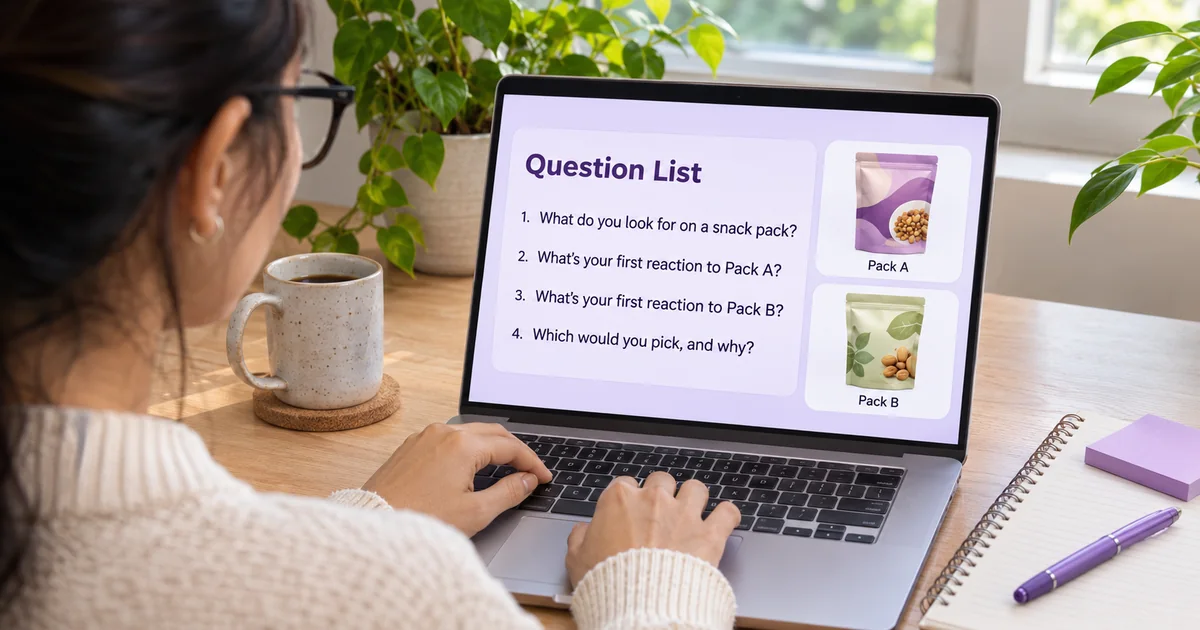
Here's how that comes together in a short guide for testing two snack pack designs with parents. The first two sections show nothing at all, so parents say what matters to them before they see either pack, and half of them should see Pack B first.
| Section | Stimulus | Example question |
|---|---|---|
| Warm-up | None | Tell me about the last time you bought a snack for your kids. |
| Open questions | None | What do you look for on a snack pack? |
| Pack A | Pack A | What's your first reaction? What is this pack telling you? |
| Pack B | Pack B | What's your first reaction? What is this pack telling you? |
| Comparison | Packs A and B together | Which would you pick, and why? |
| Close | None | Is there anything about snack packs we haven't covered? |
How does Qualz.ai support stimulus in a discussion guide?
In Qualz.ai, you attach stimulus images to the questions in your guide, and nothing shows until the moderator reaches one, which keeps your opening questions unprompted. Each image comes with a private note that tells the moderator what it shows and what you want to learn. Stimulus appears in the order of your guide, so to rotate, duplicate the study and reorder the questions in each copy.
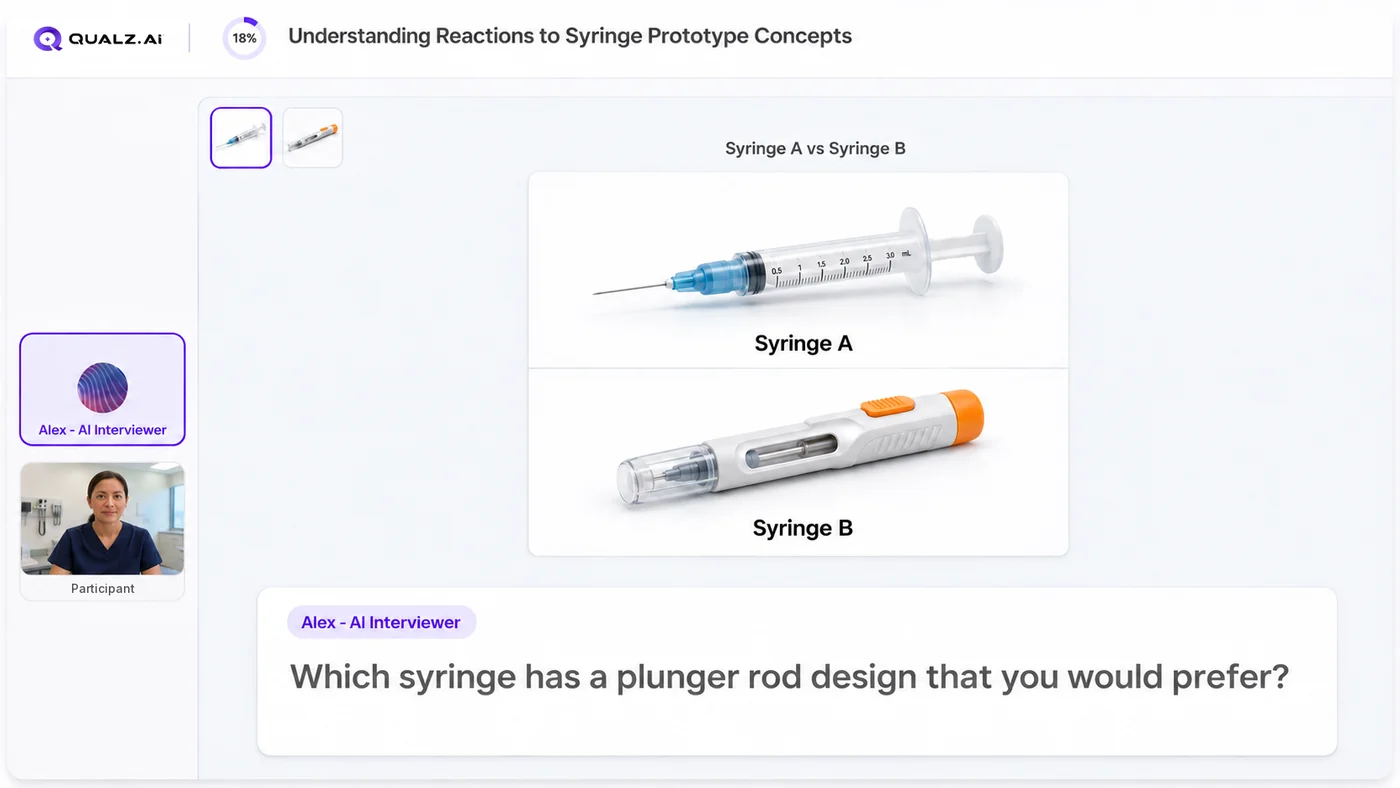
A video or PDF everyone must see first can go on the Pre-Interview Stimulus Screen, images can also sit beside survey questions, and AI analysis finds the themes afterwards. Before you go live, take the interview yourself through the preview link to check each image appears at the right moment.
One pharmaceutical manufacturer used it to test a multi-million-dollar product decision, with findings from 155 interviews in 28 days instead of 14 to 20 weeks (read the case study). Book a call if you'd like a second pair of eyes on your guide.
Frequently asked questions about stimulus in discussion guides
What is the difference between monadic and sequential monadic testing?
In a monadic test, each participant sees just one concept. In a sequential monadic test, each participant sees several, one after another, and reacts to each on its own before any comparison.
What is order bias in research?
It's when the order you show things in changes how people judge them. The item shown first often has an advantage, which is why researchers rotate the order across participants.
How do you write a discussion guide for an AI-moderated interview?
Much the same way as for a human moderator. The difference is that the AI only knows what you tell it, so give it the briefing a person would get, such as what each image shows and what you want to learn from it.
Ready to build your discussion guide?
Book a call, bring your draft guide, and we'll help you place each stimulus.