The Agreement Problem Nobody Adjusted For
You run twenty interviews over Zoom. Participants consistently validate your product concepts, agree with your framing of their problems, and confirm your emerging hypotheses. You conclude that product-market fit is strong.
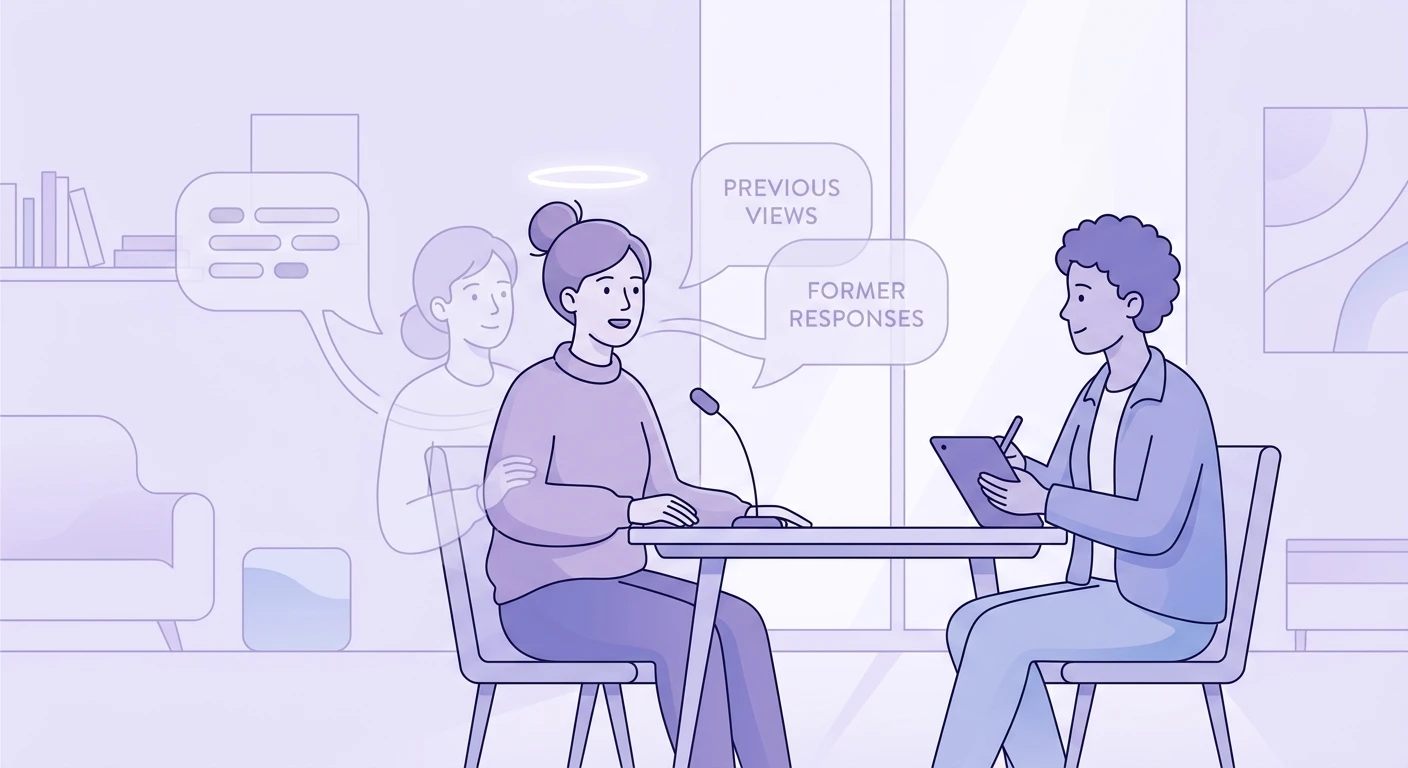
Then you run five in-person interviews with similar participants. Suddenly, the pushback appears. Participants interrupt you. They reframe your questions. They say "actually, that is not how I think about it at all."
The difference is not the participants. It is the medium. Video interviews create systematic pressure toward agreement that most research teams never account for in their analysis.
Why Video Amplifies Acquiescence
Reduced Social Presence
In face-to-face conversation, disagreement is softened by body language -- a slight lean forward, a concerned expression, a gesture that says "I hear you but..." before the words come. These micro-signals make disagreement feel collaborative rather than confrontational.
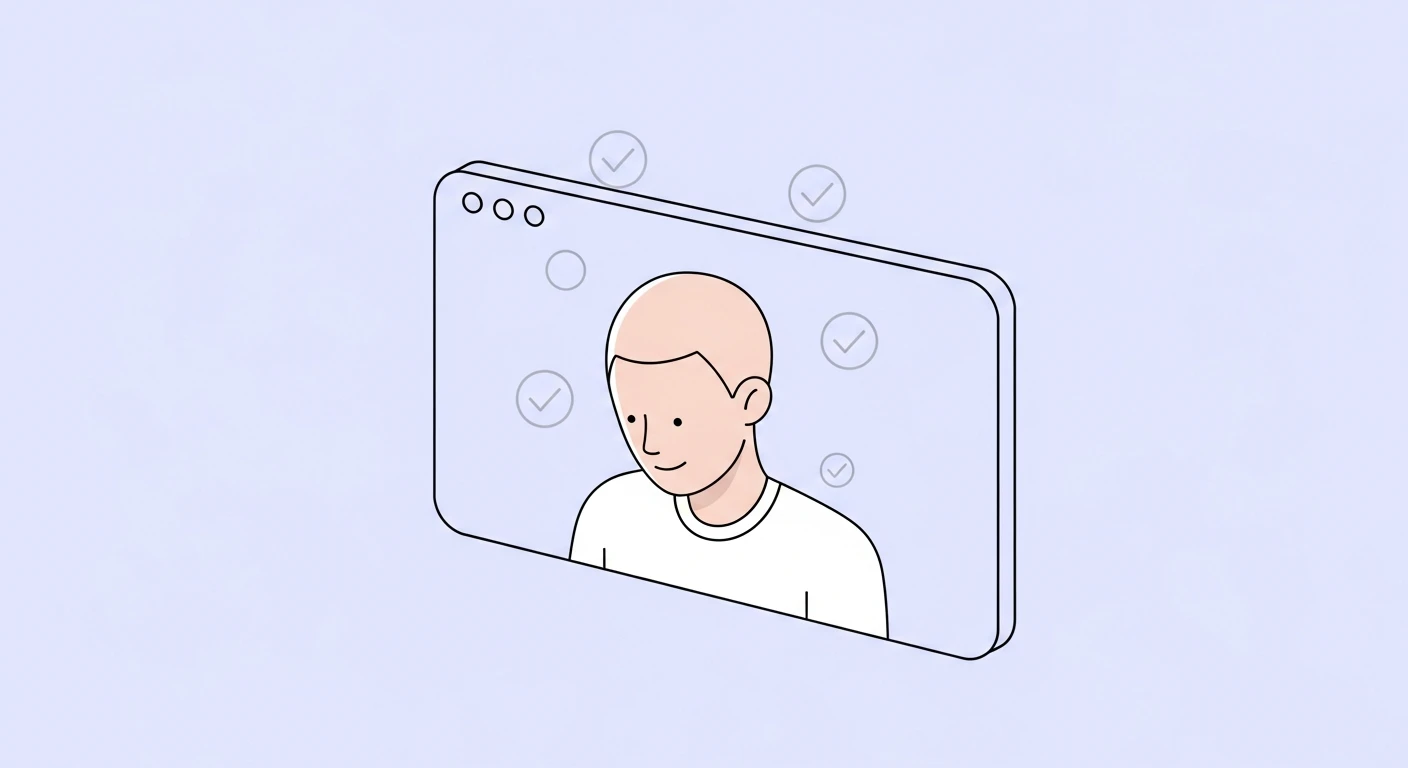
On video, these signals are flattened or invisible. The 2D representation, the slight audio delay, the inability to make natural eye contact -- all of it makes disagreement feel more abrupt, more final, more socially costly. Participants unconsciously avoid that cost by agreeing.
The Performance Frame
Video calls carry an implicit performance frame that in-person conversations do not. Participants are conscious of being "on camera" in a way they are not conscious of being "in a room." This heightened self-awareness activates impression management -- and for most people, being agreeable is the safest impression to manage toward.
This connects to the broader observer effect in UX research, but video amplifies it. The camera is a constant reminder of being watched, where in-person settings allow the observation to fade into the background as rapport builds.
Turn-Taking Rigidity
In-person conversation has fluid turn-taking. People overlap, interject, and co-construct meaning in real time. Video calls enforce rigid turn-taking because of audio processing -- speaking simultaneously creates unintelligible noise rather than natural overlap.
This rigidity means participants must wait for a clear pause to disagree. By the time that pause arrives, the conversational momentum has moved on, and the disagreement feels less relevant. The path of least resistance is to let it go and agree with the next prompt.
Cognitive Load of Digital Communication
Video calls impose cognitive overhead that in-person conversations do not: managing your own video feed, interpreting delayed reactions, compensating for audio quality, maintaining "camera presence." This additional cognitive load reduces the resources available for the effortful work of articulating disagreement.
Agreement is cognitively cheap -- it requires no explanation, no justification, no risk. Disagreement is expensive -- it requires formulating an alternative position, anticipating how it will be received, and managing the social dynamics of contradiction. When cognitive resources are already depleted by the medium itself, the cheap option wins disproportionately.
Measuring the Effect
Research comparing in-person and video-mediated interviews finds consistent patterns:
- Higher agreement rates: Participants in video interviews agree with interviewer framings 15-25% more often than matched in-person participants
- Shorter elaborations on disagreement: When video participants do disagree, their explanations are 40% shorter on average
- More hedging language: Video disagreements are wrapped in more qualifiers -- "maybe," "I suppose," "it could be that" -- signaling reduced confidence in their own contrary position
- Later emergence of contradiction: Genuine disagreements that would surface in the first third of an in-person interview often do not appear until the final third of a video interview, after extended rapport-building
The silence patterns documented in the silence problem in user interviews are even more pronounced in video -- participants fill silences with agreement rather than sitting with discomfort, because silence on video feels more awkward than silence in person.
Structural Corrections
Pre-Interview Permission Setting
Before the interview begins, explicitly normalize disagreement. Not with a generic "there are no wrong answers" (which participants dismiss as social lubrication), but with specific behavioral permission:
"I am going to share some ideas that might be completely wrong for your situation. The most helpful thing you can do is tell me where I am wrong. If something does not match your experience, saying so directly is more valuable to me than being polite about it."
This reframes disagreement as the socially desirable behavior -- which counteracts the medium's push toward agreement.
Deliberate Provocation Seeding
Include intentionally wrong or exaggerated statements in your interview guide. Not to trick participants, but to create natural opportunities for disagreement that lower the barrier for organic pushback later.
"Some teams we have spoken with say they never look at analytics data before making product decisions -- they rely entirely on qualitative feedback. Does that match your experience?"
Most participants will disagree with this extreme position. Having disagreed once successfully (and seen that the interviewer responds positively), they are more likely to disagree again on subsequent topics. The techniques behind elicitation through contradiction are especially important in video contexts where organic disagreement faces higher barriers.
Asynchronous Pre-Work
Send key stimuli or questions before the interview. Let participants form their positions privately, without the social pressure of real-time interaction. Then use the video call to explore and deepen those pre-formed positions rather than forming them live under social pressure.
This separates opinion formation (best done alone) from opinion exploration (where conversation adds value), reducing the probability that the medium shapes the opinion itself.
Mixed-Mode Validation
For critical findings, validate video interview insights with at least a small set of in-person interviews or asynchronous written responses. If a pattern appears strongly in video but weakly in other modes, treat it as potentially medium-inflated.
This is methodological triangulation applied specifically to medium effects -- the principles of research triangulation for product decisions extend beyond data sources to include communication channels.
Post-Interview Disagreement Capture
After the video call ends, send a brief follow-up: "Was there anything during our conversation where your honest reaction was different from what you expressed? Any points where you partially agreed but had reservations you did not voice?"
Participants will not always respond honestly to this either. But removing the real-time social pressure of video increases the probability of capturing suppressed disagreement. The research debriefing practices that matter post-interview should include reflection on potential medium effects.
Analytical Adjustments
Confidence Weighting
When coding video interview data, apply a "medium confidence discount" to agreement statements. An agreement expressed on video should carry less analytical weight than the same agreement expressed in person or in writing.
This does not mean dismissing video data. It means calibrating your confidence in agreement patterns -- requiring more instances and stronger language before treating agreement as a saturated finding.
Disagreement Signal Amplification
Conversely, disagreement that does emerge in video interviews should be treated as a stronger signal than it would be in person. If a participant overcomes the medium's pressure toward agreement to express a contrary view, that view likely represents a more strongly held position than face-value analysis would suggest.
Language Pattern Analysis
Train yourself (or your AI analysis tools) to detect hedged agreement -- statements that technically agree but carry signals of reservation:
- "Yeah, I guess that makes sense" (vs. "Yes, exactly")
- "I could see how that would work" (vs. "That is how I do it")
- "Sure, for some people" (vs. "Definitely, for me")
These hedged agreements are often suppressed disagreements in disguise. In video interviews, they deserve the same analytical attention as explicit contradictions. The kind of pattern detection that powers eval-driven development in AI systems can similarly identify systematic agreement inflation in research datasets.
The Organizational Implication
Most research teams shifted to video interviews during 2020 and never shifted back. The convenience, cost savings, and geographic reach are real benefits. But organizations that rely primarily on video interviews are systematically overestimating product-market fit, underestimating user frustration, and missing friction points that only surface when disagreement barriers are low.
This does not mean abandoning video interviews. It means acknowledging the medium as a variable, designing protocols that counteract its effects, and building analytical practices that discount agreement and amplify the disagreement that does manage to emerge.
As the strategic operating models evolve around AI-native research approaches, understanding medium effects becomes non-optional -- automated analysis tools trained on video interview data will inherit and amplify the acquiescence bias unless explicitly corrected for.
Practical Takeaways
- Assume inflation. Treat agreement in video interviews as 15-25% inflated compared to in-person equivalents.
- Design for disagreement. Build explicit permission-setting and provocation into video interview guides.
- Use pre-work. Let participants form opinions asynchronously before exploring them on video.
- Weight disagreement heavily. Any pushback that emerges despite video's agreement pressure is a strong signal.
- Mix modes for validation. Critical findings from video-only research need validation through at least one alternative channel.
- Track hedged agreement. Statements that technically agree but carry reservation signals are often suppressed disagreements.
The shift to remote research was necessary. The failure to adjust methodology for medium effects was not. Every video interview dataset collected without these corrections contains an unknowable quantity of false agreement -- and product decisions built on that agreement rest on shakier ground than anyone wants to admit.