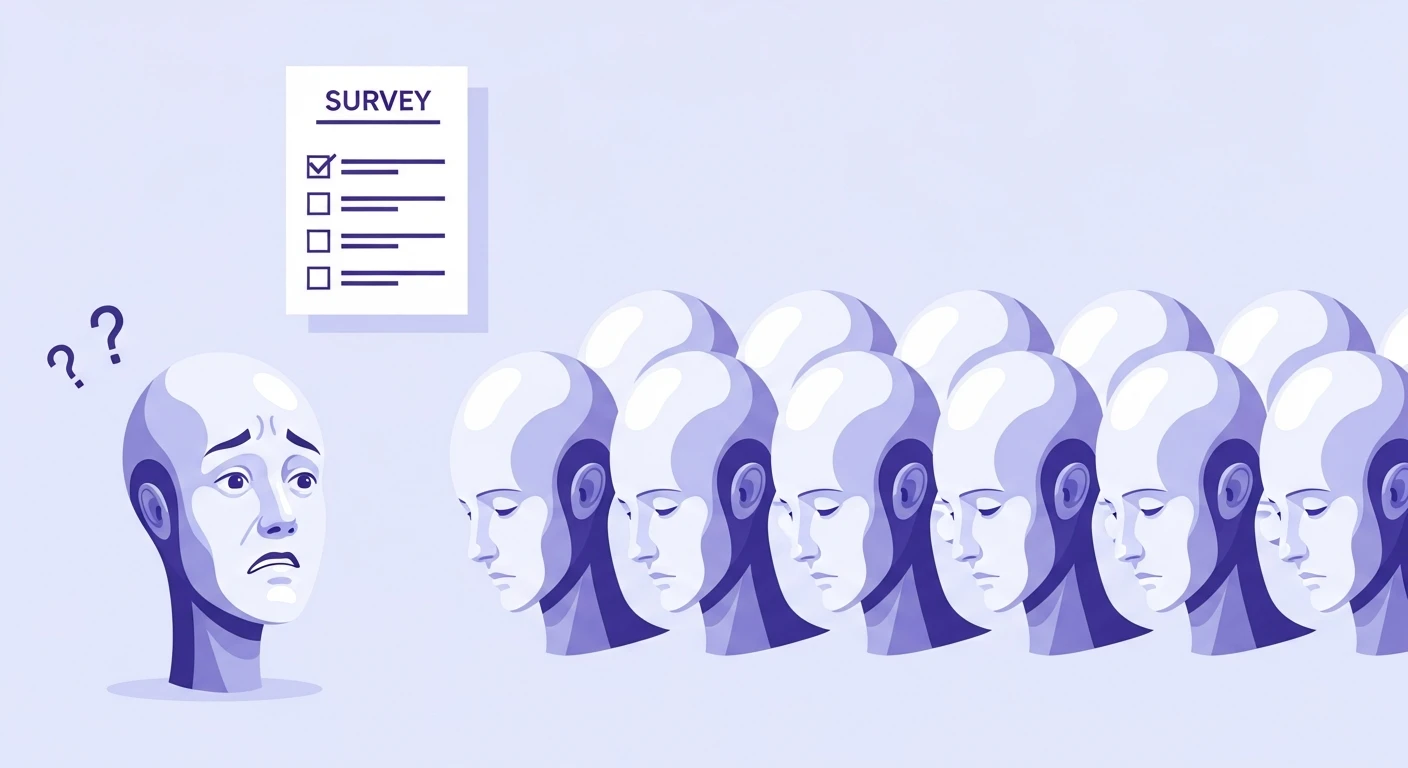
About twenty minutes into an interview on managing a new type 2 diabetes diagnosis, a participant says this:
I had the meter, I had the strips, the nurse showed me... and then I just, I didn't do it for like three weeks. Not because I forgot. I'd look at it on the counter. My husband would say did you check and I'd say yeah. I don't know why I said yeah.
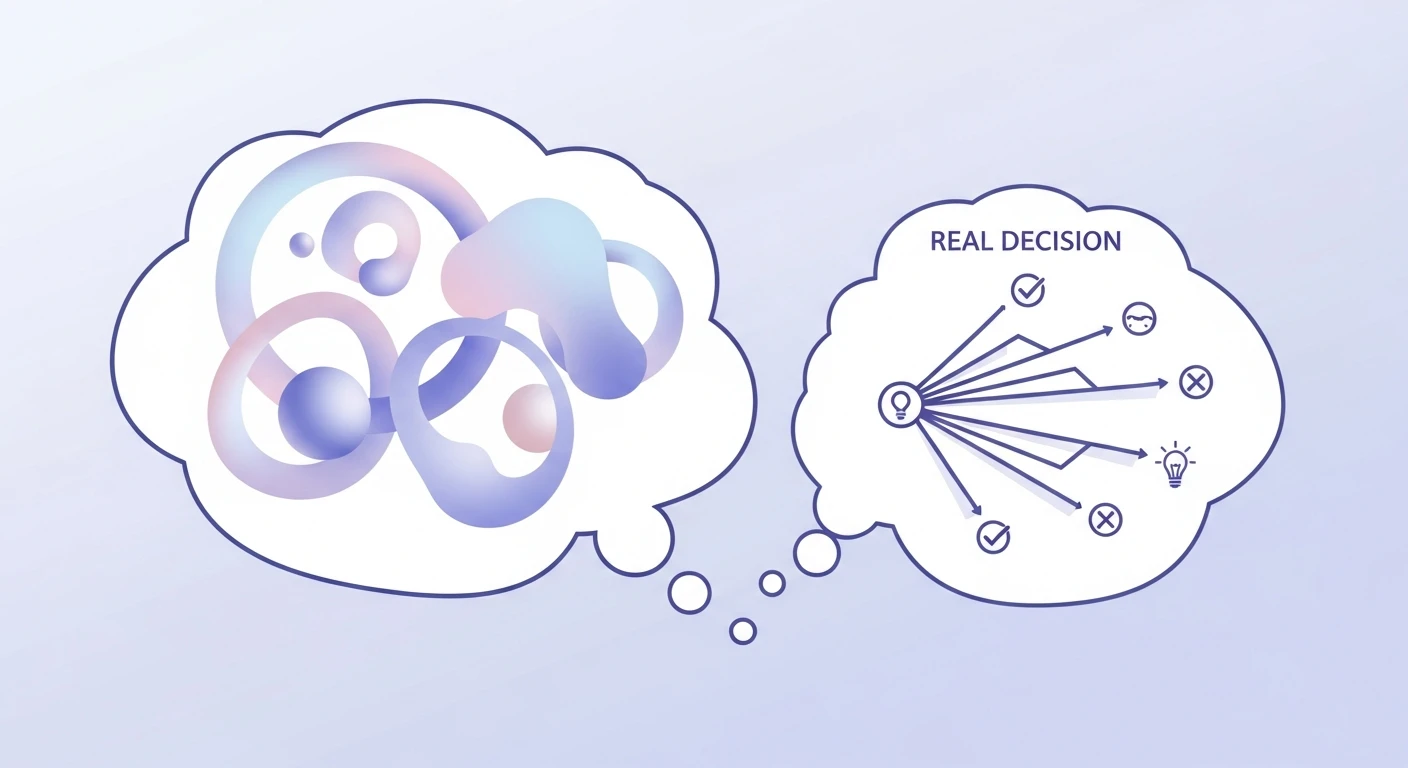
This is a composite, written to illustrate the point, but anyone who has interviewed newly diagnosed patients will have heard something close to it. It is also a passage that changes depending on what you ask of it. Read it for jobs-to-be-done and you get one finding. Read it for pain along a care journey and you get another. Read it with an empathy map and you get a third, and that third one is uncomfortable for the two before it.
The reason to read the same transcript several times is not to be thorough. It is because the analytic frame you pick decides which parts of the passage count as data, and in healthcare that decision ends up shaping services, education materials and sometimes clinical protocols. If the frame is chosen before anyone reads, the findings were partly settled before the reading started.
The jobs-to-be-done reading
A JTBD analysis asks what progress the person is trying to make and what they "hire" to make it. In this passage the official job is plain: monitor blood glucose so it can be managed. The meter and strips were hired for that job. On paper they are fit for it, the patient was trained, and still nothing happened for three weeks.
JTBD is good at pushing past the official job. The analyst asks what else the person is trying to get done that competes with it. Later in this composite interview the participant says she "wasn't ready to be a diabetic yet." That is an emotional and social job: keeping a sense of herself that doesn't include a chronic condition. The meter competes with that job and loses. Her answer to her husband, "yeah", is a workaround hired for the social job. It keeps the household peaceful and keeps the diagnosis at a distance.
The lens yields a usable, designable finding. Onboarding for glucose monitoring may need to deal with identity before it deals with technique. You can take that to a diabetes education team.
What it leaves out is the specific texture of the three weeks. JTBD compresses time into a struggle between jobs. It has less to say about when the avoidance began, what broke it, or what the first reading felt like once she took it. It also tends to treat the person as a rational chooser balancing competing goals. That is useful, and sometimes it is too tidy. "I don't know why I said yeah" doesn't read like a choice.
For a fuller account of how the method frames motivation, our earlier piece on running jobs-to-be-done interviews for user motivation covers the interview side.
The journey pain reading
A journey lens lays the account out in sequence and marks where friction sits: diagnosis, the education visit, going home with supplies, the gap, the first check, the follow-up appointment. Read this way, the passage is a pain point in the handoff from clinic to home. The nurse trained her, and then there was no contact until the next appointment. The three weeks fall in a stretch the care pathway doesn't watch.
That is a strong finding for a health services researcher, because it points at structure. It suggests a check-in call in the first week, or a pharmacist touchpoint, or a remote monitoring prompt. It also moves responsibility away from the patient's character and onto the system, which is usually both fairer and more accurate.
The journey lens has two blind spots. It depends on the participant's retrospective sequencing, and retrospective timelines are reconstructions. "Three weeks" may have been ten days or five. We wrote about this in why retrospective journey timestamps mislead. The second is that a journey map labels moments as pain, and that label assumes the person wanted the step to go smoothly. Did she want a check-in call during those three weeks? The empathy reading suggests she may not have.
The empathy map reading
An empathy map sorts the account into what the person says, thinks, does and feels. It was developed in design practice, not academic qualitative research, and some methodologists are suspicious of it, with reason. The "thinks" and "feels" quadrants invite the analyst to put words in the participant's head. Used carefully, though, it forces the gap between saying and doing out into the open, and that gap is the most important thing in this passage.
She says she checked. She did not. She thinks about it daily: "I'd look at it on the counter." What she feels is the part the analyst has to handle with care. Shame is the easy guess. But the transcript only gives us "I don't know why," and an honest empathy map writes that down as not knowing rather than filling the quadrant with an emotion that fits the story.
What this lens shows, and the other two lean past, is that the telling is itself an event. She is disclosing a lie to her husband to a stranger in a research interview. That raises questions any anthropologist would ask. Why is she telling us? Did the interviewer's warmth make it feel safe? Is there an element of confession, or of social desirability working the other way, presenting herself as honest about her lapse? Goffman's distinction between front stage and backstage is relevant: the "yeah" to her husband was a front-stage performance, and the interview is a new stage with its own audience.
The empathy reading complicates the journey finding. A check-in call during week one might have been one more person to say "yeah" to. The intervention the journey lens points to could produce the same performance with someone else on the other end.
What changes when you hold the three together
None of the three readings is wrong, and none is complete. JTBD gave us identity as a competing job. The journey lens gave us an unwatched gap in the pathway. The empathy map gave us a gap between saying and doing that may defeat the obvious fix for the second finding. Put together they produce a more defensible recommendation than any single lens: support in the first weeks should be built around making it safe not to have done it yet, not around checking whether it was done.
This is the old argument for triangulation, applied inside one dataset. Denzin wrote about theory triangulation, examining the same data through several theoretical perspectives, decades ago. Lincoln and Guba's work on trustworthiness gives you the vocabulary to defend it to a review committee. What has changed is cost. Reading forty transcripts three ways by hand used to be out of reach for most funded projects. So teams chose one frame, usually the one the funder or the department already spoke, and the frame quietly became the finding.
Some cautions, because using several lenses is not automatically more rigorous:
- Lenses are not neutral instruments. Each carries assumptions about people: JTBD about purposive action, journey mapping about linear service encounters, empathy mapping about readable inner states. If you report findings from a lens, report what it assumes.
- More lenses can mean more confirmation. If an analyst expects identity to be the story, three frames give three chances to find it. Write down what each lens did not find, and treat disagreement between lenses as data, the way negative case analysis treats contradicting cases.
- Keep the participant's own words at the centre. The emic account, "I don't know why I said yeah", should survive every lens without being translated into tidier etic terms. Member checking can help, with the usual caveat that participants may endorse whichever interpretation sounds kindest.
- Choose the lenses on purpose. Fourteen readings of every transcript is not a method. Pick the frames that match your research question and say why. Our decision guide to the 14 analysis lenses lays out what each is suited to.
Where software helps and where it doesn't
Qualz.ai's AI Analysis runs a transcript set through 14 lenses, including JTBD, journey pain points and empathy mapping, and links every finding back to the passages that support it. For healthcare teams, what that buys you is the chance to see where the readings disagree before you commit to a frame, and to do that across a whole study instead of one hand-picked interview. Our overview of multi-lens analysis explains the mechanics, and the comparison of thematic and lens-based analysis covers when a lens is the wrong tool.
What software doesn't do is reflexivity. It won't notice that the interviewer's warmth made the confession possible, or that the analyst expected identity to matter. It also won't resolve the tension between the journey fix and the empathy finding. Those calls belong to people who know the clinical setting and are accountable to patients. Data handling matters as much as interpretation in this domain, so read about what a HIPAA-aware research workflow looks like in practice before you upload anything.
If you'd like to see how your own patient transcripts read under different lenses, book a short session with us and we'll go through the AI Analysis lenses on a de-identified sample.