The Seductive Shortcut in Survey Design
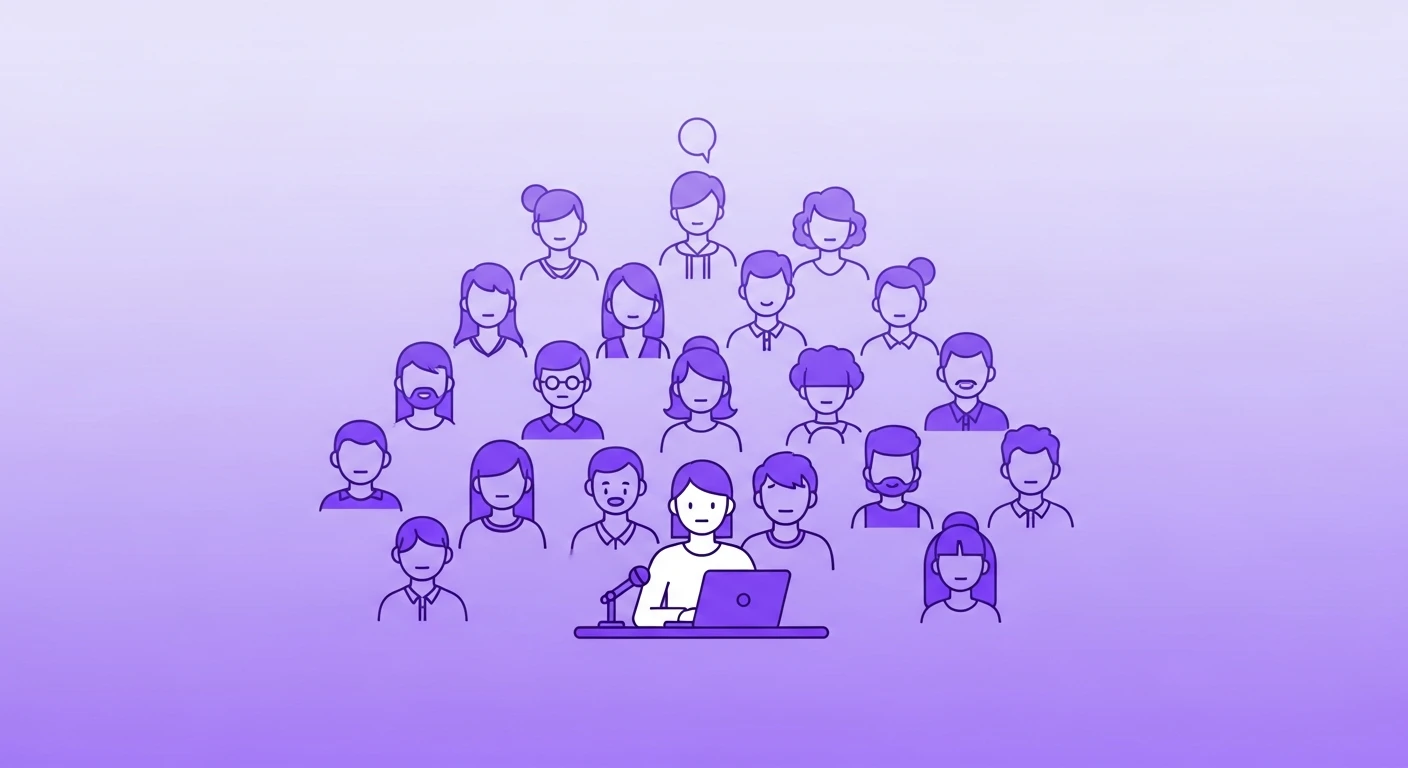
Cognitive pretesting -- sitting real people down and watching them struggle through your draft questions -- is slow, expensive, and awkward. So it is no surprise that teams have started routing draft surveys through AI personas instead: spin up a dozen synthetic respondents with different demographics, have them "take" the survey, and read back where they got confused. It is fast, it costs almost nothing, and it produces a tidy report.
It also produces a dangerous false negative. The synthetic respondents glide through questions that would stop real humans cold, because a language model is constitutionally incapable of reproducing the specific way a person misreads an ambiguous question. The survey comes back looking validated. Then it ships, and the comprehension failures you never saw show up as noise in your data -- unrecoverable, and invisible, because the pretest told you everything was fine.
Why Models Cannot Fail the Way Humans Fail
The entire point of cognitive pretesting is to catch the gap between what you meant and what respondents understand. Real people fail in structured, revealing ways: they interpret "regularly" as "monthly" while you meant "weekly," they answer a double-barreled question about only one of its two clauses, they read "not uncommon" as "uncommon," they anchor on the first response option and never read the rest. These failures are the signal. They tell you exactly where the instrument is broken.
A language model does not reproduce these failures because it resolves ambiguity too well. Trained to find the most plausible reading of any text, it silently repairs your double-barreled question, disambiguates your vague quantifier, and infers your intent from context a real respondent does not have. It answers the question you meant to ask rather than the question you actually wrote -- which means it can never show you the difference between the two. This is a survey-design instance of the confabulation risk in AI-generated research output, where fluent machine responses invent a coherence that was never in the underlying reality.
The Comprehension Monoculture
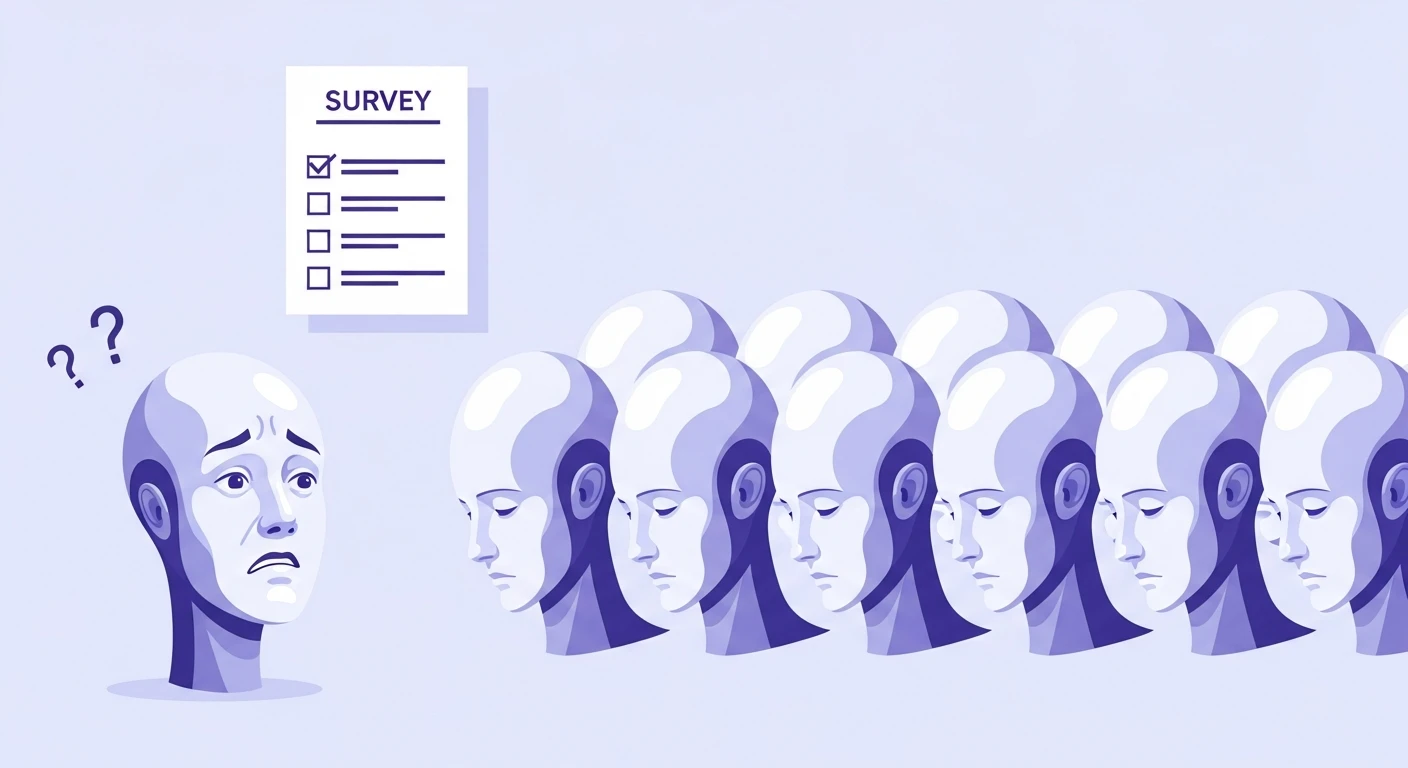
Even when synthetic personas are prompted to "act confused" or role-play a low-literacy respondent, they fail differently than the people they are imitating. Their confusion is a plausible model of confusion, not the real distribution of it -- and crucially, it is homogeneous. Every synthetic respondent draws from the same underlying model, so they share the same interpretive tendencies and stumble in the same places.
That homogeneity manufactures a false sense of coverage. When ten synthetic personas all understand a question the same way, it reads as strong evidence the question is clear -- when in fact you have simply consulted the same interpreter ten times. This is the synthetic saturation illusion applied to instrument design: AI-generated respondents feel like new data points but are not, and it collapses your pretest into exactly the homogeneous sample that produces false saturation. The variance you rely on to find broken questions -- the fact that different real humans misread different things -- is precisely what the model averages away.
What Actually Gets Missed
The failures synthetic pretests reliably hide are the ones that matter most for data quality:
Vocabulary mismatches. A term that is obvious to your team ("dwell time," "primary workspace," "activation") but meaningless or differently understood by respondents. The model knows your jargon; your respondents do not. Real pretesting exposes the vocabulary gap that quietly traps people in a framing they did not choose.
Recall boundaries. Questions that assume respondents can accurately remember behavior over a time window they cannot. A model confabulates a plausible answer; a human hits the wall of memory and satisfices. Synthetic pretests never surface the recall and temporal-anchoring distortions that plague retrospective questions.
Satisficing triggers. Questions long or tedious enough that real respondents stop engaging and start pattern-matching answers. Synthetic respondents never fatigue, so they never reveal the point where a real person mentally checks out -- the same satisficing threshold that quietly wrecks unmoderated studies.
Sensitive-topic evasion. Where real respondents soften, skip, or dress up an answer, a model complies. You lose all signal about which questions will drive the self-censoring that reshapes what people are willing to tell you.
The Engineering Reality Behind the Illusion
The deeper issue is that a synthetic pretest is only as valid as the assumption that the model's interpretive behavior maps onto your population's. That assumption is almost never tested, and it is exactly the kind of silent, unmonitored dependency that turns into a production failure. Enterprise teams that deploy LLMs into real workflows have learned this the hard way -- the reason eval-driven development treats behavior testing as non-negotiable is that models drift and mis-generalize in ways you only catch with a real ground-truth baseline. A synthetic pretest with no human baseline is an eval with no ground truth: it can only tell you the model is self-consistent, never that it is correct.
The same discipline that keeps production AI honest -- rigorous observability so you can see when a system's behavior diverges from reality -- is what synthetic pretesting lacks by construction. There is no instrument watching whether the synthetic respondents behave like real ones, because the whole appeal was skipping the real ones.
How to Use Synthetic Pretests Without Getting Burned
Synthetic pretests are not worthless. They are a useful first-pass filter for the crudest problems -- a question so broken that even a model chokes on it is genuinely broken. The discipline is to treat them as a smoke test, never as validation.
Use them to generate hypotheses, not conclusions. Let synthetic runs flag candidate problem questions, then confirm every flag with real cognitive interviews. The model is a cheap way to prioritize which questions to test with humans first, nothing more.
Always keep a human ground-truth baseline. Calibrate what the model catches against what real pretesting catches on the same instrument, so you know the model's blind spots for your population. This is the same calibration-against-human-baseline discipline that makes synthetic participants usable at all.
Never let synthetic smoothness override a real signal. If real respondents struggle with a question the synthetic personas breezed through, the humans are right. The model's fluency is the failure mode, not the verdict.
Reserve real cognitive interviews for the questions that carry your key measures. Wherever the data will drive a decision, the depth of expert-led probing that surfaces how people actually parse a question is not optional -- and no synthetic shortcut replaces it.
The Cost of a Clean-Looking Pretest
The worst outcome of a synthetic pretest is not that it misses problems. It is that it manufactures confidence. A messy human pretest, with its awkward pauses and misreadings and "wait, what does this mean" moments, tells you the truth about your instrument. A synthetic pretest hands you a clean report that says everything is fine -- and clean is exactly what a broken survey looks like right before it ships.
Fast and cheap are real advantages. But in instrument validation, the thing you are buying is exposure to failure, and a respondent that cannot fail like a human cannot give you what you came for.
Building surveys and interview guides you can actually trust? Qualz.AI helps research teams validate instruments against real human comprehension -- surfacing where genuine participants misread, stall, or satisfice, instead of where a model smooths everything over. Book a demo to see how it keeps your questions honest before they ship.