The Assumption Buried in Every Recruitment Budget
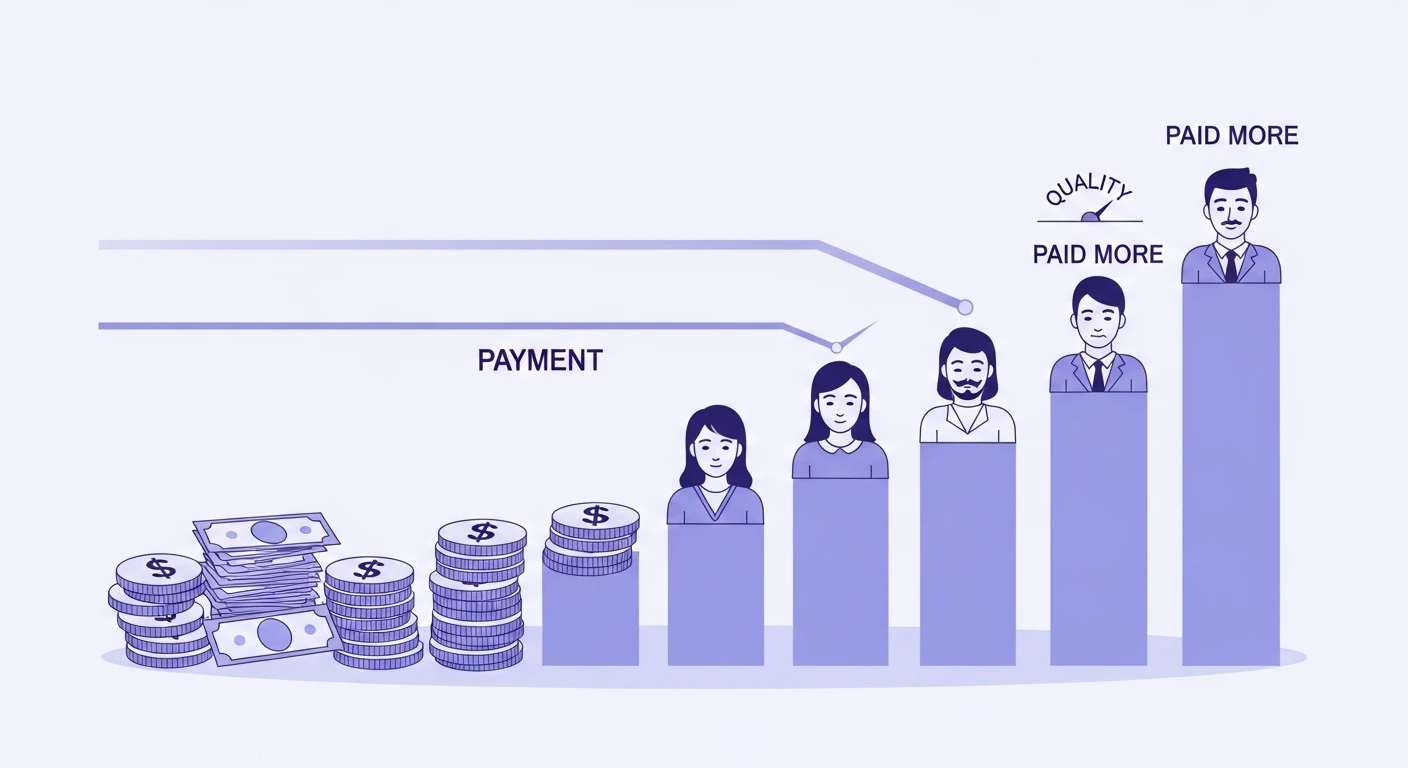
When a study is not attracting enough participants, or the ones showing up seem low-effort, the reflex is almost universal: raise the incentive. More money, better people, richer data. It is such an intuitive lever that most teams never question the shape of the curve underneath it. They assume it is monotonic -- that more payment always buys more quality, or at least never hurts.
It is not monotonic. Incentives help, steeply, up to a point. Past that point the curve bends, and additional money starts recruiting the wrong people for the wrong reasons and buying you compliance instead of candor. There is a ceiling, and most premium research budgets are spending well past it without knowing the ceiling exists.
What High Incentives Actually Select For
A participant's decision to join a study is driven by a mix of motivations: genuine interest in the topic, willingness to help, curiosity, and the incentive. When the incentive is modest, it functions as a thank-you, and the people who show up are disproportionately those with intrinsic reasons to participate. When the incentive gets large, its share of the total motivation swells until it crowds everything else out -- and now you are selecting on willingness to be paid, which is a very different trait than willingness to be useful.
The people most responsive to a large incentive are, definitionally, the people for whom the money matters most relative to their time -- which skews your sample toward serial study-takers and away from the busy, high-context users you actually want. This is the recruitment-stage engine behind the professional respondents who game your screeners, and it quietly reshapes your panel into exactly the fatigued, over-recruited pool that fresh recruitment is supposed to prevent.
The Obligation Effect
Money does not just change who shows up; it changes how they behave once they are in the room. A large payment creates a sense of obligation -- the participant feels they owe you a good session, and "good" gets silently defined as agreeable, articulate, and confirming. They over-prepare, they perform engagement, and they suppress the boredom, confusion, or indifference that would have been your most honest signal.
This is the performative candor trap purchased directly with dollars: the better you pay, the harder participants work to seem like the thoughtful, insightful respondent they think justifies the fee. It compounds acquiescence bias -- a well-paid participant is even less likely to disagree with your premise, push back on a concept, or admit a feature left them cold, because disagreement feels like failing to deliver value for money.
The Homogenization Problem
There is a structural cost beyond individual behavior. Because high incentives select on the same trait -- responsiveness to payment -- across every participant, they narrow the sample along a hidden dimension. Everyone who cleared the incentive threshold shares a motivational profile, which means the variance you rely on for insight collapses.
This is the screener precision trap arriving through the incentive rather than the criteria: you get a tight, homogeneous, agreeable pool that reaches false saturation quickly because everyone is subtly the same kind of person. And because the skew is correlated across the whole sample, no amount of cross-participant comparison will reveal it -- the bias is invisible precisely because it is universal, the same structural blind spot that makes the counting trap in analysis so seductive.
Finding the Ceiling
The goal is not to underpay -- underpayment has its own failure modes, including the recruitment funnel fallacy where optimizing the wrong number produces worse participants. The goal is to price at the point where the incentive is sufficient to respect people's time without becoming their dominant reason for showing up.
- Benchmark to opportunity cost, not maximum willingness. Pay what fairly compensates the participant's time for their segment -- a physician and a student have different clocks -- rather than the highest number that fills the calendar fastest. The fastest fill is a warning sign, not a win.
- Watch the fill-rate curve. If a slot fills in minutes at your incentive, you are likely over the ceiling and recruiting the money-motivated. Healthy recruitment for high-context users is a little bit hard.
- Segment the incentive. A flat, high payment attracts flat, homogeneous participants. Varying compensation by the genuine burden of the ask keeps your motivational mix diverse.
- Recruit on interest, not just eligibility. Screen for topic relevance and lived context so that intrinsic motivation, not the payment, is doing the selecting. This is the recruitment-side complement to adaptive sampling that changes your plan as you learn.
- Measure downstream, not just upstream. Track data quality -- specificity, contradiction, surprise -- against incentive level over time. The ResearchOps metrics that matter should include the yield of your recruitment spend, not just its speed.
The Enterprise Parallel
The incentive ceiling is a specific instance of a general law: when you optimize a proxy hard enough, the proxy detaches from the thing it was supposed to measure. Payment is a proxy for participant commitment; push it too far and it measures money-motivation instead. Enterprise AI teams hit the identical wall when they optimize a cheap metric and watch true performance quietly diverge -- which is why governance frameworks that keep proxies honest and eval-driven development that measures the real outcome instead of a convenient stand-in exist. Spend on recruitment the way a disciplined team spends on compute: not to maximize a vanity number, but to buy the outcome you actually need.
Pay enough to be fair. Stop before the money becomes the reason. The best participants are the ones who would have shown up anyway.
Recruit for Signal, Not for Speed
Qualz.ai helps you screen for genuine relevance and track data quality against your recruitment spend, so you find the incentive ceiling before it costs you your insights. Book a demo to see how quality-weighted recruitment changes what your studies can find.