The Candor Performance
Experienced research participants learn what researchers reward. They observe that interviewers lean in when participants express vulnerability, ask follow-up questions when participants share negative experiences, and visibly relax when participants say "honestly" or "to be frank." Over multiple research sessions -- or even within a single interview -- participants calibrate their performance to maximize interviewer engagement.
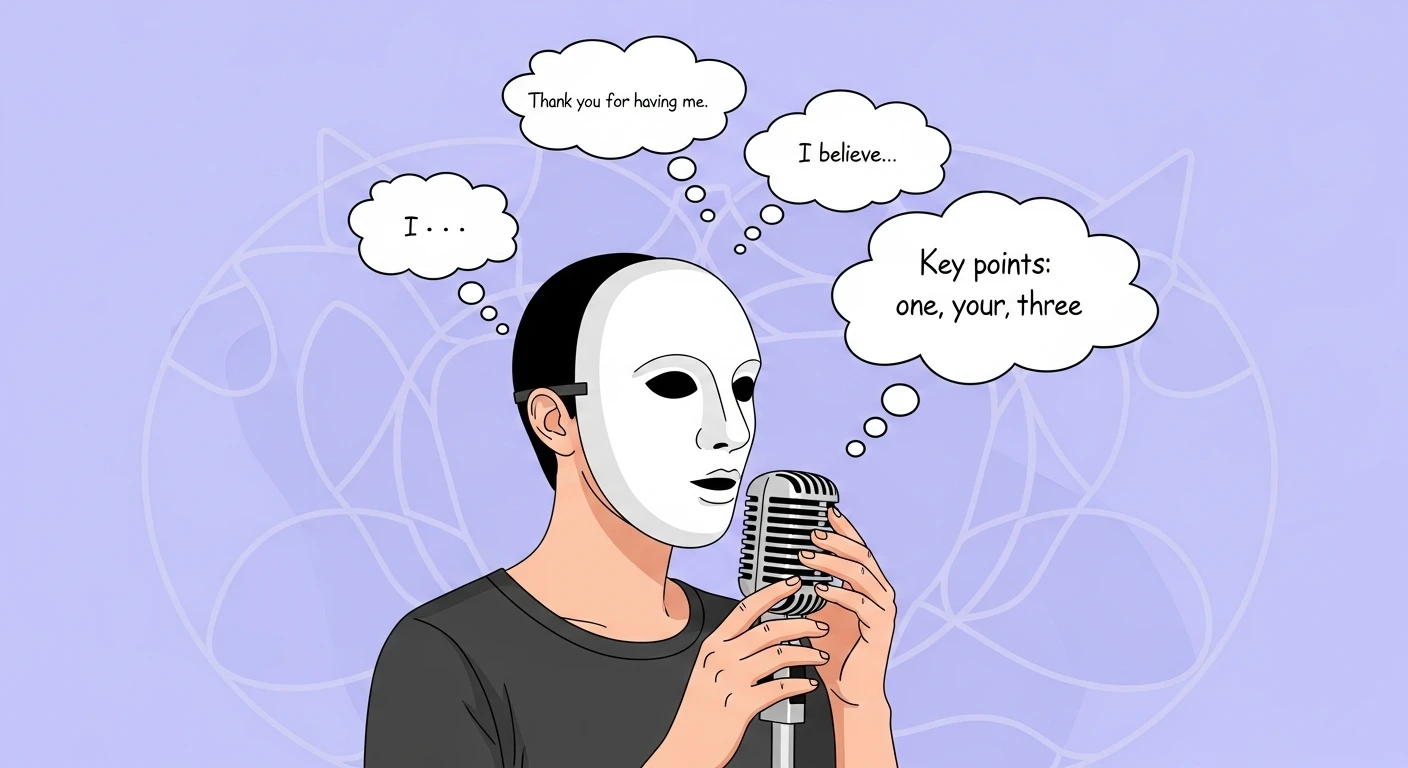
The result is a specific behavioral pattern: performative candor. It looks like honesty. It sounds like honesty. It has all the linguistic markers researchers associate with authentic disclosure. But it is a social performance -- optimized for the interview context rather than reflecting genuine internal states.
This matters because qualitative research depends on the assumption that participants are reporting their actual experiences, beliefs, and behaviors. When performative candor contaminates data, researchers build theories on the appearance of honesty rather than its substance. The participants who seem most forthcoming may be the ones telling you what they have learned research contexts reward.
How Performative Candor Develops
Panel Conditioning
Participants who complete multiple research studies develop sophisticated models of what researchers want. They learn that complaints are more interesting than praise, that specific anecdotes get more follow-up than general statements, and that emotional language signals authenticity. This conditioning happens whether participants join formal panels or simply participate in research frequently through platforms.
The research panel fatigue problem is well-documented, but its most insidious form is not boredom -- it is expertise. Conditioned participants do not give worse data because they are disengaged. They give worse data because they are too engaged -- performing the role of "good participant" rather than reporting genuine experience.
Social Desirability in Reverse
Traditional social desirability bias pushes participants toward positive self-presentation. Performative candor inverts this: participants perform negativity, criticism, and vulnerability because they have learned these responses receive researcher attention and validation.
A participant who says "I know this sounds bad, but I actually did not care about the privacy settings at all" is performing anti-social-desirability -- appearing honest by confessing to socially undesirable behavior. But this confession may itself be a performance designed to seem refreshingly honest, when the actual truth might be more mundane: they simply did not notice the settings.
Interview Context Priming
The interview setup itself primes performative candor. Consent forms emphasizing honesty, moderator assurances that "there are no wrong answers," and warm-up conversations establishing rapport all signal that candor is the expected performance. Participants who excel socially -- articulate, emotionally intelligent, verbally fluent -- are most skilled at delivering this performance convincingly.
This creates a systematic bias: the participants who perform best in interviews are often those most skilled at social performance generally. Their data feels richest precisely because they are best at giving researchers what they want.
Detecting Performative Candor
Linguistic Markers of Rehearsal
Genuine unrehearsed thought tends to be halting, contradictory, and self-correcting. Speakers pause, backtrack, contradict themselves, and struggle for words. They say things like "wait, actually no" and "I am not sure that is right either" and "it is hard to explain."
Performative candor is fluent. It arrives in complete sentences with narrative structure. Anecdotes have beginnings, middles, and ends. Confessions are neatly packaged. The participant who delivers a perfectly structured three-part story about their frustration -- complete with emotional arc and tidy resolution -- may be delivering a rehearsed narrative rather than recalling actual experience.
Look for:
- Excessive meta-commentary about honesty ("I will be real with you," "honestly," "I know this sounds harsh but")
- Perfectly structured negative anecdotes that feel like they have been told before
- Absence of self-contradiction or backtracking
- Immediate emotional fluency without processing time
The Contradiction Test
Genuine attitudes are messy. People hold contradictory beliefs, behave inconsistently, and feel ambivalent. A participant who presents a perfectly coherent narrative without any internal tension has likely smoothed out the contradictions -- either through rehearsal or through real-time narrative construction.
Deliberately probe for contradiction: "Earlier you mentioned you loved the simplicity, but now you are describing wanting more features. How do those fit together?" Genuine participants embrace the tension. Performative participants either deny the contradiction or quickly construct an explanation that resolves it too neatly.
The detecting contradictions in qualitative interviews framework applies directly here: inconsistency is not data quality failure -- it is a signal of genuine, unrehearsed thought. Consistency, paradoxically, should raise suspicion.
Behavioral-Verbal Mismatch
Compare what participants say with what they do. A participant who delivers eloquent criticism of a feature while their behavioral data shows consistent usage is performing candor rather than reporting reality. The verbal criticism is for the interview; the continued usage is the actual behavior.
This is why combining interview data with observational or behavioral data is essential for detecting performative candor. The research triangulation approach becomes not just methodologically rigorous but specifically diagnostic: mismatches between verbal and behavioral data often indicate performance rather than genuine attitude.
Why Researchers Miss It
Confirmation of Expertise
Researchers unconsciously prefer data that confirms their professional value. A participant who delivers rich, articulate, emotionally detailed accounts makes the researcher feel skilled at elicitation. "I really got them to open up" becomes a professional accomplishment -- blinding the researcher to the possibility that the participant opened up because they are skilled at performing openness, not because the moderator was skilled at creating safety.
The Depth Illusion
Performative candor feels deep. It provides quotable moments, emotional peaks, and narrative richness. Genuine unrehearsed thought feels shallow -- incomplete sentences, vague gestures at feelings participants cannot articulate, and frustrating inability to explain why they did what they did.
Researchers trained to seek depth systematically reward performance over authenticity. The articulation gap research shows that genuine experience is often inarticulate. Yet researchers preferentially quote the articulate participant -- who may be performing rather than reporting.
Sample Size Pressure
When researchers need to fill interview slots quickly, they draw from panels of experienced participants. These experienced participants are precisely the ones most conditioned to perform candor. The operational pressure for recruitment efficiency directly increases performative candor contamination in the sample.
Mitigation Strategies
Value Incoherence Over Fluency
Actively seek and analytically privilege messy, contradictory, inarticulate data. When a participant struggles to explain their behavior -- pausing, backtracking, expressing confusion at their own choices -- treat this as higher-quality data than the participant who delivers a polished account.
This requires retraining analytical instincts. Most researchers are trained to code the clearest, most quotable statements. Instead, code the moments of breakdown: where participants cannot maintain narrative coherence, where their story falls apart, where they admit confusion. These ruptures are often the most analytically valuable data points.
Delayed Probing
When participants deliver fluent, apparently candid narratives, do not immediately follow up with validating probes. Instead, return to the same topic later in the interview from a different angle. Rehearsed narratives tend to reproduce verbatim; genuine recollections shift and expand when approached differently.
Fresh Recruitment Priority
Prioritize recruiting participants with minimal prior research experience. First-time participants lack the conditioning that produces performative candor. Their data may be less fluent and harder to work with analytically, but it is more likely to reflect genuine unrehearsed experience.
Behavioral Anchoring
Start with behavioral observation or artifact-based discussion rather than opinion questions. Ask participants to walk through their actual recent usage -- with timestamps, screenshots, or device activity as anchors. Performative candor is harder to sustain when grounded in verifiable behavioral evidence rather than open-ended attitudinal questions.
The Governance Parallel
Just as AI governance frameworks require verification mechanisms rather than trusting self-reported compliance, research methodology should build verification into participant data collection. Trust-but-verify is not cynicism -- it is methodological rigor applied to the social dynamics of research participation.
Practical Takeaways
- Treat excessive fluency as a yellow flag. Perfectly structured negative narratives may indicate rehearsal rather than genuine experience recall.
- Value confusion and contradiction. Participants who struggle to explain their behavior are likely reporting genuine experience rather than performing a research-appropriate narrative.
- Cross-reference verbal and behavioral data. Mismatches between what participants say and what they do indicate performative rather than authentic responses.
- Probe the same topic from multiple angles. Rehearsed narratives reproduce; genuine recollections shift and expand with different framing.
- Prioritize research-naive participants when possible. First-time participants lack the conditioning that enables sophisticated performative candor.
- Watch for meta-commentary about honesty. Statements like "I will be completely honest" often precede performed rather than genuine candor.
- Reframe what good data looks like. The most analytically valuable interviews may feel disappointing in the moment -- halting, unclear, frustrating -- because genuine unrehearsed thought is messy.
The performative candor trap is particularly dangerous because it is invisible to researchers who equate fluency with authenticity. Breaking this equation -- learning to see polished performance as potential contamination rather than as research success -- is one of the most important calibrations a qualitative researcher can make.