Survey scores can tell a health system that one facility's discharge experience trails the others. They almost never say why. Ask the unit manager and you get a theory. Ask the patients and you get something messier and more useful: a confusing medication list, a ride that arrived before the paperwork did, a nurse who explained everything well but at 6 a.m., when nobody could take it in.
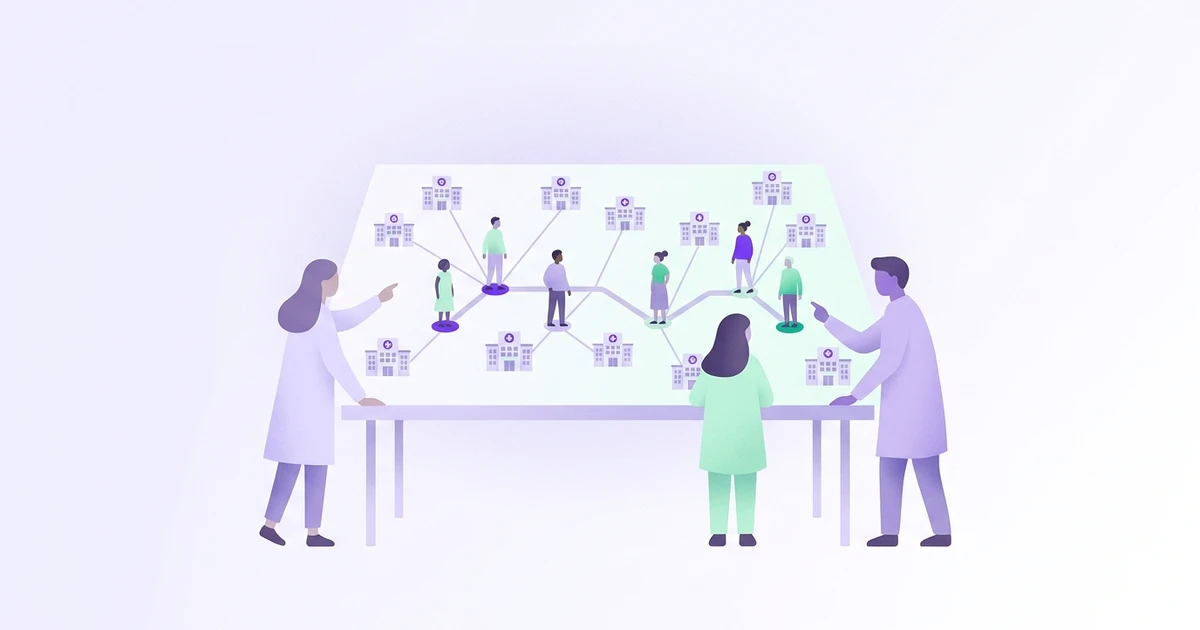
Getting that second kind of answer from one facility is a standard qualitative project. Getting it from fifteen, with an experience team that might be three people who also run rounding, complaint review and the CAHPS reporting cycle, is a different problem. The rest of this post describes a workflow built for that situation, organised around a study of 450 patients across 15 facilities. I'll be specific about the design decisions and honest about where they stop working.
Why the multi-site version is harder than it looks
The tempting plan is to run the single-facility study fifteen times. That fails for reasons that have little to do with effort. Each site ends up with a slightly different guide, a different interviewer, a different recruitment route, and by the time you compare them you can't tell whether a difference between facilities reflects the patients or the study. We've written about this more generally in what changes methodologically when you scale from 10 to 100 interviews. With multiple facilities the risk is sharper, because leaders will compare sites, and some of those comparisons will reach budget and staffing decisions.
The opposite plan, pooling everyone into one big sample, loses the thing leaders asked for. A system-wide finding that "patients want clearer communication" is true everywhere and helps nowhere.
So the design has to hold two things at once: enough consistency that sites can be compared, and enough attention to each site that its local story survives.
The workflow
These steps are numbered because the order matters. Several of the later steps only work if the earlier ones were done carefully.
1. Write one research question per decision, not per facility
Before writing a guide, list the decisions the findings will feed. In a typical multi-site program those are things like where to put a discharge redesign pilot, whether a scheduling change at three ambulatory sites is working, or why one emergency department's complaints cluster around waiting rather than care. Each decision becomes a research question. Facilities then become a sampling dimension, not separate studies.
This sounds bureaucratic. In practice it stops scope creep, because every stakeholder from every site will want to add questions, and the list of decisions gives you a principled reason to say no.
2. Set quotas by facility and by the experiences that differ
Four hundred and fifty patients across fifteen facilities works out to roughly thirty per site. That is enough to say something about a site, but only if those thirty aren't all the same kind of patient. Set quotas on the dimensions you expect to shape experience: inpatient versus outpatient encounter, planned versus unplanned admission, age band, primary language, and whether the patient had a caregiver involved. You won't fill every cell evenly, and you shouldn't pretend a cell of four people tells you much. The quotas exist to stop the sample from collapsing into whoever is easiest to reach.
Malterud and colleagues' idea of information power fits here better than a target number chosen for saturation. A narrow aim with patients whose experience is closely relevant needs fewer participants. A broad aim across varied encounters needs more. Thirty per site is reasonable for comparing a handful of journey stages. It is too thin if every site's leadership wants a full persona set.
3. Recruit through channels that reach the patients you'd otherwise miss
Recruitment is where multi-facility studies most often go wrong, and the failure doesn't show up in the data. Patients who answer the first post-discharge text are disproportionately those who had a smooth stay, have reliable phones and speak the language the message was written in. That's the pattern described in how the first people to schedule can skew your findings, and in healthcare it falls along lines of equity.
Practically, that means recruiting through more than one channel (the post-discharge message, a follow-up call from patient access for under-filled cells, and an offer at the clinic for outpatient encounters) and tracking fill rates by quota cell as recruitment runs. When one site's unplanned admissions stay empty for a week, you find out while you can still do something about it. Offer the interview in the patient's preferred language from the start, not as a later accommodation.
Keep the screener free of identifying detail and keep facility codes separate from contact records. The HIPAA-aware workflow post covers the plumbing. The short version is that compliance depends on how data moves between steps, not on a badge on the vendor's website.
4. Use AI-moderated interviews for consistency, and design the guide for it
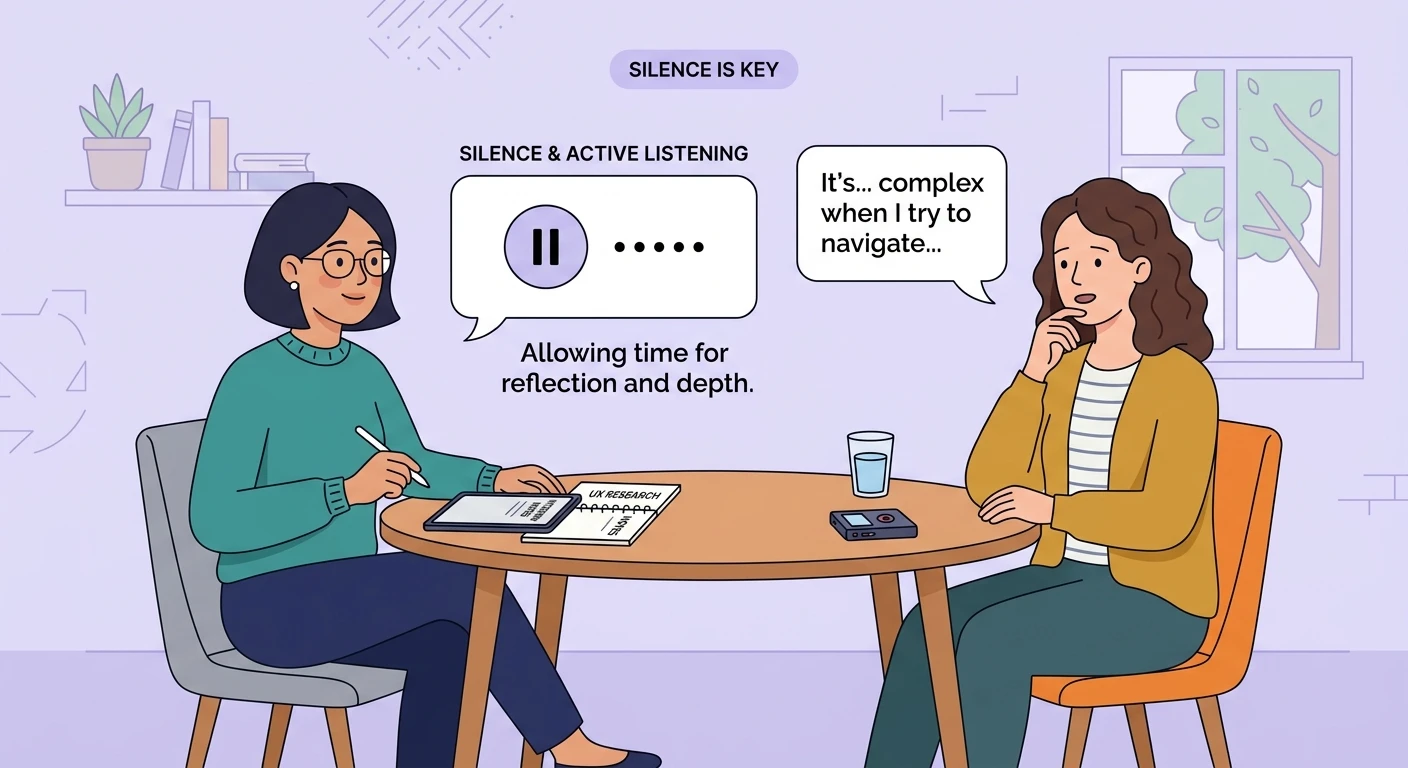
This is the step that makes the study possible without a large team. A human team interviewing 450 patients in a reasonable window means many moderators, and many moderators means many interviewing styles, which is exactly the variation that makes cross-site comparison unreliable. An AI moderator asks the core questions the same way every time, probes on what the patient actually said, runs at 9 p.m. when a caregiver finally has a quiet hour, and works in the patient's language.
It also changes the social situation in ways that matter for patient experience. Patients interviewed by someone who looks like hospital staff tend to soften criticism. That's social desirability, and it's sharpened by a dependency the patient may still have on that system. Some patients are more candid with a system that clearly isn't their nurse. Some are less comfortable. Neither group is the majority you can assume, and the comparison of AI-moderated and human-moderated interviews sets out the trade-offs honestly.
Design the guide around the journey, not around departments. Patients don't experience "environmental services" or "case management." They experience the night the room was too loud and the morning nobody could say when they were going home. Open with a concrete recall prompt ("Take me back to the day you found out you'd be going home") and let the probes follow. A patient might say:
I mean, they were nice. Everyone was nice. It's just, I had the papers and I didn't, I didn't know which pills were the new ones, and my daughter was already in the car.
A good probe goes after "which pills were the new ones," not "nice." Write that intent into the guide so the moderator knows which threads matter.
Patients will mention names, dates and diagnoses even when you never ask. Plan for that, as covered in how PHI shows up in interviews that never asked for it, with redaction before transcripts reach analysts.
5. Pilot at two sites before launching at fifteen
Run the full process at two contrasting facilities (say, a large urban hospital and a small community site) for the first fifteen or twenty interviews. Read every transcript. You are looking for questions patients misread, probes that loop, and terms that mean something different at each site. Fix the guide, then launch everywhere. If you change it after launch, you've split your dataset, and you should record exactly when and why.
6. Analyse with two lenses that answer different questions
At this volume, open coding alone produces a codebook nobody can hold in their head. Lenses give the analysis structure before it starts. Two suit patient experience particularly well, and they work best together.
Journey pain points maps where along the encounter things went wrong: scheduling, arrival, waiting, care, discharge, the first week home. This is the lens that makes facilities comparable, because every site shares the same stages even when the problems differ. It answers "where."
Empathy mapping sorts what patients said, thought, did and felt. It answers "what it was like," and it catches what journey mapping smooths over: the patient who reports no problem with discharge but describes feeling dismissed, or the caregiver who did all the work and never appears in any process diagram. The gap between what someone says and what they felt is often where the finding sits.
Run both across the full dataset, then filter by facility. A pain point that appears at every site is a system problem. One concentrated at two sites is a local one, and that distinction matters more to quality leaders than almost anything else in the report. If you're weighing other options, the guide to choosing among analysis lenses covers when each one fits.
7. Report counts carefully and keep every claim traceable
With thirty patients per site it becomes tempting to write "Facility 7 scored 40% worse on discharge clarity." Don't. These aren't survey estimates, and the quota design wasn't built for that inference. Say how many patients at each site described a pattern, say what they described, and quote them. Using counts in qualitative research without faking quant goes into the wording.
Every finding should link back to the transcripts behind it. When a site leader pushes back, and they will, you want to be able to say "here are the nine patients who described this, read them," not "the analysis found."
8. Member check with frontline staff, not just patients
Lincoln and Guba's member checking usually means going back to participants. In a multi-site study it also helps to take site-level findings to a small group of staff at that facility before the system readout. They won't validate patient experience, since that isn't theirs to validate, but they'll often explain the mechanism: the pharmacy cut-off, the transport contract, the shift change at 7. That turns a finding into something someone can fix.
Where this approach falls short
Some patients shouldn't be interviewed this way. Patients in acute distress, people recently bereaved, and those with significant cognitive impairment need a human interviewer with clinical judgment and a clear escalation path. Build that route in from the start and don't treat it as an exception.
An interview-based study also can't see what patients don't remember or never noticed. Pair it with observation at the sites where the findings are most surprising. And reflexivity still applies. Someone chose the journey stages, someone wrote the probes, someone decided which pain points went on the first slide. Write those choices down, because they shaped the result as much as the patients did.
Qualz.ai handles the parts of this that a small team can't do by hand: running AI-moderated interviews in multiple languages, redacting PHI, applying the journey pain and empathy mapping lenses, and keeping every theme linked to its source quotes across sites. It doesn't decide what your study is for, and it can't recruit the patients your outreach doesn't reach. Those still need you.
If you're planning patient experience research across several facilities and want to see how this workflow would fit your sites, book a healthcare-focused information session. We can go through your recruitment channels and journey stages with you.