The Archetype That Erased Your Users
Personas earn their place for a good reason. A wall of raw interview notes is impossible to hold in your head, and a product team cannot make decisions against a spreadsheet of forty participants. So we summarize. We cluster the population into a handful of memorable archetypes -- Busy Brenda, Technical Tom, Skeptical Sam -- give them faces and goals, and hang them on the wall. Suddenly the whole organization is speaking the same language about who they are building for.
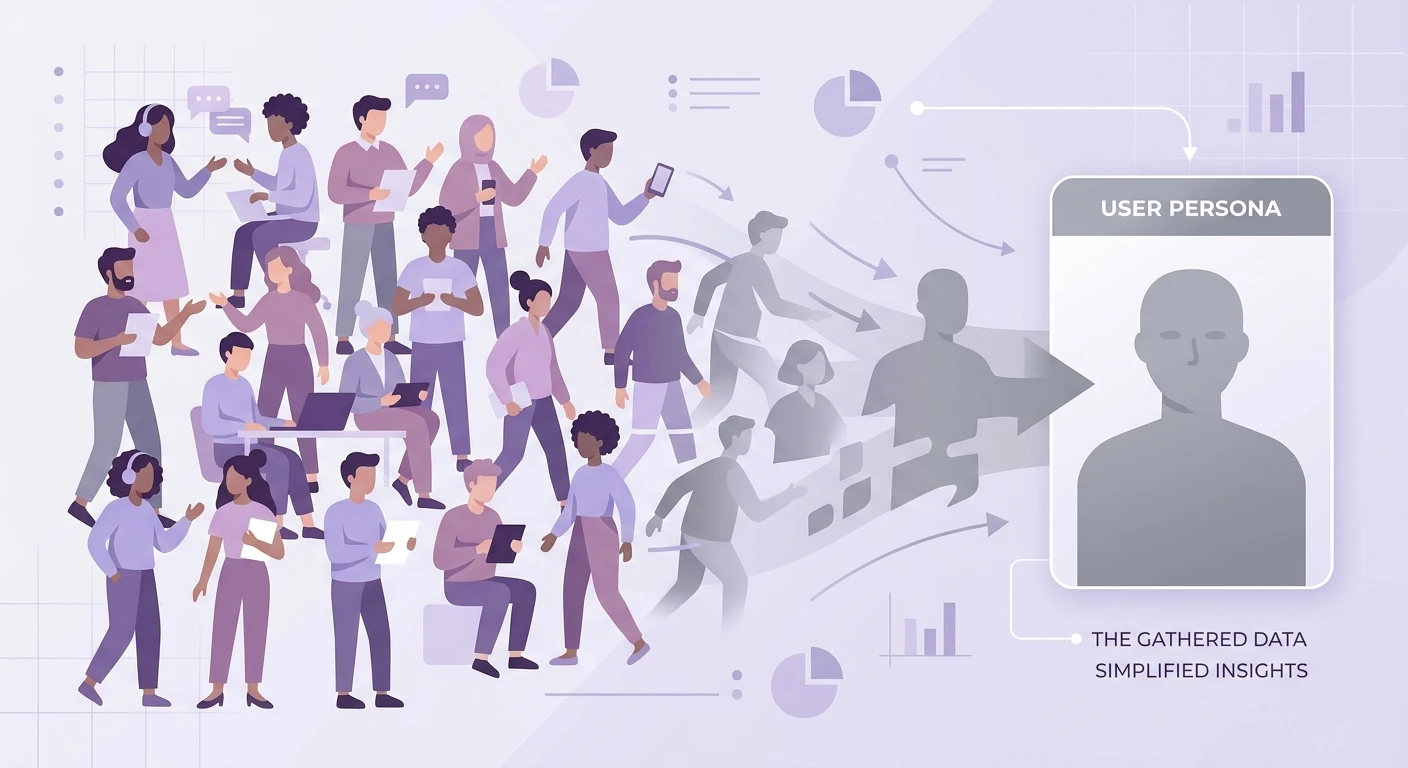
The trouble is that summarizing is a lossy operation, and personas are one of the lossiest summaries we produce. Every archetype is an average, and an average is precisely the thing that erases variance. The moment you collapse a diverse population into three tidy composites, you throw away the outliers, the contradictions, and the small-but-critical segments whose behavior does not fit the mean. What you are left with is a set of plausible, well-groomed humans who do not actually exist -- and a team confidently designing for them.
The persona collapse problem is the systematic loss of decision-relevant variance that happens when qualitative data is compressed into archetypes. The persona is not wrong, exactly. It is just averaged, and the average is where the signal went to die.
Where the Collapse Destroys Signal
The bimodal segment becomes one fictional middle. Suppose half your users are power users who live in the product daily and half are occasional users who log in monthly. Average them and you get a "moderate" user who checks in weekly -- a person who represents neither real group. Every design decision made for this phantom middle serves nobody. This is the same distortion described in the vocal minority problem, where your most engaged panelists point you at the wrong product, except here the averaging itself manufactures a majority that was never there.
The critical minority disappears entirely. A segment that is ten percent of your users but eighty percent of your churn risk gets rounded away in a three-persona model. They are too small to earn their own archetype and too different to fold into an existing one, so they simply vanish from the wall. The team never designs for them because, as far as the personas are concerned, they do not exist.
Contradictions get smoothed into coherence. Real people want fast onboarding and deep configurability. They want privacy and personalization. A persona built to be internally consistent quietly resolves these tensions in one direction, hiding the fact that the tension itself was the finding. This is a close cousin of the narrative coherence bias, where a tidy story beats a messy truth.
Behavior gets frozen into a trait. A persona says "Brenda is not technical." But Brenda was not technical in the specific, unfamiliar context you studied. In her own domain she is deeply expert. The persona converts a situational observation into a permanent attribute, and the team starts treating a context-dependent behavior as a fixed personality.
Why Smart Teams Collapse Anyway
Persona collapse is not a failure of intelligence. It is a response to real pressure. Stakeholders want something memorable, not a variance table. Slides have limited space. A three-persona model is easy to socialize; a nuanced segmentation with overlapping distributions is not. And there is a genuine cognitive limit -- nobody can design against forty individuals, so compression is not optional.
The mistake is treating the persona as the finding rather than as a lossy index into the finding. A good archetype should be a pointer back to the evidence, not a replacement for it. When the summary becomes the only artifact anyone consults, the variance it discarded is gone for good. This is the qualitative equivalent of the problem enterprise data teams fight when they enforce data contracts across their AI pipelines: the moment a downstream consumer trusts a summarized value without any way to inspect what was aggregated away, silent errors become structural.
Building Personas That Preserve Variance
Report the spread, not just the center. For every persona attribute, note how much of the population it actually covers and how much it does not. "Sixty percent match this; twenty-five percent behave the opposite way" is infinitely more useful than a confident singular claim. The dissenting quarter is often where the roadmap lives.
Keep a live link to the raw evidence. A persona should be traceable back to the specific participants and quotes that produced it. When a team can click from an archetype into the underlying interviews, the summary stops being a dead end. This is the same discipline behind research triangulation, where no single method or artifact gets to stand alone.
Protect the outliers on purpose. Before you collapse, explicitly ask which segments are small but strategically important -- high-value, high-risk, or high-growth -- and give them representation even if the numbers say to round them away. Statistical insignificance is not the same as strategic insignificance.
Treat personas as versioned, not eternal. Users change, and a persona built two years ago is describing a population that has moved. Revisit archetypes against fresh data on a schedule, the same way you would refuse to trust any research finding past its half-life.
The Analysis Layer Is Where This Is Won or Lost
Persona collapse is fundamentally an analysis-time failure, which is exactly where an AI-native research platform can change the economics. When your qualitative data lives in a system that can hold the full population -- every transcript, every code, every contradicting case -- you no longer have to choose between a memorable summary and a faithful one. You can surface the three-persona overview for the stakeholder deck and, in the same breath, expose the segments the average erased, the contradictions it smoothed, and the outliers it rounded away.
That is the promise of doing synthesis on Qualz.ai: the archetype becomes a lens onto the data rather than a wall in front of it. You keep the clarity personas were always meant to provide, without paying for it in the variance that actually drives good product decisions.
The goal was never to stop summarizing. It is to stop mistaking the summary for the users. Build personas that remember the people they came from -- and keep a way back to the ones the average left behind.
Book a demo to see how teams preserve segment-level variance while still shipping the crisp personas their stakeholders need.