The Reconstruction Problem
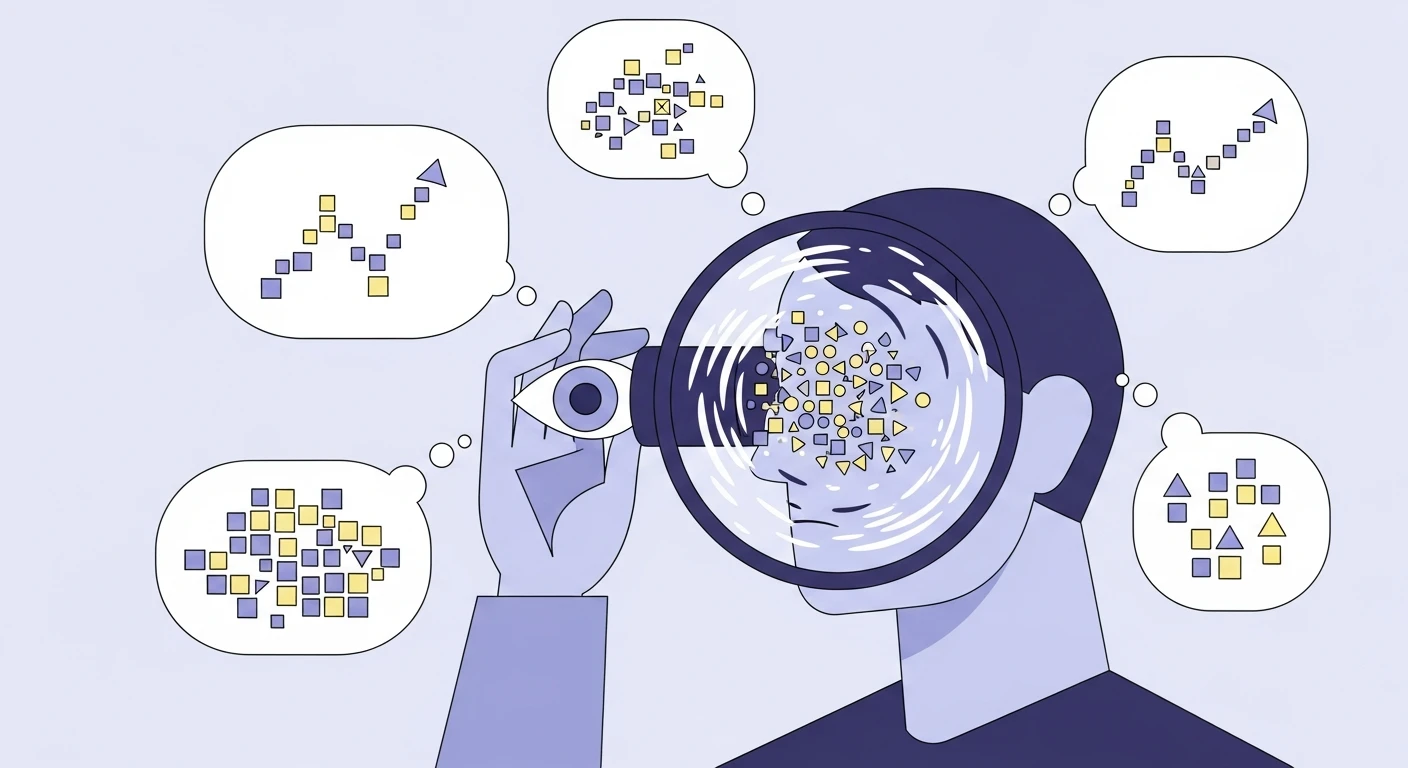
Every retrospective interview asks participants to perform an impossible cognitive task: accurately reconstruct the mental state, contextual factors, and decision logic that produced a past behavior. They cannot do it. Memory does not replay -- it reconstructs. And reconstruction smooths out the messy, contradictory, context-dependent reality of how decisions actually happen.
The recall bias problem in user interviews is well-documented. But most research methodologies treat it as an unavoidable limitation rather than a solvable design problem. Intercept research -- catching users in the exact moment of decision -- eliminates recall bias entirely by never asking users to remember. Instead, it captures the live experience before post-hoc rationalization can reshape it.
What Intercept Research Is
Intercept research captures data at the point of experience rather than after it. Instead of scheduling a 60-minute interview next Tuesday to discuss workflow decisions made last month, you catch the user at the moment they make a choice and ask a brief, focused question about what just happened.
The method has roots in intercept surveys (mall intercepts, website pop-ups) but extends far beyond surveys into qualitative depth. Modern intercept research combines:
- Trigger-based micro-interviews: Automated detection of decision moments that trigger brief (2-5 minute) qualitative prompts
- Contextual snapshots: Capturing the full decision context (what was on screen, what preceded the choice, what options were visible) alongside the user's explanation
- Experience sampling with qualitative depth: Going beyond the numeric scales of traditional ESM into open-ended meaning-making
Why Moments Beat Memories
The 30-Second Window
Cognitive research shows that accurate experiential recall degrades rapidly. Within 30 seconds of an experience, the narrative construction process begins -- smoothing inconsistencies, attributing causation, and aligning the memory with the person's self-concept.
Intercept research operates within this window. When you ask a user why they just clicked that button -- right now, while the page is still loading -- you get the actual reason: "I could not find the other option," "This was the first thing I saw," "I am not sure, it just seemed right." Ask them tomorrow, and the reason becomes a coherent narrative: "I evaluated the options and chose the one that best matched my workflow needs."
The difference is the difference between decision-as-experienced and decision-as-narrated. Research that relies on narration misses the fundamental messiness of real cognitive processes.
Contextual Factors That Vanish
Decisions are shaped by contextual factors that participants cannot reconstruct because they were never consciously registered:
- Time pressure ("I was between meetings")
- Emotional state ("I was frustrated from a previous task")
- Environmental distractions ("My phone buzzed")
- Visual salience ("That button was the brightest thing on the page")
- Social context ("My manager was watching my screen")
These factors vanish from retrospective accounts because they feel irrelevant to the participant's reconstructed narrative. But they are often the actual causal factors. Intercept research captures them because the context is still live when you ask.
This relates to the articulation gap -- but where the articulation gap describes users' inability to explain behavior, intercept methods solve it by catching behavior before the explanation is needed.
Implementation Patterns
Event-Triggered Micro-Interviews
Define decision moments in your product that warrant investigation. Common triggers:
- Feature adoption or rejection moments (user encounters a new feature and either engages or dismisses)
- Path divergence (user takes an unexpected route through a workflow)
- Abandonment signals (user starts a task and stops midway)
- Error recovery (user encounters an error and chooses a recovery path)
- Speed anomalies (user completes something unusually fast or unusually slow)
When the trigger fires, present a brief (2-3 question) qualitative prompt that captures:
- What were you trying to do?
- Why did you choose that specific action?
- What else did you consider?
This is lightweight enough that completion rates remain high (60-70% vs. 15-20% for scheduled interviews with the same users).
Progressive Depth Escalation
Not every intercept moment warrants deep investigation. Implement a progressive depth model:
- Level 1 (80% of intercepts): Single question, multiple choice or 1-sentence open-end
- Level 2 (15% of intercepts): 3-question micro-interview, 2-5 minutes
- Level 3 (5% of intercepts): Full contextual interview, 15-20 minutes, triggered when Level 1/2 responses indicate high-value exploration opportunity
Level 3 triggers can be automated based on response content analysis, or researchers can review Level 1/2 responses and selectively escalate. This mirrors how AI adaptive interviews adjust depth based on participant signals -- but applied to the research architecture itself.
Contextual State Capture
Alongside the participant's verbal response, capture the full decision context automatically:
- Screenshot or screen recording of the moment
- Clickstream of the preceding 60 seconds
- Session metadata (duration, page sequence, previous actions)
- Time-of-day and session-in-day position
This contextual data allows researchers to analyze decisions against their full situational backdrop -- something retrospective interviews can never provide because participants cannot reconstruct the context accurately.
Overcoming Intercept Research Challenges
The Disruption Dilemma
The primary objection to intercept research is that it disrupts the very behavior you are studying. Asking someone why they just made a choice changes their subsequent behavior -- a version of the observer effect in UX research.
Mitigation strategies:
- Sampling, not census: Do not intercept every user at every trigger. Sample 5-10% of qualifying moments, so most users experience the product uninterrupted
- Post-action timing: Trigger the intercept immediately after the decision but before the next action, capturing recall without disrupting the choice itself
- Dismissal without penalty: Make intercepts instantly dismissable with zero friction, and never re-trigger for users who dismiss
- Between-subject design: Each user sees at most 2-3 intercepts per week, distributed across different decision types
Response Quality in Brief Encounters
Can a 2-minute micro-interview produce qualitative insight comparable to a 60-minute depth interview? No -- and it should not try to. Intercept research answers different questions:
- Depth interviews reveal: rich mental models, emotional narratives, identity-level motivations
- Intercept research reveals: immediate decision factors, contextual influences, real-time cognitive state
The methods are complementary, not competitive. Use intercept data to identify which decisions warrant depth follow-up, and use depth interviews to explore the meaning systems behind patterns revealed by intercepts.
Participant Consent and Fatigue
Longitudinal intercept programs require clear consent frameworks. Participants must understand they may be prompted during product use, can decline at any time, and will not face different product experiences based on participation.
Fatigue management follows the same principles as the experience sampling method -- careful frequency capping, varied prompt types, and monitoring response quality for degradation signals.
Analysis Frameworks for Intercept Data
Decision Context Mapping
Aggregate intercept responses by decision type to build context maps showing:
- What factors influence decisions at each point
- How contextual variables (time pressure, prior actions, session state) moderate choices
- Which decisions are deliberate vs. reflexive
- Where the same user makes different choices in different contexts
This produces insight unavailable through any retrospective method -- because the contextual factors that shape decisions are precisely what vanishes from memory first.
Temporal Pattern Analysis
Intercept data with timestamps enables temporal analysis impossible with retrospective methods:
- Do decision patterns shift by time of day? Day of week?
- Do users make different choices when they are early vs. late in a session?
- How does decision quality change after interruptions or context switches?
The temporal bracketing analysis that reveals chronological patterns in qualitative data becomes vastly more powerful when the temporal metadata is captured in real-time rather than reconstructed from participant memory.
Pattern Divergence Detection
Compare intercept-captured decision explanations against what users say in retrospective interviews about the same decisions. The divergence between in-the-moment and after-the-fact explanations reveals exactly where narrative construction distorts understanding.
This divergence data has strategic value: it identifies which product decisions you can trust retrospective research about (low divergence) and which require in-context methods (high divergence). It calibrates your entire research program's methodology selection.
Building an Intercept Research Program
Start With High-Stakes Decisions
Do not intercept-research everything. Start with decisions that:
- Have high business impact (conversion, retention, feature adoption)
- Show unexplained variance in quantitative data
- Produce contradictory findings in retrospective research
- Involve multiple options with non-obvious trade-offs
Integrate With Product Analytics
Intercept research reaches full potential when integrated with your analytics pipeline. Use quantitative signals to identify which decision moments warrant qualitative investigation, and use intercept findings to explain quantitative anomalies.
This integration mirrors the research triangulation principle -- but operationalized as a continuous system rather than an occasional methodology choice.
Scale Through AI Analysis
At volume, intercept research produces more qualitative data points per week than traditional methods produce per quarter. Manual analysis cannot keep pace. AI-assisted pattern detection, clustering, and summarization makes intercept research viable at scale -- processing hundreds of brief responses daily into actionable patterns.
The same structured output engineering approaches that enable reliable AI pipelines in production systems apply to building reliable intercept-to-insight pipelines that maintain qualitative nuance at quantitative scale.
Practical Takeaways
- Stop asking users to remember decisions. Memory reconstruction introduces systematic distortion that no interview skill can overcome.
- Implement trigger-based micro-interviews at 3-5 key decision points in your product. Start with high-stakes, high-variance moments.
- Capture contextual state automatically alongside participant responses. The context is the insight -- and it vanishes from retrospective accounts.
- Use progressive depth escalation to balance data richness against user disruption. Most intercepts should be brief; few should be deep.
- Compare intercept vs. retrospective data to calibrate which decisions your existing methodology captures accurately.
- Treat intercept and depth interviews as complementary. Intercepts reveal what happens and when; depth interviews reveal why it matters.
The future of user research is not better retrospective interviews -- it is capturing experience before memory transforms it. Intercept methods are not a replacement for depth research. They are the missing temporal dimension that makes all your other research more honest about what users actually experience in the moments that matter.