Why Words Are Not Always Enough
Ask someone to describe their morning routine and you get a tidy summary: wake up, check phone, make coffee, commute. Ask them to photograph every moment of friction in that routine and then walk you through the images, and you get something entirely different -- the cluttered counter that forces a workaround, the app notification that derails their focus, the three-step process they have simplified into a single word.
This is the core insight behind photo elicitation: images bypass the narrative smoothing that verbal accounts impose on messy reality. When participants respond to visual prompts rather than abstract questions, they access a different layer of memory and meaning. The result is richer, more specific, and more emotionally honest than what traditional interview techniques typically produce.
Photo elicitation is not new. Social scientists have used it since the 1950s. But its application in UX research -- particularly remote UX research -- is still underexplored. As research teams have adapted to distributed work, the techniques that depend on physical co-presence have faded. Photo elicitation is one of the few methods that actually works better in remote contexts than in person.
What Photo Elicitation Actually Is
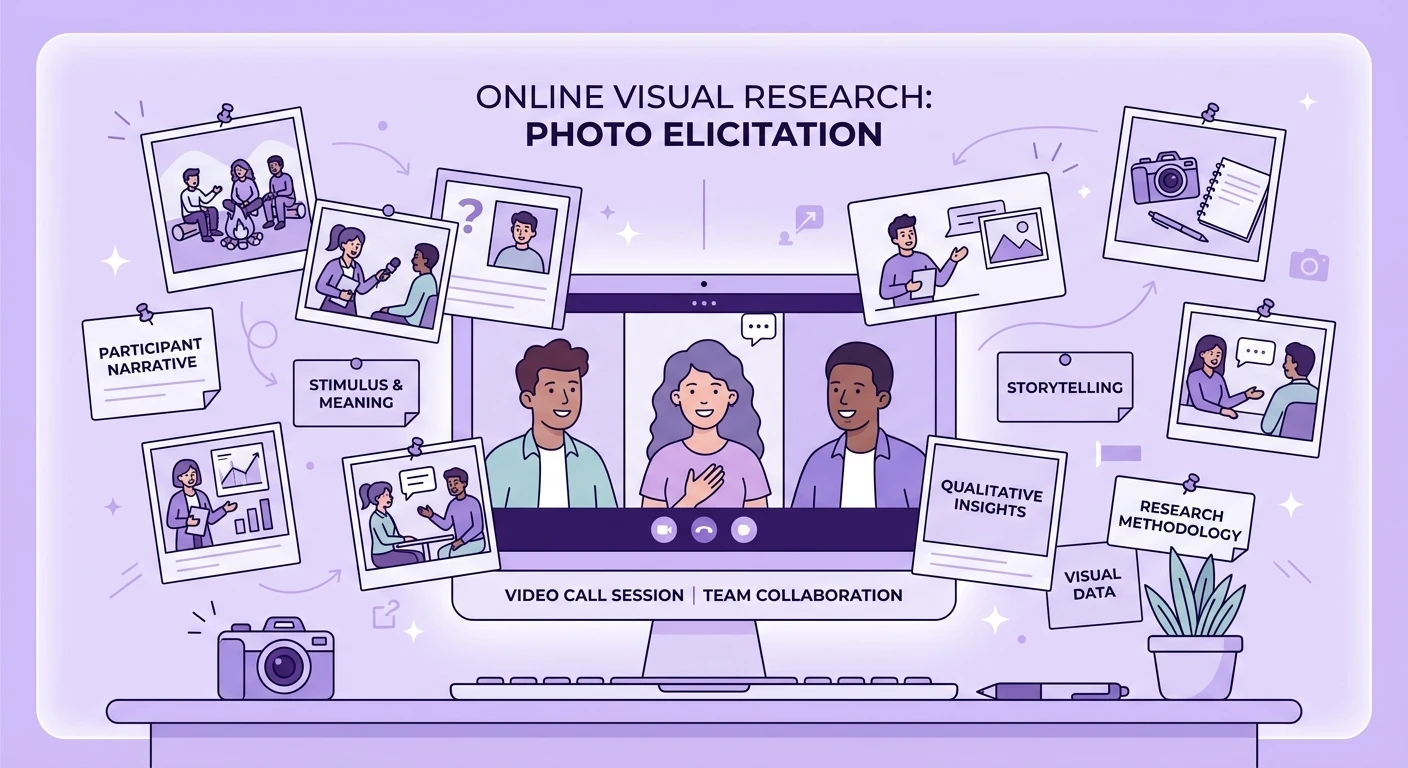
Photo elicitation is a research technique where photographs or images are introduced into an interview to stimulate discussion. The images can be researcher-generated (you choose the photos), participant-generated (they take the photos), or drawn from existing sources (stock images, screenshots, artifacts).
The method works because images function as a third party in the conversation. Instead of the researcher asking questions and the participant answering them, both parties examine an image together and discuss what it represents. This triangulated dynamic reduces the power imbalance inherent in interviews and gives participants a concrete anchor for abstract experiences.
There are several variants, each suited to different research questions:
Auto-driven photo elicitation asks participants to take photographs in response to a prompt before the interview. "Photograph three moments this week where technology helped you" or "Capture every point of frustration in your workflow" gives participants an assignment that forces them to observe their own experience with fresh eyes.
Researcher-driven photo elicitation uses images selected by the researcher to prompt discussion. Screenshots of interface states, photos of physical environments, or even abstract images can serve as conversation starters that surface unexpected associations.
Photo sorting and ranking asks participants to arrange a set of images according to criteria you define -- most to least frustrating, most to least useful, most to least representative of their experience. The sorting process externalizes decision-making that participants might struggle to articulate verbally.
Why It Works Better Than You Expect
The effectiveness of photo elicitation rests on several well-documented cognitive mechanisms.
Images Access Different Memory Systems
Verbal questions activate semantic memory -- the system that stores general knowledge, categories, and abstract concepts. When you ask "How do you feel about your project management tool?" participants search their semantic memory for relevant attitudes and opinions, producing a summary that may be accurate in general terms but stripped of specific detail.
Images activate episodic memory -- the system that stores specific experiences embedded in time and place. When you show a participant a screenshot of their actual Kanban board and ask "Tell me about this," they access the specific experiences associated with that visual context. The stories that emerge are grounded in particular moments rather than generalized impressions.
This distinction matters enormously for UX research. Semantic memory gives you attitudes. Episodic memory gives you behaviors. Most research questions require the latter, but most interview techniques elicit the former. This connects to broader AI memory architectures -- just as AI systems need different memory structures for different types of knowledge, human cognition uses distinct systems that researchers must deliberately engage.
Visual Prompts Reduce Interviewer Dominance
In a standard interview, the researcher controls the conversation through questions. Even with the best open-ended technique, the interviewer's mental model shapes what gets discussed. Photo elicitation shifts control to the participant. When a participant is talking about their own photograph, they are the expert. They determine what is significant, what needs explaining, and what context matters.
This power shift is particularly valuable when researching experiences that participants find difficult to articulate or that carry social desirability pressure. Remote ethnographic approaches have shown that giving participants more agency in the research process consistently produces more authentic data.
Concrete Anchors Prevent Abstraction Drift
Without visual anchors, interview conversations naturally drift toward abstraction. Participants generalize their experiences into tidy summaries. Photos pin the conversation to specific, concrete moments. "I always have trouble finding things" becomes "See this drawer? Every morning I spend two minutes looking for the right adapter because they all look the same." The specificity difference transforms the quality of insight available to the research team.
Implementing Photo Elicitation in Remote Research
Remote research environments actually offer advantages for photo elicitation that in-person settings do not. Participants are in their natural context. They have cameras in their pockets. Screen sharing allows real-time collaborative examination of images. Here is how to design an effective remote photo elicitation study.
Phase 1: The Photo Assignment
Before the interview, give participants a clear, bounded assignment. Specificity matters. "Take photos of your workspace" is too vague. "Photograph three things on your desk that help you focus and three things that distract you" gives participants a framework that is specific enough to be actionable but open enough to surface unexpected insights.
Provide the assignment 3-5 days before the interview. This gives participants time to notice and capture relevant moments without the task feeling rushed. Send a reminder at the midpoint.
Be explicit about what you do and do not need. Participants often worry about photo quality or composition. Clarify that you are interested in content, not aesthetics. A blurry photo of the right moment is worth more than a perfectly composed photo of the wrong one.
When designing effective interview guides, integrate the photo review as a structured segment rather than treating it as an icebreaker. The images should drive the substantive portion of the conversation.
Phase 2: The Photo-Driven Interview
Structure the interview around the participant's images. Open by asking them to share their screen or send their photos, then let them choose which image to discuss first. This seemingly small choice reveals what the participant considers most important or most interesting, which is itself valuable data.
For each image, use a consistent but flexible probing structure:
The description layer: "Tell me what I am looking at here." Let them set the context.
The experience layer: "Walk me through what was happening when you took this." Ground the discussion in a specific moment.
The meaning layer: "Why did this one make your list?" Explore the significance they assign to this particular moment or object.
The connection layer: "How does this relate to [theme from previous photo]?" Help participants build connections across their own images.
Resist the urge to interpret images before the participant has spoken. Your reading of a cluttered desk or a complex dashboard may be completely different from theirs. The participant's interpretation is the data; yours is just a hypothesis.
Phase 3: Collaborative Analysis
After discussing individual images, move to synthesis. Ask the participant to arrange their images in order -- by importance, by frequency of occurrence, by emotional intensity. The sorting process makes implicit priorities explicit and often triggers new insights that neither the researcher nor the participant had anticipated.
This collaborative analysis phase is where photo elicitation produces its most distinctive value. Participants are not just reporting their experience; they are actively analyzing it with you, using their own visual evidence as data. The insights that emerge from this joint analysis are co-created rather than extracted, which typically makes them more nuanced and more actionable.
Common Pitfalls and How to Avoid Them
The Tourism Problem
Some participants treat the photo assignment as a performance rather than a documentation task. They stage photos, choose aesthetically pleasing subjects, or photograph what they think you want to see rather than what actually represents their experience.
Mitigate this by framing the assignment around moments rather than objects. "Capture the moment when..." produces more authentic images than "Photograph your..." because moments are harder to stage than still lifes.
The Overwhelm Problem
Asking for too many photos overwhelms participants and produces diminishing returns. Five to seven images is the sweet spot for a 60-minute interview. Fewer than five does not provide enough material for pattern recognition. More than seven means you will rush through later images or run out of time.
The Interpretation Trap
Researchers sometimes use photo elicitation as a projective technique, interpreting images as though they are Rorschach tests. This is methodologically unsound in UX research. The value of the image lies entirely in the participant's relationship to it, not in the researcher's interpretation. Always let the participant speak first.
The Privacy Problem
Participants photographing their environments may inadvertently capture sensitive information -- other people's faces, confidential documents, personal items they did not intend to share. Address this proactively in the assignment instructions. Provide guidance on what to avoid photographing, and give participants the opportunity to review and redact images before the interview.
Scaling Photo Elicitation With Technology
The traditional limitation of photo elicitation was scale. Analyzing image-anchored interviews was time-intensive, making it impractical for large studies. Modern research tools are changing this equation.
AI-assisted analysis can transcribe photo-driven interviews, tag images with participant descriptions, and identify visual patterns across participants. What used to require days of manual coding can now be accomplished in hours. The rise of builder-researchers who combine research skills with technical fluency is making these workflows accessible to teams that previously lacked the resources for visual methods.
Mobile research platforms can manage the photo assignment workflow -- sending prompts, collecting images, organizing submissions by participant -- without requiring manual coordination. This operational scaffolding makes photo elicitation practical for studies with 20 or 30 participants, not just the 5-8 participant studies where it has traditionally been confined.
When to Use Photo Elicitation
Photo elicitation is not a universal method. It excels in specific research contexts:
Environmental research where the physical or digital context of use matters. Home office setups, retail environments, clinical workspaces -- any setting where the surroundings influence the experience.
Emotional experience research where participants struggle to articulate feelings verbally. Images provide an indirect route to emotional content that direct questions often miss.
Cross-cultural research where language differences make verbal-only interviews unreliable. Images create a shared reference point that transcends vocabulary limitations.
Longitudinal studies where you want to track changes over time. Asking participants to repeat photo assignments at intervals creates a visual timeline of evolving experience.
Discovery research where you do not yet know what questions to ask. Participant-generated images surface themes and concerns that the researcher may not have anticipated, making photo elicitation an excellent method for the earliest stages of a research program.
The Deeper Value
Photo elicitation does more than produce better interview data. It transforms the relationship between researcher and participant from interrogator-witness to co-investigators examining shared evidence. This shift in dynamic produces not just richer data but more honest data, because participants feel like collaborators rather than subjects.
In a research landscape that increasingly defaults to surveys and analytics, photo elicitation reminds us that the most powerful insights often come from looking at the world through someone else's eyes -- literally. The photographs participants choose to take, the stories they tell about those images, and the connections they draw between them reveal layers of experience that no amount of clever questioning can access on its own.
The method requires more setup than a standard interview. It demands more from participants. It produces data that is harder to systematize. But for the research questions where it fits, photo elicitation delivers something that faster, leaner methods cannot: the texture of lived experience, captured in the participant's own visual language and interpreted in their own words.