The Fidelity Trap
Product teams face a persistent dilemma in concept testing: how polished should the stimulus be? Too rough and participants cannot envision the experience. Too polished and they evaluate aesthetics instead of value. The instinct is always toward higher fidelity -- it looks more professional, it is easier for participants to react to, and stakeholders prefer seeing something that resembles the final product.
But this instinct systematically undermines research quality. Higher-fidelity prototypes trigger a specific cognitive shift in participants: from evaluative reasoning about whether the concept solves their problem to aesthetic judgment about whether the execution is pleasing. You asked them to validate your idea. They gave you a design critique instead.
This is not participant error. It is stimulus error. The prototype's fidelity communicated that design decisions were already made, inviting feedback on execution rather than direction. By the time your prototype looks real, participants treat it as real -- and real products get surface-level opinions, not deep conceptual engagement.
Why High Fidelity Suppresses Critical Feedback
The Completion Signal Problem
High-fidelity prototypes signal completion. When participants see polished UI, smooth animations, and refined copy, their implicit assessment shifts from "is this concept worth building?" to "is this product ready to ship?" These are fundamentally different questions that produce fundamentally different feedback.
The completion signal triggers social dynamics that suppress honest critique. Participants perceive that significant investment has already been made. Criticizing a wireframe feels like brainstorming. Criticizing a polished prototype feels like rejecting someone's finished work. The scaffolding problem in concept testing is real -- abstract ideas need anchors -- but anchoring too concretely constrains the feedback space.
Research teams notice this pattern: early-stage wireframe tests generate controversial, divergent feedback that challenges assumptions. Late-stage prototype tests generate convergent feedback about details. Teams interpret this as the concept being validated when it has merely been accepted as a given.
The Aesthetic Dominance Effect
Human attention is drawn to the most salient stimulus features. In a high-fidelity prototype, visual design dominates salience. Participants cannot help but react to what they see most vividly: color choices, typography, layout balance, animation smoothness. These elements occupy perceptual foreground while underlying information architecture, interaction models, and value propositions recede to background.
This creates a systematic bias in feedback data. You receive abundant signal about visual execution and sparse signal about conceptual validity. The research report fills pages with aesthetic preferences while the fundamental question -- does this solve a real problem in a way users would adopt? -- receives thin, ambiguous evidence.
The attention economy of research findings applies within individual sessions too: participants allocate their evaluative attention to whatever is most visually prominent, leaving less cognitive resource for the deeper assessment you actually need.
The Anchoring Lock-In
Once participants see a specific implementation, they cannot unsee it. Their feedback becomes anchored to the particular execution rather than the problem space. Ask "how would you solve this problem?" after showing a high-fidelity prototype and participants will describe minor variations of what you showed them. Their generative capacity collapses around your specific solution.
This is devastating for discovery research. The whole point of early-stage testing is exploring whether your approach is one of many valid solutions or the optimal one. High-fidelity stimuli foreclose this exploration by defining the solution space so concretely that alternatives become cognitively unavailable to participants.
The anchoring effect in user research operates at both the finding level and the session level. High-fidelity prototypes anchor the entire session around execution details rather than conceptual questions.
The Fidelity-Feedback Quality Curve
The Sweet Spot Is Lower Than You Think
The relationship between prototype fidelity and feedback quality is not linear. It follows an inverted-U curve:
- Too low (blank canvas): Participants cannot engage with nothing. They need enough structure to react to.
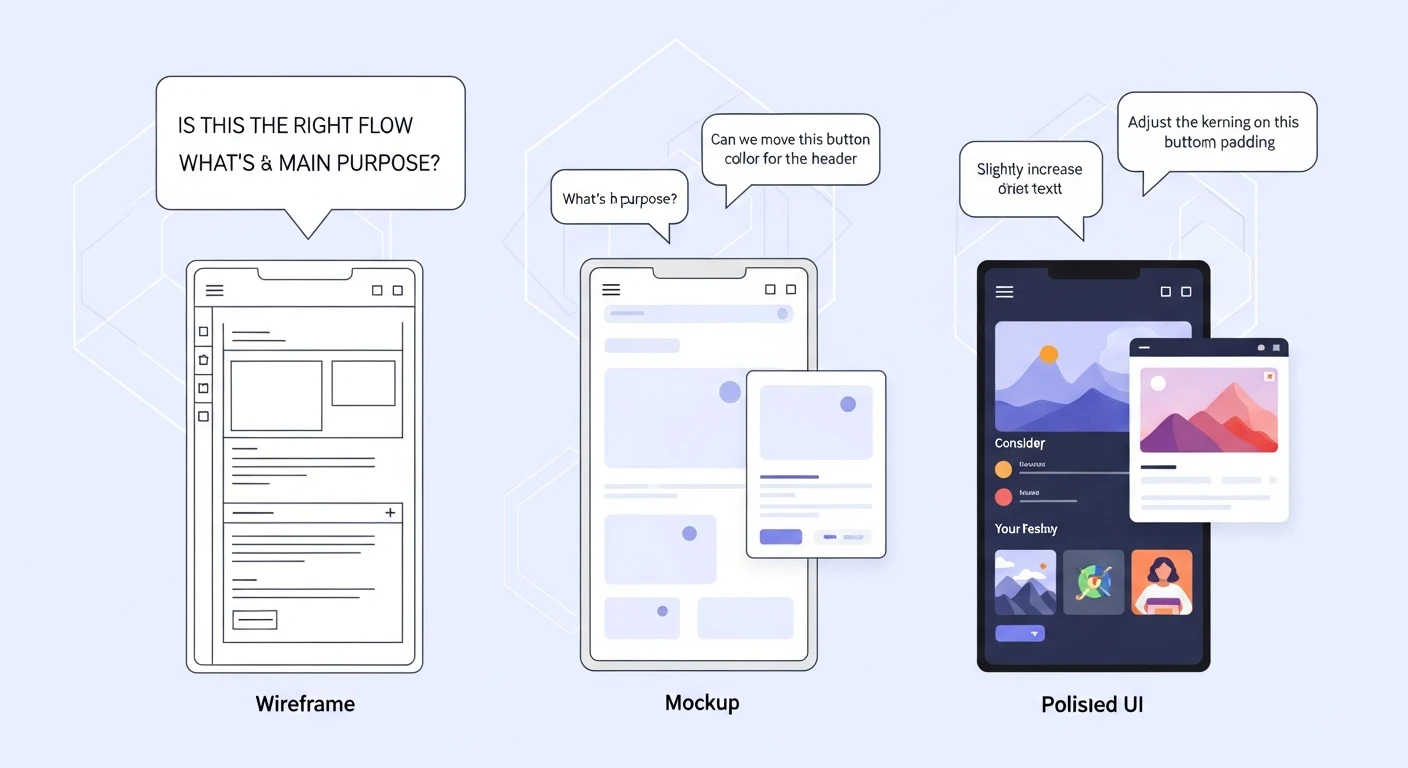
- Low-medium (wireframes, sketches): Participants understand the concept but perceive it as in-progress. They feel empowered to suggest alternatives, challenge assumptions, and think generatively.
- Medium-high (clickable mockups): Participants can evaluate flow and interaction but still see room for change. Feedback balances validation with critique.
- High (pixel-perfect prototypes): Participants shift to aesthetic evaluation. Critical feedback declines. Confirmation bias increases.
Most teams operate at high fidelity because it is comfortable and stakeholder-pleasing. The optimal research stimulus lives in the low-medium to medium range -- uncomfortable for teams accustomed to showing polished work, but productive for generating honest, conceptual-level feedback.
Fidelity Should Match Research Questions
The appropriate fidelity is determined by what you need to learn, not what you are capable of producing:
- "Is this problem worth solving?" -- Scenario descriptions, problem statements, no prototype at all
- "Is this approach valid?" -- Low-fidelity sketches, concept cards, storyboards
- "Does this flow work?" -- Medium-fidelity wireframes with basic interaction
- "Is this usable?" -- Higher-fidelity clickable prototypes
- "Is this desirable?" -- High-fidelity visual designs
Teams that use pixel-perfect prototypes for conceptual validation are answering a question nobody asked while leaving their real question unaddressed. This mirrors how mixing generative and evaluative research in one study produces neither -- mismatched stimulus fidelity achieves the same methodological confusion.
The Organizational Pressure Toward High Fidelity
Stakeholder Confidence Theater
Product leaders want to see polished prototypes in research sessions because polished prototypes feel like progress. A wireframe test signals "we are still figuring this out." A prototype test signals "we are almost ready to ship." Research becomes a validation ceremony rather than a discovery instrument.
This pressure is not malicious. Leaders need confidence that the team is moving forward. But when research stimulus fidelity is driven by stakeholder comfort rather than methodological appropriateness, the research becomes research theater -- activity that looks like validation but produces neither challenge nor confirmation of real quality.
The Engineering Investment Sunk Cost
When engineering builds a functional prototype for research, the team has already invested significant resources. This investment creates psychological pressure to validate rather than invalidate. The research question subtly shifts from "should we build this?" to "how should we refine this?" -- a less risky question that preserves the sunk investment.
Functional prototypes should be reserved for evaluative research where the concept is already validated and you are optimizing execution. Using them for discovery research is methodologically backward -- and expensive.
Designing Effective Low-Fidelity Stimuli
The Art of Strategic Incompleteness
Effective concept testing stimuli are deliberately incomplete. They provide enough structure for participants to understand the concept while leaving enough ambiguity to invite challenge and alternatives. This requires design skill -- strategic incompleteness is harder to achieve than comprehensiveness.
Principles for stimulus design:
- Show structure, not style. Boxes and labels, not colors and fonts.
- Imply interaction, not demonstrate it. "Tapping here would show your results" rather than a smooth animation.
- Name, not implement. "AI-generated summary appears here" rather than an actual AI summary.
- Invite projection. "What would you expect to see next?" works better when the prototype does not already show what is next.
Multiple Concepts Over Single Polish
The time spent polishing one prototype to high fidelity would be better spent creating three low-fidelity alternatives. Showing participants multiple rough concepts invites comparative evaluation -- which is more valid than absolute evaluation of a single polished option.
Comparative judgment is more reliable than absolute judgment for several cognitive reasons: it activates analytical rather than aesthetic processing, it forces explicit prioritization of feature values, and it reduces acquiescence bias because participants can prefer one option without rejecting anything outright.
As eval-driven development in AI systems demonstrates, comparing multiple approaches against criteria produces more reliable quality signals than evaluating a single output in isolation. The same principle applies to concept testing: comparison forces criteria articulation that single-stimulus testing cannot.
Practical Framework
Before Your Next Concept Test
- State your research question explicitly. What do you need to learn? If it is conceptual validation, lower your fidelity. If it is usability evaluation, higher fidelity is appropriate.
- Match fidelity to question. Use the fidelity-question mapping above. Challenge any instinct to over-polish.
- Create multiple stimuli rather than polishing one. Three rough concepts produce better data than one refined one for discovery research.
- Brief participants on the stage. Explicitly say "this is early-stage -- we want to know if the concept is wrong, not whether the design is pretty." Permission to critique changes feedback quality dramatically.
- Remove visual distractions. If your wireframe has realistic-looking content, replace it with obvious placeholders. Anything that looks real attracts aesthetic attention.
- Start with concept narration before showing anything. Describe the idea verbally, ask for initial reactions, then show the visual stimulus. This separates conceptual evaluation from visual evaluation.
- Ask generative questions. "What is missing?" and "What would make this not work for you?" are more productive with rough stimuli than "What do you think?" with polished ones.
The Counter-Intuitive Rule
The more uncertain you are about a concept, the lower your prototype fidelity should be. Uncertainty means you need honest, challenging feedback -- which requires stimuli that invite challenge rather than acceptance. Save your high-fidelity testing for concepts you have already validated at lower fidelity and are now refining for production.
Teams that understand this rule conduct faster, cheaper research cycles with better signal quality. Teams that polish everything before testing conduct slower, more expensive cycles that confirm assumptions without challenging them. The prototype fidelity paradox is ultimately a speed paradox: lower-fidelity research moves products forward faster precisely because it is willing to discover that the current direction is wrong.