The Illusion of Standardized Questions
Your team spent two weeks perfecting the interview guide. Every question was reviewed, piloted, refined. You distributed it to four researchers with clear instructions: ask these questions, in this order, with these probes.
Six weeks later, you have 48 transcripts. And a problem.
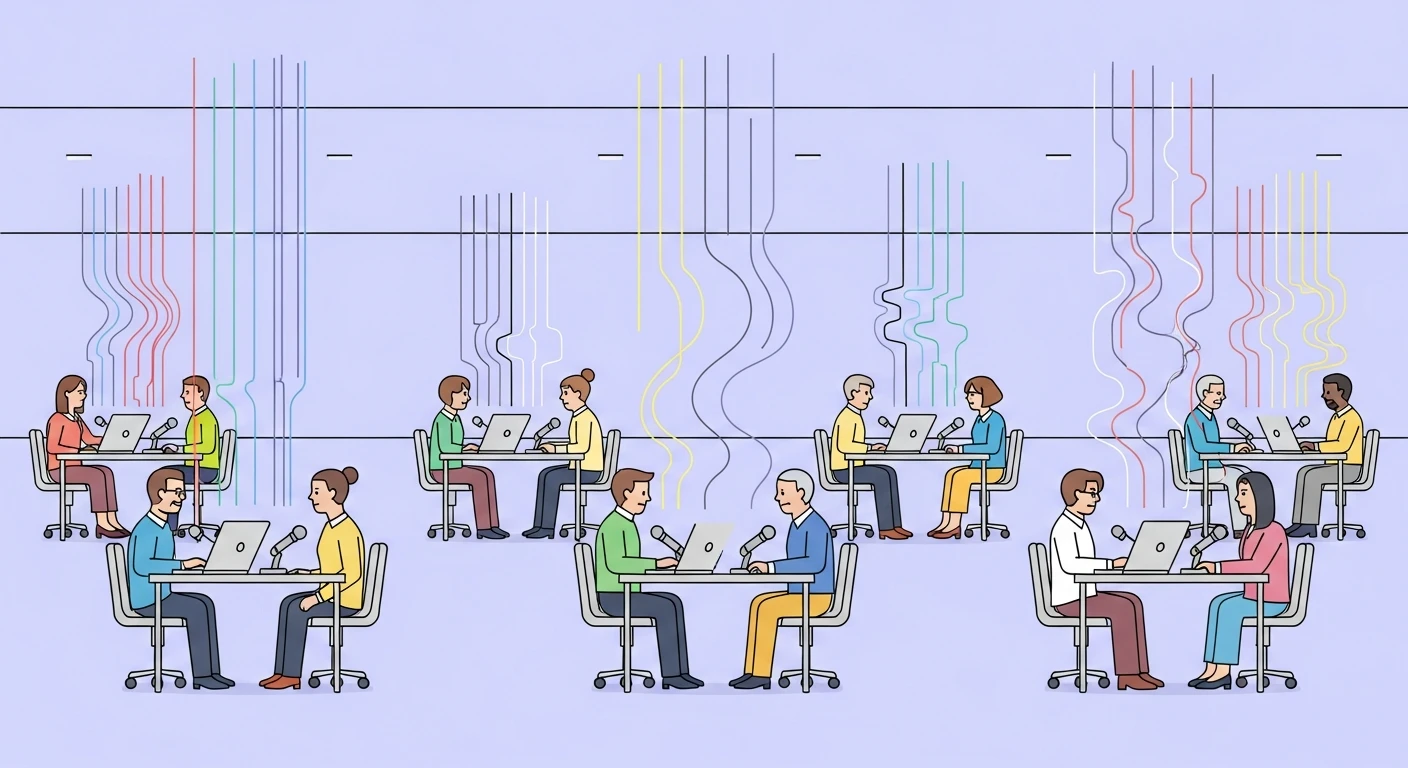
Researcher A consistently surfaced rich emotional narratives about workflow frustration. Researcher B got detailed procedural descriptions. Researcher C received aspirational wishlists. Researcher D collected cautious, brief responses peppered with qualifiers.
Same questions. Same participant profiles. Systematically different data.
This is the question contamination effect: the phenomenon where standardized questions mutate through the embodied delivery of different researchers, producing data that appears comparable but actually measures different constructs depending on who asked.
Why Identical Questions Become Different Instruments
Language on paper is inert. Language spoken by a human carries paralinguistic information that fundamentally alters what it means. Pace, emphasis, micro-pauses, facial expressions during delivery, body posture while listening -- all of these communicate to participants what kind of answer is expected.
When Researcher A asks "Tell me about your typical workflow," her slight forward lean and sustained eye contact signal genuine curiosity about emotional experience. Participants respond with how work feels. When Researcher B asks the identical question with a notepad ready and a slight head tilt suggesting categorization, participants respond with procedural steps.
Neither researcher is doing anything wrong. Both are competent. But they have created different conversational contracts with participants through non-verbal channels that no written guide can standardize.
The research on how the articulation gap shapes user behavior demonstrates that participants need contextual cues to determine what level of disclosure is appropriate. Different researchers provide different cues, which means participants calibrate differently for each one.
The Compounding Effect Across Follow-Up Probes
The initial divergence is problematic enough. But it compounds exponentially through follow-up probing.
Once Researcher A receives an emotional response to the first question, her subsequent probes naturally follow that thread. She asks "How did that make you feel?" and "What was going through your mind?" -- deepening the emotional register. Researcher B, having received a procedural answer, probes with "And then what happens?" and "Who else is involved?" -- deepening the procedural register.
By the third question in the guide, each researcher is conducting a fundamentally different study. The written guide is identical. The lived interview is not.
This is why interpretation drift in qualitative coding often begins not at the analysis stage but at the data collection stage. The data itself is already pre-interpreted by the conditions of its production.
The Calibration Problem Nobody Solves
Most research teams address this through training sessions: "Here is how to ask these questions." They conduct pilot interviews together. They discuss probing strategies.
These efforts help at the margins but cannot solve the fundamental problem. You cannot standardize embodiment. You cannot train away paralinguistic individuality. A researcher who naturally creates warmth will always get different data than one who naturally creates intellectual distance -- even if both are excellent at their jobs.
The real question is not how to eliminate this variation but how to account for it in analysis. And most teams do not account for it at all. They treat 48 transcripts as a unified dataset without acknowledging that they contain four different studies conducted under a shared label.
When organizations adopt structured output engineering approaches for AI systems, they invest heavily in ensuring that identical prompts produce consistent outputs. Yet in human research, we accept that identical prompts produce wildly inconsistent outputs and simply pretend the inconsistency does not exist.
What Cross-Researcher Contamination Actually Looks Like in Practice
Consider a product research team studying enterprise software adoption. Four researchers interview 12 users each about onboarding experiences.
Researcher A tends to empathize aloud: "That sounds frustrating." Her participants disclose more negative experiences because they feel permission to complain. Her dataset skews negative.
Researcher B maintains neutral composure. Her participants self-moderate, offering balanced accounts. Her dataset appears more ambivalent.
Researcher C unconsciously nods more vigorously at certain answers. Participants learn what interests her and produce more of it. Her dataset clusters around specific themes she inadvertently reinforced.
Researcher D is slightly more formal. Participants treat the interview as a professional exchange and provide more guarded, considered responses. Her dataset appears more polished but contains less raw experience.
When the team combines all 48 transcripts and codes them together, the resulting themes are an artifact of researcher composition, not participant experience. Change the team and you change the findings.
Strategies That Actually Help
Researcher-stratified analysis. Before combining data, analyze each researcher's transcripts separately. Look for systematic differences in theme prevalence, response depth, and emotional register. If patterns emerge that correlate with researcher rather than participant characteristics, you have contamination.
Audio review calibration. Record all interviews and have researchers listen to each other's sessions -- not to judge quality, but to identify paralinguistic patterns. Awareness of one's own delivery patterns is the first step toward managing their effects.
Rotating researcher-participant assignment. Rather than assigning each researcher a subset of participants, rotate so that some participants are interviewed by multiple researchers at different study phases. This creates built-in validity checks.
Explicit delivery protocols for critical questions. For the three or four most important questions in your guide, specify not just what to ask but how: pace, pause length, whether to maintain or break eye contact, whether to write during the answer or after. This will not eliminate variation, but it narrows the band.
AI-assisted consistency monitoring. Tools that analyze interviewer speech patterns across sessions can flag systematic drift. When a researcher's delivery of question 4 has shifted measurably from session 1 to session 8, the team can recalibrate. This is where observability principles from AI systems translate directly to research quality management.
The Uncomfortable Implication for Multi-Site Studies
If question contamination affects teams working in the same office with shared training, imagine what happens in multi-site research programs. Different offices, different research cultures, different norms around interview behavior -- and teams treat the data as directly comparable.
Enterprise research programs running identical studies across multiple locations are often comparing research cultures, not user experiences. The question is not whether contamination exists but whether the contamination is systematic enough to invalidate cross-site comparison.
For most programs, the answer is yes. But acknowledging this would mean acknowledging that the expensive multi-site study produced less certainty than anyone wants to admit.
Building Contamination Awareness Into Your Practice
The goal is not perfect standardization -- that is impossible with human researchers and arguably undesirable. The goal is contamination awareness: knowing where your data reflects methodology rather than phenomena, and adjusting your confidence accordingly.
Document researcher assignment in your analysis. Report which researcher collected which data. When themes appear strongly in one researcher's transcripts but weakly in another's, investigate whether this reflects real participant variation or researcher-induced variation.
The research on collaborative analysis sessions suggests that team coding can help surface these patterns -- but only if the team explicitly looks for researcher effects rather than treating all transcripts as equivalent.
Most importantly, stop treating the written interview guide as the study. The guide is a skeleton. Each researcher builds a different body around it. Your analysis must account for the bodies, not just the bones.