The Rapport Paradox
Every qualitative researcher knows the rule: build rapport before diving into substance. Participants who feel comfortable share more honestly, reveal vulnerable experiences, and provide the kind of thick description that transforms interviews from data collection into genuine understanding.
But rapport-building is not neutral. Every strategy you use to make participants comfortable simultaneously shapes what they will tell you. Agree too enthusiastically with an early statement and you have signaled which answers please you. Share too much about your own experience and you have anchored their narrative to yours. Express visible surprise at a response and you have taught them which answers are unexpected — and therefore interesting to you.
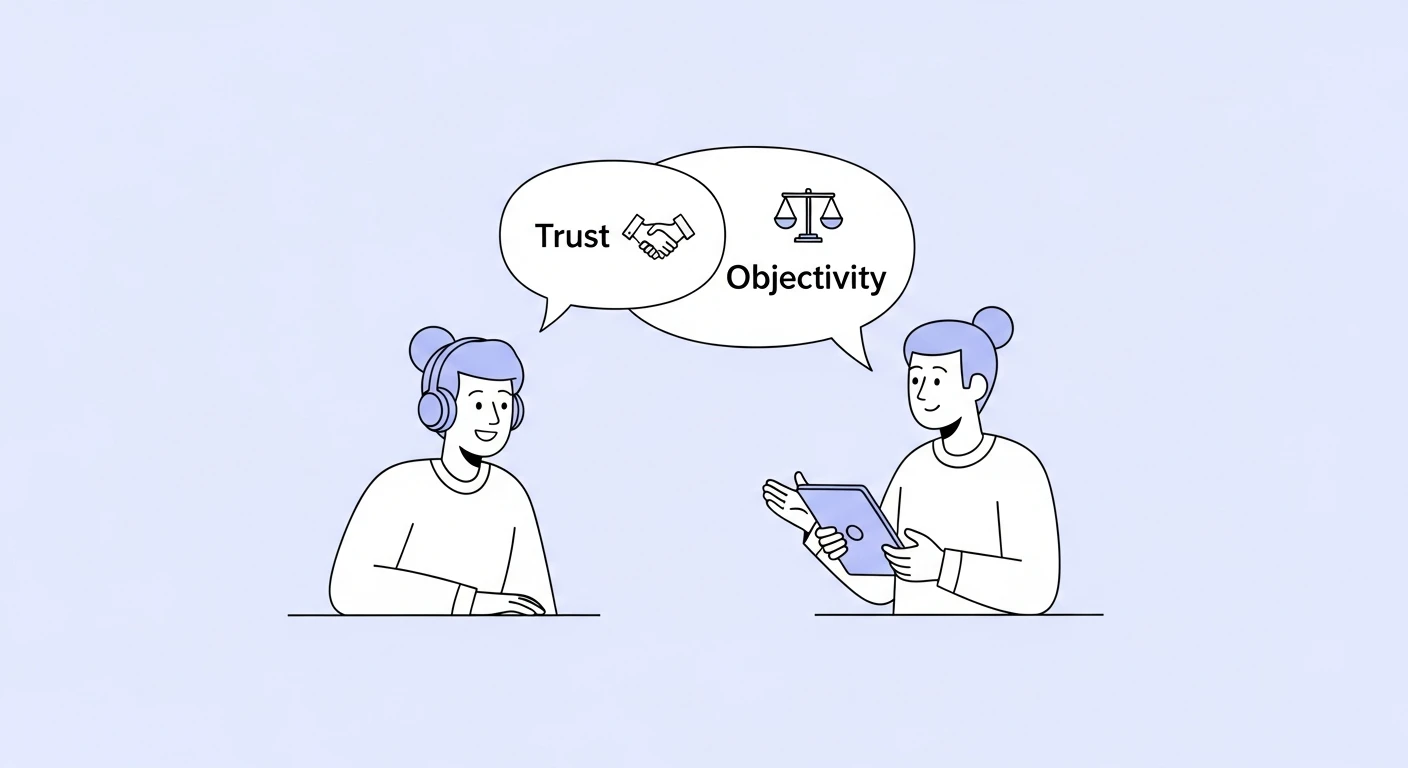
This is the rapport paradox: the very techniques that unlock depth also threaten validity. Cold, clinical interviews produce defensive, shallow responses. Warm, connected interviews risk producing responses calibrated to the relationship rather than the truth. The craft lies in building genuine trust through strategies that do not simultaneously contaminate the data you collect.
How Rapport Becomes Contamination
Contamination through rapport operates through four mechanisms:
Social desirability amplification. All interviews carry some social desirability bias — participants want to present themselves favorably. But strong rapport amplifies this because participants now want to present favorably to someone they like and respect. The closer the researcher-participant relationship, the stronger the desire to appear competent, thoughtful, or aligned with what the researcher seems to value.
Reciprocity obligation. When researchers share personal information or express vulnerability, participants feel obligated to reciprocate. This produces disclosure, which looks like depth, but the content is shaped by what the researcher shared rather than what the participant would have volunteered unprompted. The resulting data reflects the researcher's framing as much as the participant's experience.
Confirmation signaling. Micro-expressions of agreement, nodding patterns, and verbal affirmations teach participants what resonates with the researcher. By mid-interview, attuned participants — and most are more attuned than researchers realize — have learned the researcher's hypothesis and are unconsciously providing supporting evidence. This connects to the broader problem of how observation changes behavior in research settings.
Narrative anchoring. When researchers establish shared context ("I have talked to several people who struggle with X"), they anchor the participant's narrative. Participants who might have described their experience as Y now reframe it through the X lens because the researcher established X as the relevant topic. What feels like efficient context-setting is actually premature interpretation imposed before the participant has spoken.
Strategies That Build Trust Without Distortion
Effective rapport-building uses strategies that communicate safety and respect without signaling preferred content:
Structural transparency over personal disclosure. Instead of sharing your own experiences, share the interview structure. Explain what will happen, how long it takes, what you will do with the information, and what the participant controls. This builds trust through predictability and respect rather than through personal connection. Participants feel safe because they understand the container, not because they like you personally.
Curiosity posture rather than agreement posture. Train yourself to respond to participant statements with genuine curiosity rather than agreement or validation. "Tell me more about that" is rapport-building without contamination. "That is really interesting" teaches the participant which answers you find interesting. The difference is subtle but the cumulative effect over a 60-minute interview is dramatic.
Non-content warmth. Warmth in logistics — flexible scheduling, comfortable setup, genuine thanks for their time, clear communication about recording — builds trust without touching content. Participants who feel respected in the process trust the researcher without needing the researcher to validate their perspectives.
Normalizing the full range. Early in the interview, explicitly normalize diverse experiences: "People I speak with have very different experiences with this — some find it straightforward, others find it frustrating, and many are somewhere in between. I am interested in whatever your actual experience has been." This gives permission for any answer without signaling which answer you expect.
The Opening Minutes Problem
The first five minutes of an interview disproportionately shape everything that follows. This is where rapport is built or lost, and where contamination is most likely to be introduced. Many researchers use warm-up questions that seem harmless but carry hidden framing:
"Tell me about your role" seems neutral but primes professional identity, making participants more likely to give work-appropriate answers throughout the session. For research about personal experiences with a product, this can suppress the emotional and informal dimensions you most need to hear.
"What do you think about [product/category]?" as an opener invites evaluative framing before you understand their experience. Participants who start by evaluating spend the rest of the interview defending their evaluation rather than describing their experience.
Better opening strategies ask participants to describe recent, concrete situations without evaluation: "Walk me through the last time you [relevant activity]." This produces narrative rather than opinion, grounds responses in specific events rather than general impressions, and gives you rich contextual detail without requiring the participant to have pre-formed views.
This approach mirrors what research on progressive disclosure in guide design recommends — building from concrete experience toward abstraction rather than starting with conclusions.
Managing Your Own Signals
Researchers leak information constantly through channels they do not monitor:
Note-taking patterns. If you write more when participants say certain things, they notice. Maintain consistent note-taking behavior regardless of content relevance. Better yet, rely on recording and use notes only for your own analytical reactions rather than transcription.
Energy shifts. Your body language and vocal energy shift when participants hit topics relevant to your research questions. This is nearly impossible to eliminate entirely but can be mitigated by maintaining genuine curiosity about everything — including tangents and irrelevant details. If you are only engaged when participants discuss your target topic, they learn the target topic quickly.
Follow-up distribution. Which statements you probe deeper and which you let pass teaches participants your priorities within minutes. Probe consistently — follow up on surprising statements whether or not they relate to your primary research questions. You can always analyze selectively later, but you cannot un-teach a participant what you care about.
These signal management skills directly improve how teams handle the debriefing process after interviews, ensuring the documented record reflects participant perspective rather than researcher enthusiasm.
The AI Interview Advantage
One underappreciated benefit of AI-moderated interviews is their immunity to rapport contamination. An AI interviewer does not leak micro-expressions, does not have energy shifts when hearing relevant content, and does not create reciprocity obligations through personal disclosure. It builds trust through consistent, respectful interaction patterns without the social dynamics that distort human interviews.
This does not make AI interviews universally superior — some research topics require human connection that AI cannot provide. But for research where social desirability bias is a primary threat, AI moderation eliminates an entire category of contamination while maintaining engagement through adaptive questioning and genuine responsiveness to participant input.
The key insight is not to choose between human warmth and AI neutrality but to understand which studies are most threatened by rapport contamination and select the moderation approach accordingly. Studies exploring sensitive topics where social desirability is high benefit most from AI moderation's natural objectivity. Studies requiring deep empathic connection for trauma or identity topics may still warrant human moderation with careful bias management.
Building a Rapport Protocol
Teams that achieve consistent data quality build explicit rapport protocols rather than relying on individual researcher intuition:
- Define trust goals — what does the participant need to feel safe enough to share honestly? Focus on safety, not likeability.
- List contamination risks — which specific biases threaten this study? Design rapport strategies that avoid those specific risks.
- Script the opening — standardize the first two minutes so all researchers use non-contaminating warm-up approaches.
- Practice signal management — record practice sessions and review your own non-verbal leakage.
- Debrief on rapport quality — after each interview, note whether the participant seemed genuinely comfortable or performatively comfortable. The difference matters for data interpretation.
Rapport without bias is not about being cold or clinical. It is about being warm in ways that communicate "you are safe here" without simultaneously communicating "here is what I want to hear." Master this distinction and your qualitative data improves more than any other single methodological intervention can achieve.