The Freshness Illusion
You just finished an incredible interview. The participant articulated a pain point so clearly that it felt like a revelation. You share the insight in Slack. Your product manager gets excited. By the next sprint planning meeting, this single conversation has become the rationale for a roadmap change.
But here is what did not happen: nobody went back to check whether this "revelation" was consistent with the previous twenty interviews you conducted over the past two months. Nobody verified whether the pain point was new or simply well-articulated this time. Nobody asked whether the participant represented your core user base or an edge case.
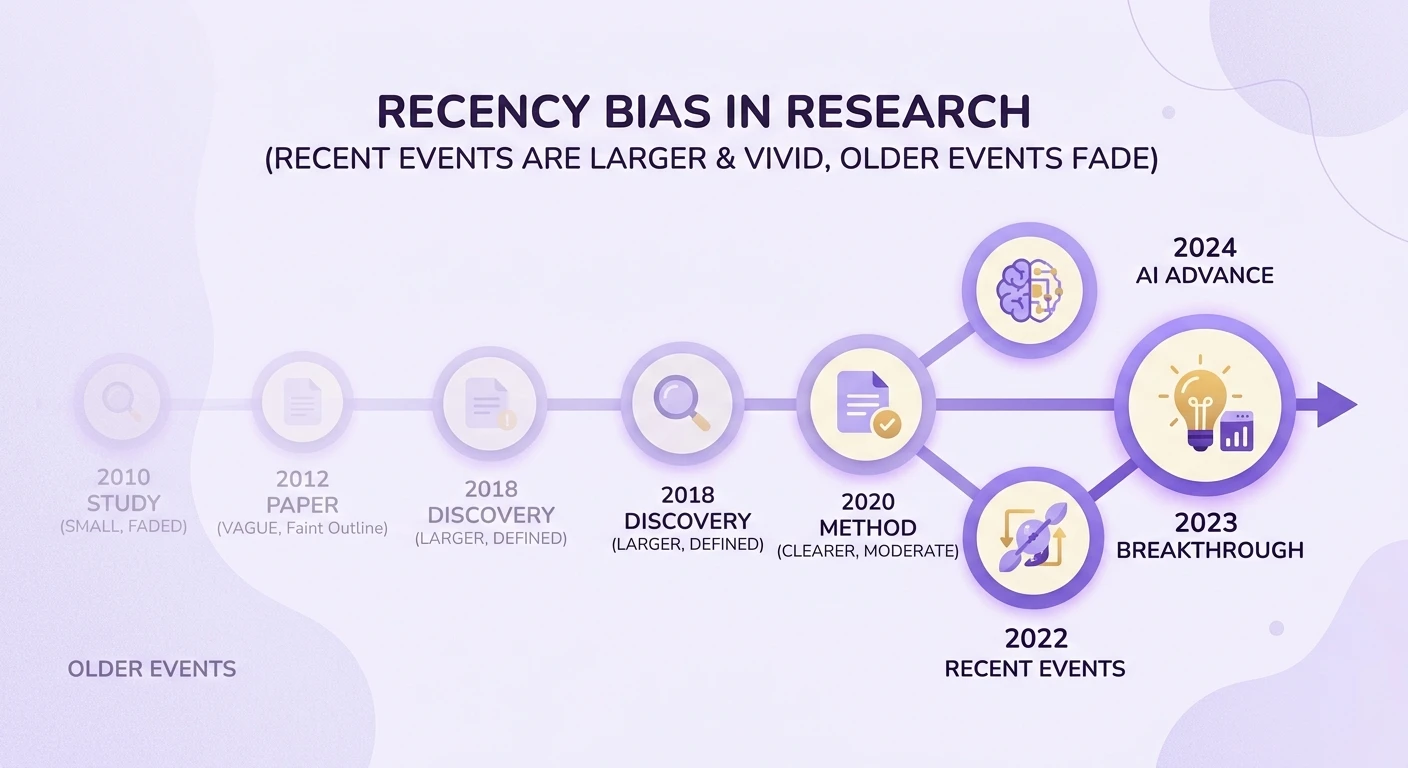
This is recency bias operating at the organizational level — the systematic tendency to overweight recent information while discounting historical evidence. In project-based research, this bias is contained by the study boundaries. You analyze everything at once, giving equal weight to early and late sessions.
But in continuous discovery — the model that Teresa Torres popularized and that most product teams now practice — there are no natural boundaries. New data arrives constantly. And each new data point has an outsized influence on decisions simply because it is fresh in memory.
How Recency Bias Manifests in Research Programs
The latest-interview effect. The most recently completed interview disproportionately shapes the researcher's mental model of user needs. Details from sessions conducted three weeks ago have faded to vague impressions while yesterday's conversation remains vivid and specific. Decision-makers hear detailed stories from recent sessions but only summary claims from older ones — and stories always win.
Momentum-driven themes. When a theme appears in two consecutive interviews, teams treat it as validated. When the same theme appeared in three non-consecutive interviews spread over two months, it went unnoticed because no single occurrence was recent enough to trigger attention. Temporal clustering creates false signal strength.
Contradiction blindness. A new finding that contradicts earlier data gets treated as an update — "users have changed" — rather than as a data point requiring reconciliation with the existing evidence base. The easier explanation (things changed) replaces the harder one (our earlier understanding was incomplete or our recent participant is atypical). As explored in detecting contradictions in qualitative interviews, inconsistency is a signal — but only if you notice it.
Stakeholder recency. Product managers and executives remember the last research readout they attended. If that readout covered a specific user segment or pain point, it becomes their mental model of "what research says" — regardless of whether that readout represented the full body of evidence. Teams that present findings incrementally rather than synthetically amplify this effect.
The Cognitive Mechanics
Recency bias is not a character flaw. It is a feature of how human memory works.
Availability heuristic. We judge the importance of information by how easily we can recall it. Recent information is more easily recalled. Therefore recent information feels more important. This is not a conscious evaluation — it operates below awareness.
Emotional vividness. Recent experiences carry emotional residue that older memories have lost. The frustration in yesterday's participant's voice still resonates. The frustration from three weeks ago has been abstracted into a clinical note. Emotional data is more persuasive than clinical data, so recent findings carry more persuasive weight.
Cognitive load management. Holding forty interviews in active memory is impossible. The brain naturally compresses older data into schemas and generalizations while maintaining recent data in richer detail. This compression is efficient but lossy — nuances and exceptions from earlier sessions disappear.
Serial position effect. From psychology research: in any sequence, the last items are remembered best (recency effect) and the first items second-best (primacy effect). Everything in the middle disappears. For a continuous discovery program running over months, this means the bulk of your evidence base — the middle — is cognitively invisible.
This connects to the research fatigue recovery problem. When researchers are cognitively depleted from high-volume continuous programs, recency bias intensifies because they lack the mental resources to actively recall and integrate historical data.
Measuring Your Recency Exposure
Before implementing countermeasures, assess how vulnerable your team is:
Citation audit. In your last five product decisions that referenced research, how many distinct interview sessions were cited? If decisions reference only sessions from the past two weeks despite having months of data available, recency bias is operating.
Temporal distribution check. Look at the evidence supporting your current product strategy. What percentage comes from the most recent quarter of your research timeline versus earlier periods? If recent data dominates and you cannot articulate why it should (e.g., the product changed significantly), bias is likely present.
Contradictions ignored. Review your insight repository for findings that contradict your current strategic direction. Were those findings from earlier in your research timeline? Were they ever explicitly addressed and resolved, or did they simply fade from attention as newer data accumulated?
Structural Countermeasures
You cannot overcome recency bias through willpower. You need structural interventions that force historical evidence into present decisions.
1. Periodic Synthesis Rituals
Do not rely on cumulative understanding building naturally over time. Schedule explicit synthesis sessions — monthly for active programs — where the team reviews ALL evidence collected during the period, not just what they remember.
During synthesis, weight each session equally regardless of when it occurred. Use structured frameworks that require evidence from multiple time periods. If your synthesis only draws on the past two weeks, it is not synthesis — it is a recap.
This connects to preventing research synthesis debt from accumulating to the point where the historical evidence base becomes inaccessible.
2. Insight Aging and Resurfacing
Build systems that periodically resurface older findings for relevance checking. An insight from three months ago should not disappear from view — it should reappear with the question: "Is this still true? Has subsequent evidence confirmed or contradicted this?"
This is not about pestering teams with old data. It is about preventing the organizational equivalent of memory loss. If a finding was important enough to document, it is important enough to track — and important enough to override with newer evidence only through deliberate evaluation rather than passive forgetting.
3. Evidence Weighting in Decisions
When a product decision references research support, require explicit documentation of:
- How many total relevant sessions exist in the evidence base
- The temporal distribution of supporting evidence
- Whether contradicting evidence exists from any time period
- Whether the recency of evidence reflects genuine environmental change or mere memory availability
This does not mean old evidence always trumps new evidence. Sometimes things DO change. But the burden should be on demonstrating that change rather than assuming it because recent data feels more real.
4. Repository Architecture That Fights Recency
Design your research repository to counteract recency bias:
- Default views that show findings by theme rather than by date
- Evidence strength indicators that count total supporting sessions regardless of timing
- Automatic flagging when a decision is supported only by recent evidence
- Trend views that show how themes have evolved over time rather than snapshots of the latest state
5. Devil's Advocate Protocol
Before any decision based on recent research, assign someone to argue from historical evidence. Their job: find older findings that complicate, qualify, or contradict the recent insight. This person is not trying to block decisions — they are ensuring that decisions account for the full evidence base rather than the most memorable fragment.
When Recency Is Actually Appropriate
Not all privileging of recent data is bias. Sometimes recent evidence genuinely should override older findings:
After product changes. If you shipped a major feature update, pre-release research about the old experience is legitimately less relevant. The product changed; user experience changed with it.
After market shifts. External events (competitor launches, regulatory changes, economic shifts) can genuinely change user behavior. Post-event research reflects the new reality that pre-event research cannot.
After methodology improvements. If your interview technique improved — you addressed question order effects or fixed compound question problems — recent data collected with better methods may genuinely be higher quality.
The distinction: appropriate recency weighting is deliberate, justified, and documented. Recency bias is automatic, unjustified, and invisible. If you cannot articulate WHY recent evidence should override older findings, you are probably experiencing bias rather than making a reasoned methodological judgment.
The Organizational Cost
Recency bias in continuous discovery creates measurable damage:
Strategy oscillation. Product direction changes based on whatever the last interviews revealed rather than stable patterns across the evidence base. Teams feel whipsawed. Engineers build features that get deprioritized two sprints later when the next interviews surface a different pain point.
Missed longitudinal patterns. Some of the most valuable insights only emerge from patterns across time — seasonal behaviors, adoption curves, evolving mental models. These are invisible to teams operating in a perpetual present tense. The temporal bracketing approach specifically addresses this blind spot.
Wasted research investment. If findings from three months ago have no influence on present decisions, those interviews were effectively wasted. The organization paid for insights that it then forgot. Over a year of continuous discovery, this can represent hundreds of sessions — and hundreds of thousands of dollars — generating insights that influenced nothing.
False confidence. Teams believe they are "data-informed" because they conduct research continuously. But if decisions only reflect the most recent data points, the team is making decisions based on a sample of 3-5 sessions while believing they have the backing of 50+. This creates confidence without validity.
Building Recency-Resistant Teams
Beyond structural interventions, cultivate team habits that naturally counteract recency bias:
Teach the bias explicitly. Teams that know about recency bias catch themselves falling into it. Include recency bias awareness in researcher onboarding and product team research literacy programs.
Normalize "how old is this evidence" as a standard question. When someone cites research in a meeting, asking about the temporal depth of the evidence should be as natural as asking about sample size.
Celebrate historical pattern detection. When someone connects today's finding to something documented months ago, celebrate that synthesis. It is harder cognitive work than simply reporting what is fresh — and it deserves recognition.
Use AI to augment human memory. AI systems can hold entire research histories in context and surface relevant historical findings when new data arrives. This is not replacing human judgment — it is compensating for a well-documented human cognitive limitation.
Platforms like Qualz.ai that maintain cumulative research context can automatically flag when a new finding connects to, confirms, or contradicts historical evidence — ensuring that organizational memory extends beyond what individual humans can hold in mind.
Running a continuous discovery program and worried about recency bias eroding your evidence base? Book an information session to see how Qualz.ai maintains full research memory across time.