The Diary That Becomes a Snapshot
Diary studies exist to escape the tyranny of the single interview. Instead of asking someone to reconstruct two weeks of behavior from memory, you capture experience as it happens, day by day, in context. That is the promise: a longitudinal record that shows the arc of a journey rather than a compressed recollection of it.
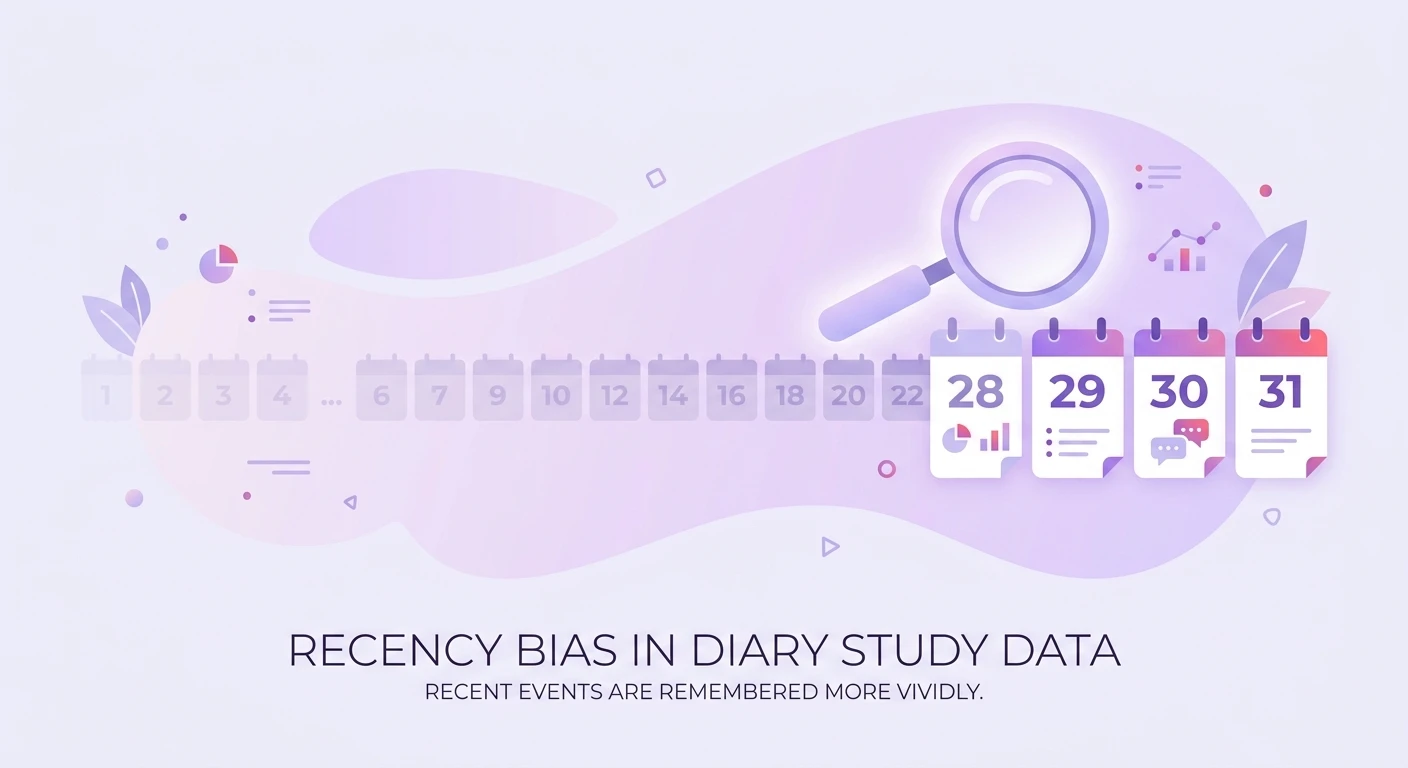
Then you run the debrief and discover the record is not evenly weighted at all. Participants describe the last few days in rich, specific detail and wave vaguely at everything before that. The entries themselves are lopsided too -- sparse and dutiful early, then a flurry near the end as the study deadline approaches. The diary you designed to capture the whole journey has quietly collapsed into a high-resolution snapshot of the final week, with the earlier weeks reduced to a blur. Recency skew is the systematic overweighting of the most recent entries and experiences in both what participants log and what they report -- and it defeats the entire reason you chose a longitudinal method.
Why the Recent Days Overwrite the Rest
Logging effort front-loads onto the deadline. Diary compliance is rarely uniform. Many participants log lightly at first, then compensate with a burst of entries as the end-date looms. The result is a dataset that is densest exactly where memory is freshest, so recency compounds: the recent period has both more entries and better-remembered ones.
The debrief samples memory, not the diary. Even with good entries, the debrief conversation is driven by what the participant can readily recall -- and that is the recent stuff. Unless the moderator actively pulls them back to early entries, the discussion orbits the last few days. This is a longitudinal version of the debrief timing trap, where the conversation right after an interview overwrites the interview itself.
Recent entries feel more true. Participants trust their vivid recent memories and discount their own hazier early ones, even when the early entries were logged accurately in the moment. When a fresh memory contradicts an old entry, the participant often "corrects" toward the recent feeling -- overwriting real-time data with retrospective impression. This is the same distortion behind the timestamp illusion in retrospective journey mapping, where memory rearranges when things actually happened.
Analysis inherits the skew. When researchers synthesize, the richest material is the recent material, so it dominates the themes -- not because it matters more, but because there is more of it and it is more vivid. A single quotable recent moment can hijack the readout, an effect familiar from the verbatim overweighting effect, where one quotable sentence dominates an entire study.
What Recency Skew Costs You
The core loss is the arc itself. Journeys have onboarding friction, mid-period habit formation, and late-stage routine -- and these are qualitatively different phases. If your data over-represents the final phase, you will mistake a settled, habituated user for a typical one and miss the early struggles that actually determine whether someone stays. The most decision-relevant moments in many journeys happen early, precisely where recency skew erases the detail.
Worse, recency skew is invisible in the deliverable. A journey map built from a recency-skewed diary looks complete -- it has entries across the whole period -- but its resolution is wildly uneven. Stakeholders read it as a faithful two-week arc when it is really a detailed last-week with a sketch attached. And because the early phase is where drop-off concentrates, the skew systematically hides the failures, echoing the attrition blindspot, where the participants who leave take your most important signal with them.
Designing So the Early Journey Survives
Prompt on a schedule, not on the participant's initiative. Push daily or event-triggered prompts so entries are generated in the moment, not reconstructed at the deadline. A consistent prompt cadence flattens the logging curve and starves recency of its raw material.
Debrief chronologically, not associatively. Walk the participant through their own early entries before you let the conversation drift to recent events. Read their day-3 entry back to them and probe it before day-13 exists in the room. Structure the debrief to resist the memory's natural pull toward the present.
Weight the analysis by phase, not by volume. When synthesizing, deliberately balance early, middle, and late material rather than letting entry density decide emphasis. If the last three days generated 60 percent of the entries, they should not automatically get 60 percent of the findings.
Timestamp and honor the original entry. Treat the in-the-moment entry as the primary record and the debrief recollection as commentary on it -- not a replacement. When a recent memory contradicts an early entry, flag the discrepancy as data instead of quietly overwriting the earlier truth.
Recognize the data-freshness parallel. Engineers who build AI systems have learned to distrust systems that silently favor whatever is most recent, because staleness and recency bias corrupt decisions without any error surfacing -- the same discipline behind treating the feature freshness gap, where systems reason over stale data without knowing it, as a first-class problem. Longitudinal research needs the same rigor about which slice of time your data actually represents. Triangulating diary data against behavioral logs, as in research triangulation for product decisions, is the cross-check that catches the skew.
The Takeaway
A diary study is only longitudinal if the whole timeline survives to analysis. Recency skew means the last few days quietly overwrite the weeks before them -- in what participants log, what they remember, and what you end up reporting. Design your prompts, your debriefs, and your synthesis to protect the early journey, or you will pay for a two-week study and ship a one-week finding.
Qualz.ai timestamps and phase-tags every diary entry, then flags when your themes are drawing disproportionately from the final days -- so your journey maps reflect the whole arc, not just the part participants remember best. Book a demo to see the full timeline in your longitudinal data.